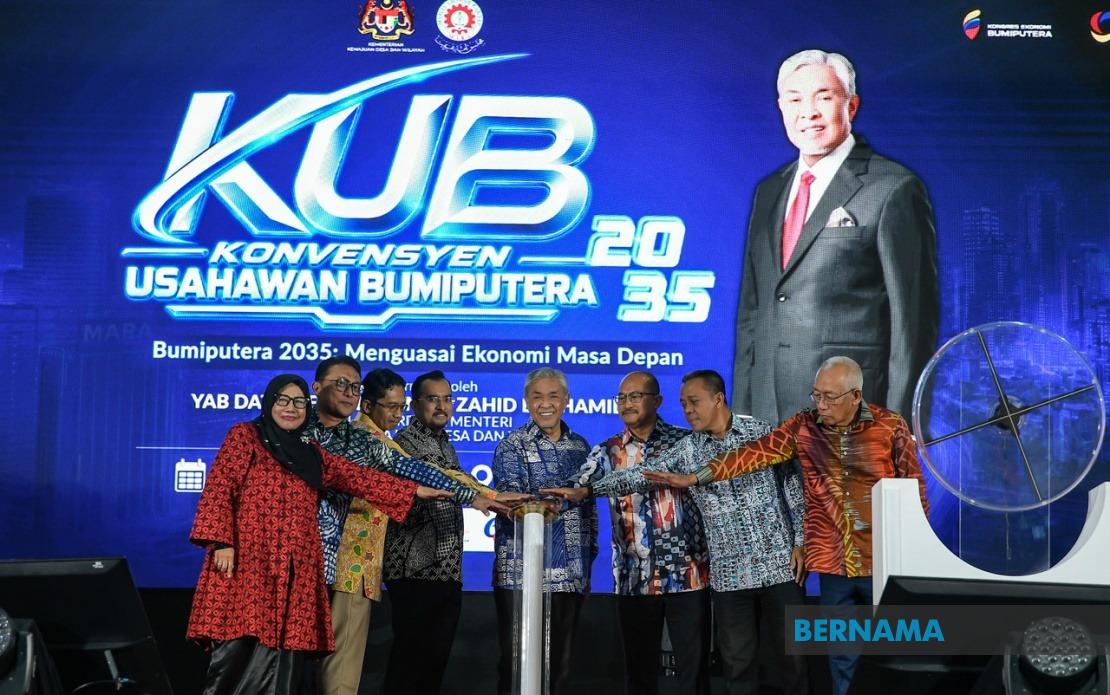
Deputy Prime Minister Datuk Seri Dr Ahmad Zahid Hamidi has delivered a stark message to Malaysia's Bumiputera business community: the era of passive participation in the economy must end. Speaking at the Bumiputera Entrepreneurs Convention (KUB) 2035 Declaration closing ceremony in Alor Setar, the Rural and Regional Development Minister outlined an ambitious vision for transforming indigenous entrepreneurship from a supporting actor into a dominant economic force by the middle of the next decade.
The underlying thrust of Ahmad Zahid's address reflects growing recognition within government circles that decades of affirmative action policies, while successful in creating a layer of Bumiputera business participants, have not delivered the structural economic control that policymakers originally envisioned. Many Bumiputera enterprises remain confined to specific market segments or operate as subcontractors and suppliers rather than commanding entire value chains or industries. This distinction carries profound implications for wealth accumulation, intergenerational prosperity, and Malaysia's broader competitive position in Southeast Asia.
Ahmad Zahid articulated three interconnected pillars necessary to achieve this transformation by 2035. The first centres on integrating the fragmented support ecosystem that currently characterises Bumiputera entrepreneurship development. Presently, aspiring and established Bumiputera entrepreneurs navigate a labyrinthine landscape where financing institutions, training providers, and market access channels operate independently, often with misaligned objectives and conflicting timelines. This fragmentation imposes substantial transaction costs on entrepreneurs who must cobble together financing from one source, business advisory services from another, and market linkages through yet another channel. An integrated ecosystem would theoretically streamline these processes, allowing entrepreneurs to access comprehensive support through coordinated mechanisms.
The second pillar involves a fundamental reorientation from quantity to quality in entrepreneurship generation. Rather than continuing to create ever-increasing numbers of entrepreneurs—a strategy that has produced mixed results given the high failure rate among new ventures—the government intends to concentrate resources on developing existing entrepreneurs into sophisticated, scalable enterprises. This pivot acknowledges that entrepreneurship itself is merely a starting point; the critical challenge lies in helping businesses mature beyond survival mode into competitive, market-leading entities capable of competing globally.
The third dimension addresses what might be termed economic nationalism with Malaysian characteristics. By ensuring that the country's overall economic growth translates into strengthened local, particularly Bumiputera-owned, enterprises, policymakers seek to prevent a scenario where national prosperity accrues primarily to foreign corporations or non-Bumiputera businesses. This reflects longstanding concerns about capital flight and wealth concentration among Malaysian minority communities, tensions that periodically resurface in political discourse.
Crucially, Ahmad Zahid tempered government commitments with an implicit call for entrepreneurial accountability. While the administration pledges to expand opportunities, strengthen the ecosystem, and broaden access to resources, entrepreneurs themselves must demonstrate courage, competitive ambition, and a commitment to value creation. This formulation—emphasising mutual responsibility rather than unilateral government obligation—signals a maturation in official thinking about Bumiputera economic development. It suggests recognition that indefinite subsidisation produces dependency rather than dynamism.
The timing of this message carries particular significance for Malaysian political economy. The Bumiputera entrepreneurship agenda intersects with multiple concurrent challenges: China's rising economic dominance across Southeast Asia, the region's integration into digital and green economy frameworks, and Malaysia's own need to graduate from middle-income status. Bumiputera entrepreneurs scaled into genuinely competitive regional players could constitute a crucial competitive advantage. Conversely, if they remain confined to protected niches and preference schemes, they risk becoming economically marginal when such protections inevitably erode under trade liberalisation pressures.
The 2035 timeframe carries strategic weight as well. A decade represents a sufficient horizon for measurable structural change while remaining within the planning cycles of major government initiatives. It also aligns with broader Southeast Asian development targets and Malaysia's own Vision 2050 framework. By anchoring Bumiputera entrepreneurship transformation to this intermediate milestone, policymakers create accountability mechanisms and measurable benchmarks against which progress can be assessed.
Implementing this vision presents formidable obstacles. Ecosystem integration requires unprecedented coordination across multiple government agencies, financial institutions, and business associations—entities that historically guard institutional turf zealously. The shift toward growing rather than creating entrepreneurs demands sophisticated identification mechanisms to distinguish genuinely scalable enterprises from those destined to remain small operators. Perhaps most challenging, genuinely competitive Bumiputera enterprises will inevitably outcompete some non-Bumiputera businesses, generating political friction that could undermine commitment to meritocratic market dynamics.
For Malaysian business observers and entrepreneurs, Ahmad Zahid's rhetoric signals that incremental adjustments to existing Bumiputera policies have exhausted their utility. The conversation is shifting toward structural transformation—a far more ambitious and uncertain undertaking. Success requires not merely government commitment but entrepreneurial capability, market discipline, and willingness to abandon comfortable protective arrangements in pursuit of genuine competitive advantage. Whether Malaysia's Bumiputera business community possesses sufficient depth of talent, capital access, and competitive hunger to deliver this transformation remains the defining question for the coming decade.

