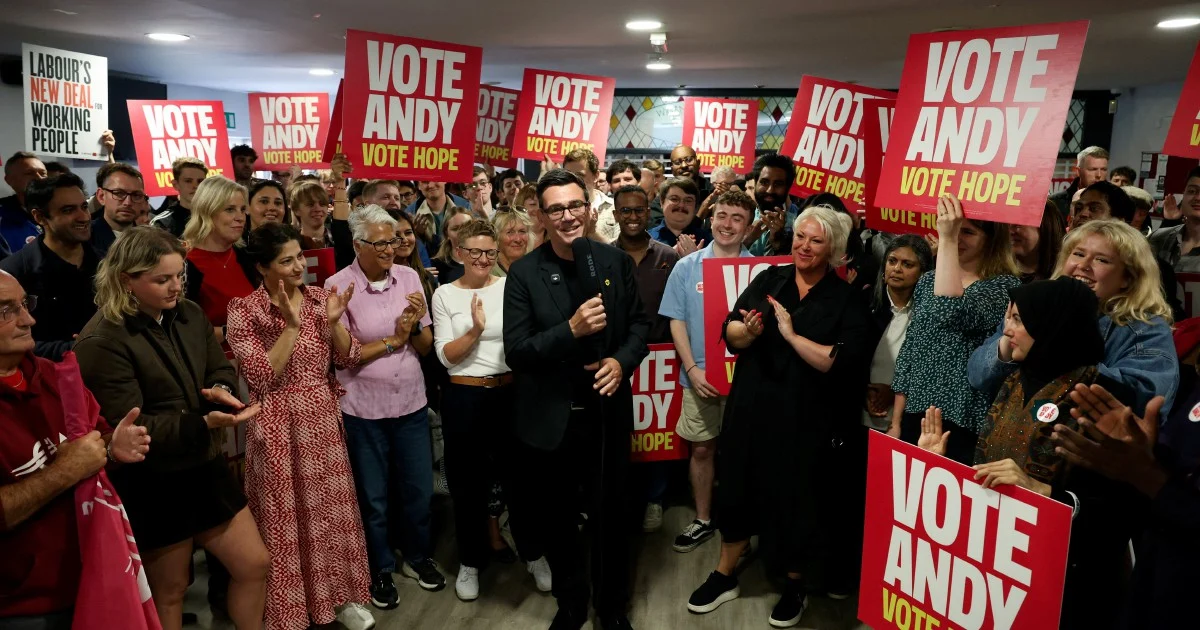
Andy Burnham's quest to emerge as a potential successor to Prime Minister Keir Starmer received an unexpected boost from the fragmentation of Britain's right-leaning political landscape, with Thursday's by-election in Makerfield potentially serving as a pivotal moment in his gradual ascent within Labour's upper ranks. The Manchester mayor's candidacy in what has long been a safe Labour seat may prove less a reflection of his personal magnetism and political prowess than the collision course between two competing populist movements vying for the allegiance of disaffected voters on the political right. This peculiar dynamic offers Burnham an opportunity to secure a comfortable victory that could bolster his profile ahead of potential future leadership contests within his own party.
The Makerfield by-election represents a rare vulnerability in Labour's electoral coalition. The constituency, nestled in north-west England, has traditionally delivered commanding Labour majorities, yet recent years have witnessed the emergence of genuine competition from unconventional quarters. The Conservative Party, which has governed since 2010 before surrendering power to Labour following the 2024 general election, continues to haemorrhage support among working-class voters who once formed the backbone of its electoral base. Simultaneously, Reform UK, the insurgent movement that capitalised on populist discontent during the last general election cycle, has carved out a meaningful presence in communities feeling economically marginalised and culturally alienated from Westminster politics.
The simultaneous candidacies of Conservative and Reform UK representatives in Makerfield effectively create a three-way contest that fragments the non-Labour vote. Rather than coalescing behind a single right-wing challenger, voters who might otherwise harbour reservations about Labour's direction find themselves distributed across competing candidates, each claiming to represent authentic opposition to the incumbent government. This splintering phenomenon has become increasingly common across Britain's electoral landscape, as traditional party allegiances erode and new political movements emerge to challenge the post-war consensus that once held the two major parties in relative equilibrium.
Burnham's positioning within Labour's hierarchy has evolved considerably over the past decade. Once regarded primarily as a local administrator with strong roots in Manchester's civic life, he has gradually cultivated a national profile through high-profile public health interventions during the coronavirus pandemic, interventions that frequently placed him in direct tension with central government. His willingness to challenge Conservative ministers publicly earned him credibility among a broad swathe of Labour members and sympathetic voters beyond party ranks. Unlike some of his Labour colleagues who remain primarily parliamentary in their orientation, Burnham has maintained executive responsibility for a major metropolitan area, lending his political voice a gravity derived from practical governance experience.
The machinations of right-wing politics constitute merely one ingredient in Burnham's broader strategy. Labour's internal dynamics regarding future leadership succession remain inchoate, with Keir Starmer currently commanding the party machinery and enjoying the prerogatives of a newly empowered Prime Minister. Yet political environments prove volatile, and the composition of potential successors worthy of serious consideration invariably includes figures with strong regional power bases and demonstrated capacity to connect with working-class constituencies. Burnham's retention of his Manchester position whilst gradually raising his national profile positions him as precisely such a figure, should circumstances eventually precipitate leadership questions.
The implications of a divided right-wing vote extend beyond this single by-election. Should Reform UK and the Conservative Party continue to splinter the anti-Labour electorate across multiple constituencies, Labour could consolidate its parliamentary supermajority and potentially accumulate additional seats from areas where its own support remains modest but rivals fail to coordinate effective opposition. This dynamic fundamentally reshapes the mathematics of British electoral competition, potentially allowing a governing party with 35-40 percent support to command overwhelming Commons majorities whilst populist challengers consume resources defending territory from one another rather than mounting comprehensive alternative visions.
For Malaysian and Southeast Asian observers monitoring British political developments, this fragmentation of right-wing politics offers instructive parallels to regional contexts where multi-party competition similarly fragments opposition votes and advantages incumbent powers. The Malaysian experience with its complex coalition politics and the Indonesian challenges of managing competitive pluralism in younger democracies suggest that party system fragmentation constitutes a recurrent feature of contemporary democratic politics. Burnham's fortuitous position exemplifies how victory can flow not from compelling leadership vision but from structural advantages arising from competitor weakness.
The Makerfield contest also illuminates broader questions about the durability of traditional party structures amid rapid social and economic change. Reform UK's emergence as a genuinely competitive political force despite its youth and organisational infancy underscores how conventional explanations of electoral stability—based on party machinery, institutional resources, and historical loyalty—increasingly falter when confronting unprecedented currents of discontent. Conversely, Labour's resilience in retaining working-class parliamentary representation even as its cultural authority over these constituencies diminishes suggests that winning elections and governing effectively constitute analytically separable challenges.
Looking ahead, Burnham's by-election victory would furnish him with renewed legitimacy and demonstrate his capacity to motivate voters in challenging circumstances. Whether this translates into serious consideration for eventual party leadership depends on myriad unpredictable factors: Starmer's longevity in office, the trajectory of Reform UK's political evolution, and potential recalibrations within Labour's own factional alignments. What seems certain is that the fragmentation of British right-wing politics creates unexpected openings for ambitious figures prepared to exploit structural advantages whilst developing independent political narratives rooted in substantive governance challenges rather than opportunistic positioning.