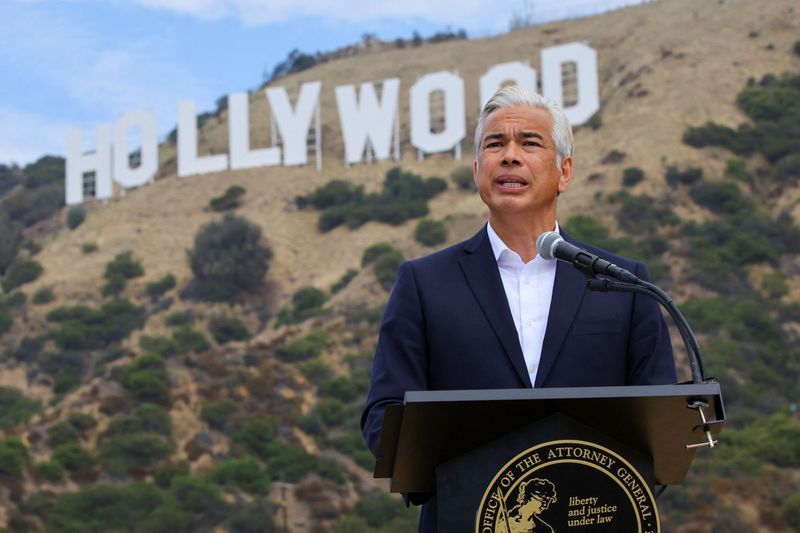
A politically charged legal battle is unfolding over one of entertainment's largest proposed mergers, as California and eleven other states mounted a federal challenge to Paramount's $110 billion bid to acquire Warner Bros Discovery. The lawsuit, filed in Oakland federal court, represents an aggressive attempt to derail the transaction despite its approval by the U.S. Department of Justice just weeks earlier, and threatens to upend CEO David Ellison's strategy to position Paramount as a streaming and traditional media powerhouse capable of competing with Netflix and Disney.
The coalition of state attorneys general contends that the combination would produce a media giant with unprecedented pricing power across multiple entertainment segments. According to their filing, the merged entity would capture more than a quarter of every dollar earned from wide-release theatrical films and basic cable channels nationally. This concentration of market control, they argue, would fundamentally alter the competitive landscape in ways that ultimately trickle down to harm ordinary Americans through higher ticket prices, reduced programming choices, and fewer employment opportunities across the entertainment ecosystem.
The states' legal challenge highlights the intricate relationship between Paramount's corporate leadership and high-level political figures, particularly CEO David Ellison's family ties. His father, Larry Ellison, is the billionaire Oracle co-founder who has cultivated prominent relationships with Republican President Donald Trump. Notably, all twelve attorneys general who filed the lawsuit are Democrats, creating a partisan dimension that underscores how antitrust enforcement has increasingly become weaponized in American political discourse. Some Democratic-led state officials view aggressive antitrust action as a counterweight to what they perceive as the Trump administration's permissive stance toward corporate consolidation.
Oregon Attorney General Dan Rayfield articulated the states' position by emphasizing protection for families, small businesses, and the film industry. California's attorney general pointed specifically to what he characterized as the Trump administration's pattern of allowing major corporate deals to proceed, citing recent antitrust settlements that he believes favored powerful corporations. Interestingly, several Republican attorneys general have joined Democratic counterparts in separate antitrust actions targeting LiveNation and Nexstar Broadcasting's acquisition of rival broadcaster Tegna, suggesting that corporate consolidation concerns occasionally transcend traditional party lines.
The substantive economic arguments presented in the lawsuit are considerable. Paramount and Warner Bros Discovery currently compete vigorously for the most desirable theatrical release dates and cinema screens across thousands of American theaters, a competition that the states argue serves as a natural check on pricing. The merged company would control approximately 27 percent of the film distribution market, 30 percent of blockbuster film distribution, and 27 percent of basic cable channels. Additionally, the combined entity would control major television networks including CNN, MTV, HGTV, Cartoon Network, and Nickelodeon, giving it substantial leverage over pay-TV distributors and their subscribers.
Paramount's defense rests on claims that the merger will enable greater productivity rather than diminish it. The company projects $6 billion in savings through eliminating redundant infrastructure, marketing expenditures, and corporate positions. CEO Ellison has committed publicly to producing thirty films annually from the combined studios, attempting to address concerns that consolidation would reduce theatrical output. The states, however, dismiss these commitments as insufficiently binding and argue that even with such promises intact, the merged company would retain substantial ability to raise prices and reduce quality across both theatrical and television platforms.
Hollywood's creative workforce has emerged as a vocal constituency opposing the transaction. Writers, actors, cinematographers, and other entertainment professionals fear that consolidation would eliminate competitive pressures that currently support job creation and maintain diverse employment opportunities. Theater owners have expressed parallel concerns that reduced inter-studio competition for release schedules would translate into fewer films distributed to cinemas, diminishing their revenue and threatening their viability. These constituencies represent tens of thousands of workers whose livelihoods depend on a competitive entertainment marketplace.
The merger's timeline creates mounting financial pressures on Paramount. The company has committed to paying approximately $650 million quarterly to Warner Bros Discovery shareholders if the transaction fails to close by October. Should the litigation drag on, Paramount may face costly delays that force renegotiation of financing arrangements, create uncertainty in its stock valuation, or potentially render the entire transaction unviable. Historical precedent suggests federal merger litigation typically requires eight months for judicial determination, positioning this case for resolution well into the future.
For Southeast Asian readers and Malaysian business observers, this dispute carries relevance beyond the American entertainment industry. The case reflects broader global trends toward aggressive antitrust enforcement against media consolidation at a time when streaming platforms and content providers compete internationally for audiences and content rights. The outcome could influence how media companies in the region structure future acquisitions and partnerships, particularly as Southeast Asian telecommunications and entertainment corporations pursue regional expansion strategies. Additionally, the politicization of antitrust enforcement in the United States signals that investment in American media assets now carries political risk dimensions that Malaysian and regional investors must factor into strategic planning.
Paramount's share price initially rose 2.9 percent following the lawsuit filing, while Warner Bros Discovery gained 2.6 percent, suggesting investors view the legal challenge as delaying rather than definitively blocking the transaction. Analyst Paolo Pescatore at PP Foresight characterized the state lawsuit as the merger's most credible threat to date, emphasizing that even ultimate victory for Paramount would come at substantial cost in legal fees, management attention, and extended uncertainty. The litigation's resolution will likely determine whether entertainment industry consolidation accelerates or faces meaningful regulatory friction in coming years, with implications for content availability, pricing, and employment across multiple markets.

