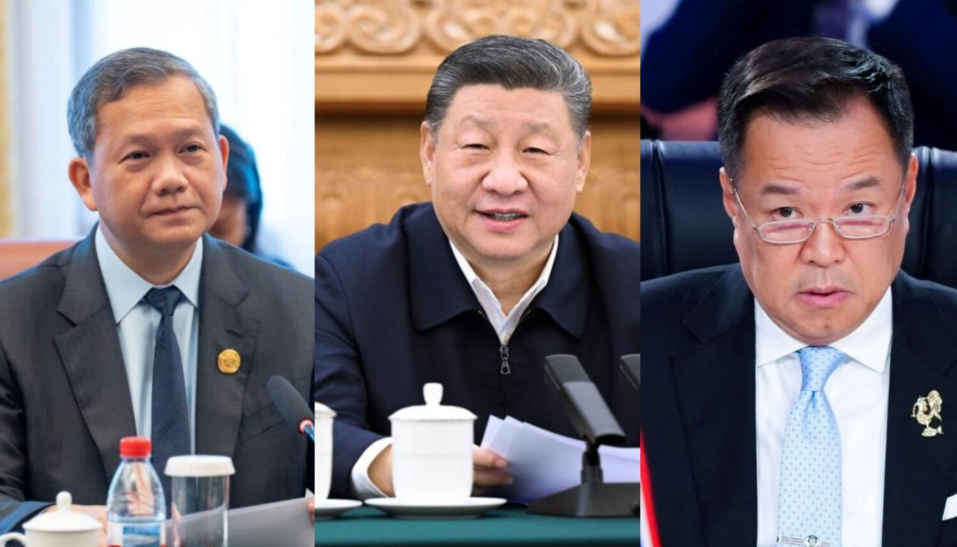
Cambodia and Thailand's prime ministers are heading to Shanghai this month for China's World AI Conference 2026, but observers are watching closely to see whether the gathering will become a platform for addressing one of Southeast Asia's most intractable territorial disputes. Hun Manet and Anutin Chanvirakul have both accepted invitations from Chinese President Xi Jinping to attend the July 17 opening session, signalling the importance Beijing places on the event. Yet the two leaders have not engaged in substantive border negotiations for more than seven months, leaving regional analysts wondering whether this high-profile summit might finally break the diplomatic impasse.
The Cambodian delegation arriving on July 15 will be substantial in scope and representation, with Foreign Minister Prak Sokhonn and Defence Minister Tea Seiha accompanying Manet alongside Sun Chanthol, first vice-chairman of the Council for the Development of Cambodia. Thailand's Foreign Minister Sihasak Phuangketkeow is expected to join Anutin in the Chinese capital. Both premiers are scheduled to hold individual meetings with Xi and Chinese Premier Li Qiang, suggesting that Beijing intends to use the platform for strategic dialogue beyond the conference's nominal artificial intelligence focus. The composition of these delegations underscores the diplomatic weight both governments are investing in the Shanghai visit.
On the surface, both capitals have framed the trip in terms of bilateral friendship and economic cooperation. Cambodia's foreign ministry released a statement emphasising the visit as a testament to "shared commitment" with China and a vehicle for advancing the Comprehensive Strategic Partnership of Cooperation, the Diamond Cooperation Framework, and what it termed an "all-weather Cambodia-China Community with a Shared Future." Thailand's government similarly couched its participation as an opportunity to "further strengthen the Thailand-China Comprehensive Strategic Cooperative Partnership for the mutual benefit of the two peoples." These carefully worded announcements reflect the formal language of modern Southeast Asian diplomacy, yet they conspicuously avoid mentioning the territorial conflict that has festered between Phnom Penh and Bangkok.
The history of recent diplomatic encounters between Manet and Anutin provides context for current speculation. The two leaders crossed paths at the third Asean Future Forum held in Hanoi during early June, where they performed the customary handshake for assembled photographers. However, that meeting produced no substantive discussion of the border issues dividing their nations, leaving the underlying tensions unresolved. The Shanghai summit represents their first significant bilateral opportunity since then, and perhaps their most consequential gathering given China's economic leverage over both countries. Beijing has increasingly positioned itself as a regional mediator in recent years, and the WAIC conference offers an ideal diplomatic setting for advancing such efforts without appearing overtly political.
China's potential role as an honest broker in these negotiations cannot be underestimated. As a major trading partner and investment source for both Cambodia and Thailand, Beijing possesses considerable economic influence over each government's strategic calculations. Analysts have suggested that Xi's administration may use this leverage to encourage both sides to return to meaningful discussions. The stakes extend beyond bilateral relations—unresolved border disputes create instability across Southeast Asia, affecting regional security architecture and economic integration efforts. For China, fostering peaceful resolution serves its broader interests in maintaining regional stability and demonstrating its capacity to mediate disputes among neighbours.
Yet serious obstacles to progress remain, according to experts monitoring the situation closely. Kin Phea, director of the Royal Academy of Cambodia's International Relations Institute, has identified a fundamental impediment: the lack of alignment between Thailand's civilian government negotiators and the military institutions that effectively control implementation of agreed measures. "The Thai military has not implemented the measures that their civilian government agreed with their Cambodian counterparts," Phea observed, noting that military actors operate with sufficient autonomy to undertake territorial encroachments despite civilian commitments. This structural divergence between Thailand's civilian and military spheres of power represents perhaps the most significant barrier to progress, as it creates a situation where agreements signed by one institutional actor cannot necessarily be enforced by another.
The dispute has created a humanitarian dimension that complicates purely technical negotiations. Approximately 20,000 Cambodian civilians remain unable to return to homes in several territories under Thai control, transforming the border issue from an abstract cartographic problem into a matter affecting tens of thousands of lives. These displaced persons represent both a moral imperative for resolution and a political pressure point that Cambodian leaders cannot ignore when addressing their own domestic constituencies. Any meaningful settlement must address the immediate return of these civilians alongside the broader demarcation and sovereignty questions.
Phea has called for a more active role from Beijing in pressing both sides toward resolution. "China should push for both countries to meet for talks and solve the issue peacefully, through diplomatic paths or other consultation effort, based on international law," he stated, adding that Beijing should function more assertively as an arbitrator rather than a passive facilitator. He specifically referenced the Fuxian Consensus, a Chinese-brokered agreement reached in December 2025 that ostensibly committed both nations to resolving their differences through dialogue and respect for international legal frameworks. This earlier accord provides a template for the kind of commitment Phea believes should be renewed and enforced during the Shanghai visit.
Phea's recommendations also include concrete demands that must accompany any renewed dialogue. Thailand must withdraw military forces from occupied Cambodian territories and return to the negotiating table with commitment to advancing joint boundary commission work without further delay. These measures represent not merely symbolic gestures but fundamental prerequisites for meaningful progress. Without military withdrawal and genuine civilian-military alignment in Thailand's negotiating position, any agreements reached in Shanghai risk becoming merely performative statements that fail to alter facts on the ground.
The Shanghai conference thus represents a potential inflection point in the Cambodia-Thailand dispute, though success is far from assured. The convergence of both prime ministers in China's capital, combined with Beijing's economic interests in regional stability, creates favourable conditions for diplomatic breakthroughs. However, structural challenges within Thailand's governance, the humanitarian dimension of displacement, and the accumulation of mutual suspicion over months of stalled negotiations suggest that even a well-intentioned Chinese intervention may struggle to produce immediate concrete outcomes. What the summit could achieve is a recommitment to dialogue and perhaps a clearer framework for subsequent technical negotiations, even if comprehensive border resolution remains a longer-term prospect.
For Malaysia and other Southeast Asian observers, the Shanghai meeting carries implications beyond the bilateral Cambodia-Thailand relationship. Border disputes, when left unresolved, create security vacuums and economic inefficiencies that affect regional prosperity and stability. The willingness and capacity of major powers like China to mediate such conflicts sets precedents for how Southeast Asia's own territorial challenges might eventually be addressed. Success in facilitating Cambodia-Thailand negotiations would enhance Beijing's credibility as a mediator and might establish templates for resolving other disputed boundaries across the region. Conversely, failure would reinforce the view that such disputes ultimately require direct engagement between claimant states rather than external pressure, however well-intentioned.

