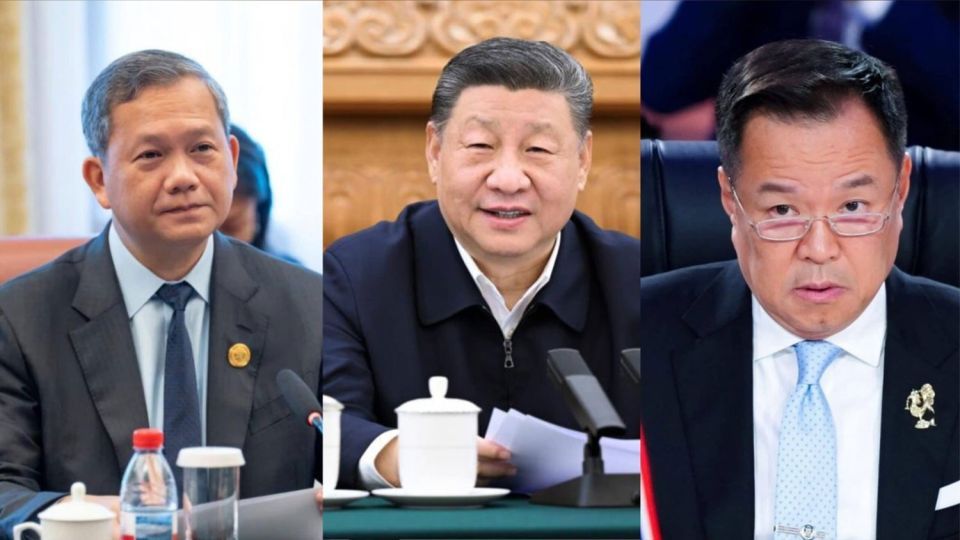
Cambodia and Thailand's prime ministers are preparing for a high-level visit to Shanghai later this month, where they will join Chinese President Xi Jinping at the opening of the World AI Conference 2026. Hun Manet and Anutin Chanvirakul have been invited by Beijing to attend the July 17 session, a gathering that observers believe could present an opportunity for China to exert diplomatic pressure on resolving the two nations' contentious border standoff, which has frozen at the negotiating table for over seven months.
Hun Manet's delegation will depart Cambodia on July 15 and return three days later, bringing along several senior officials including Foreign Minister Prak Sokhonn, Defence Minister Tea Seiha, and Sun Chanthol, the first vice-chairman of the Council for the Development of Cambodia. Thailand's delegation will similarly be led by Anutin alongside his foreign minister, Sihasak Phuangketkeow. Both premiers are scheduled for separate bilateral meetings with Xi and Chinese Premier Li Qiang, signalling Beijing's intent to engage both capitals directly on matters of bilateral concern.
Cambodia's foreign ministry framed the visit as reinforcing the kingdom's strategic partnership with China, emphasizing the trip would "deepen their long-standing friendship and promote mutually beneficial cooperation." The statement referenced Cambodia's commitment to implementing its Comprehensive Strategic Partnership with Beijing, advancing what officials described as the Diamond Cooperation Framework, and building an "all-weather" community with a shared future. Thailand's own foreign ministry release echoed similar language, focusing on strengthening the Thailand-China Comprehensive Strategic Cooperative Partnership for the benefit of both peoples. Such diplomatic messaging, however, masks a deeper concern: whether this Shanghai meeting will finally catalyse movement on a bilateral dispute that has defied resolution for years.
The Cambodia-Thailand border issue has become increasingly intractable. The two nations last met at the negotiating table in December, but have made little tangible progress since. During the 3rd ASEAN Future Forum held in Hanoi in early June, both Hun Manet and Anutin were present and exchanged a handshake for the cameras, yet substantive discussions on their border disagreement did not occur. This pattern of symbolic gestures without substantive engagement has frustrated regional observers and left thousands of Cambodian civilians in limbo. Approximately 20,000 Cambodians remain unable to return to their homes in areas that remain under Thai occupation, a humanitarian dimension that underscores the urgency of resolution.
Analysts widely expect China to leverage its position as a major trading partner of both nations to encourage a breakthrough. Beijing's economic influence over Cambodia and Thailand is substantial, and Shanghai provides a prestigious setting where Chinese leadership can appeal to both sides to prioritise peace. Yet experts caution that economic pressure alone may prove insufficient to overcome the structural obstacles blocking progress. According to Kin Phea, director of the International Relations Institute at Cambodia's Royal Academy, the real impediment may lie not with civilian policymakers but with Thailand's military establishment, which has resisted implementing agreements reached by elected officials.
Phea pointed to a pattern in which the Thai military has failed to honour commitments made by Thailand's civilian government to Cambodia. "The Thai military has not implemented the measures that their civilian government agreed with their Cambodian counterparts," Phea stated, adding that military actors have used this freedom to "arbitrarily carry out their actions, including encroaching on Cambodian sovereign territory." This distinction between civilian intent and military capacity to enforce agreements represents a fundamental challenge to any diplomatic resolution. For Cambodia, the problem is not disagreement with Thailand's elected leaders but rather the military's apparent unwillingness or inability to abide by those leaders' commitments.
The December 2025 Fuxian Consensus, brokered by China itself, established a framework for resolving the dispute through diplomatic channels and international law. That agreement, however, has remained largely unimplemented. Phea argued that China must now assume a more assertive role, moving beyond platitudes to actively enforce compliance. "China should push for both countries to meet for talks and solve the issue peacefully, through diplomatic paths or other consultation effort, based on international law," he said. More pointedly, he contended that "China should play a more active role as arbitrator so that both countries can solve their conflict, end tensions and return to normalcy."
The specific demands from Cambodia's perspective are clear and concrete. Thailand must withdraw its troops from occupied Cambodian territory, return to the negotiating table, and engage in good-faith work with the Joint Boundary Commission without further delay. These conditions reflect Cambodia's assessment that mere dialogue will not suffice; Bangkok must demonstrate commitment through concrete actions. The continued occupation and the prevention of Cambodian civilians from returning to their homes represent an ongoing violation that dialogue alone cannot remedy.
For the broader Southeast Asian region, the Cambodia-Thailand impasse carries significance beyond the bilateral relationship. ASEAN unity has been tested by various member disputes, and this particular conflict touches on fundamental principles of territorial integrity and the rule of law that undergird regional stability. Thailand and Cambodia are both influential voices within the bloc, and a resolution would strengthen ASEAN's credibility in managing intra-regional conflicts. Conversely, prolonged stalemate could set a troubling precedent, signalling that military occupation and civilian non-compliance can persist without consequence.
China's role as mediator offers both opportunities and constraints. Beijing has successfully brokered agreements in other regional disputes and possesses sufficient leverage over both capitals to potentially encourage movement. Yet for China to be effective, it must be willing to move beyond the diplomatic niceties and gentle pressure that have characterised its approach thus far. The Shanghai conference provides a high-visibility setting where Xi Jinping could personally emphasise to both Hun Manet and Anutin that their nations' relationships with China are best served by resolving their mutual grievances through sustained negotiation and implementation.
Ultimately, the question surrounding this July visit is whether it represents a genuine turning point or merely another episode in a frustrating cycle of dialogue without resolution. Cambodia enters the meetings with clear expectations: Thailand must move from words to deeds. The presence of senior military and defence officials in both delegations suggests the delegations understand that real progress requires addressing institutional resistance to compliance. Whether China possesses the will and leverage to compel such change remains the central question as both prime ministers prepare for Shanghai.

