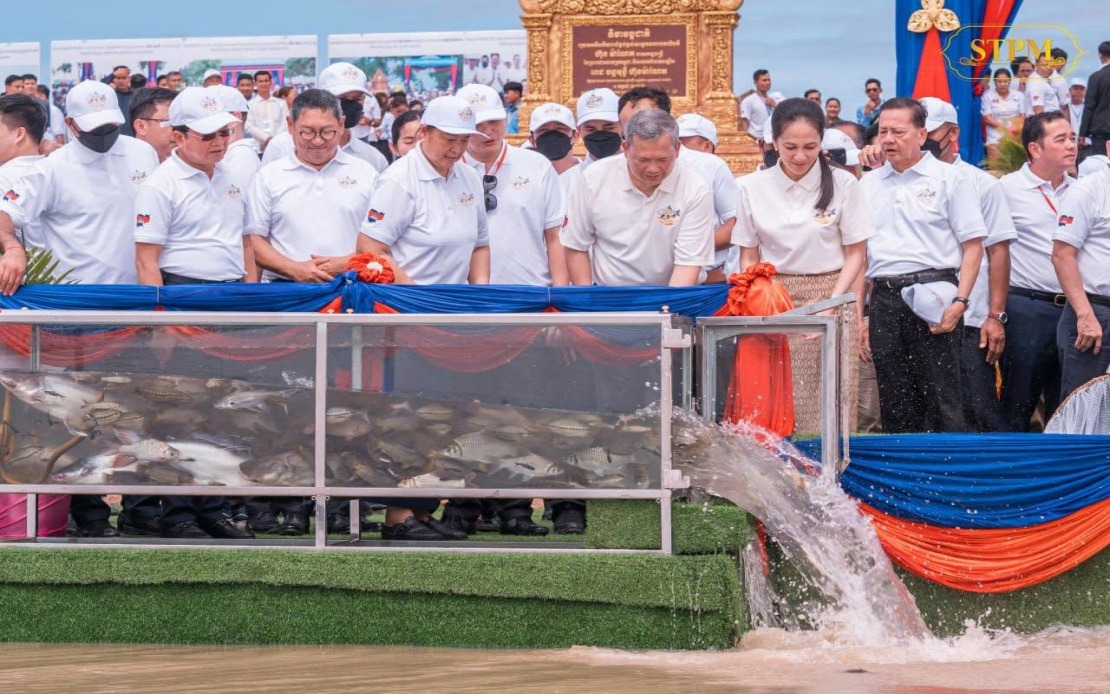
Cambodia is escalating its struggle against illegal fishing with Prime Minister Hun Manet issuing direct orders to military and civilian authorities to target unlawful operations in vital fish spawning grounds. Speaking during National Fish Day celebrations held in Svay Rieng Province on Wednesday, Hun Manet emphasised that protecting marine resources represents a strategic priority for national development, requiring coordinated action across multiple government agencies and military units stationed throughout the kingdom.
The crackdown addresses a longstanding challenge facing Cambodia's fishing industry, where unsustainable extraction practices have threatened the biological viability of freshwater and marine ecosystems that countless communities depend upon. Hun Manet acknowledged that the military's involvement in natural resource enforcement stems partly from institutional gaps, noting that Cambodia has historically lacked sufficient specialised law enforcement personnel trained in environmental crime investigation and prosecution. Over the past two years, army units have undertaken expanded roles in combating resource-related offences both on land and at sea, a temporary arrangement the Prime Minister characterised as necessary but not ideal for long-term governance.
The emphasis on reducing military involvement in routine fisheries enforcement reflects broader concerns about allocating defence resources. Hun Manet stated that the government seeks to gradually transition away from depending on armed forces for civilian regulatory functions, thereby freeing military capacity for border security and national defence responsibilities. This strategic repositioning requires simultaneous investment in civilian institutions—fisheries inspectorates, environmental police units, and specialist prosecutors—capable of sustaining enforcement without military support.
Among the specific illegal activities targeted, large-scale clam dredging has emerged as a particularly destructive practice harming fishing communities and ecosystem integrity. Hun Manet ordered an immediate cessation of such operations, signalling zero tolerance for industrial-scale extraction of benthic organisms in breeding habitats. Clam dredging devastates seabed ecosystems and displaces species that smaller-scale traditional fishermen rely upon, creating direct conflicts between industrial actors and subsistence fishing populations dependent on stable harvests.
Cambodia's fisheries sector holds extraordinary national significance both for domestic food security and rural employment. Hun Manet framed agriculture and fisheries as complementary pillars sustaining the nation, describing agriculture as providing the country's foundational caloric intake while fisheries supply essential protein sources across all population segments. This dual-pillar framework reflects Southeast Asian economic realities, where aquatic resources often represent the primary protein source for lower-income households and contribute substantially to national nutrition indicators alongside rice cultivation.
Protecting spawning seasons represents a crucial conservation mechanism, as fish reproductive cycles determine population replenishment rates and long-term stock sustainability. Illegal fishing during breeding periods reduces recruitment significantly, creating cascading ecosystem effects that eventually compromise entire fisheries' productivity. Hun Manet's emphasis on temporal restrictions during spawning demonstrates awareness of fundamental fisheries science, particularly relevant given that many Southeast Asian species migrate across jurisdictional boundaries, complicating enforcement and requiring international cooperation.
The scale of restocking efforts undertaken during the celebration illustrates Cambodia's commitment to ecosystem rehabilitation alongside enforcement. Releasing 1.5 million fish and aquatic organisms into the Vai Ko River represents substantial investment in stock replenishment, though such measures function most effectively when coupled with rigorous protection of natural reproduction processes. Without controlling illegal harvest pressure, restocking initiatives deliver only temporary benefits before populations decline again under unsustainable extraction rates.
For Malaysia and other Southeast Asian nations, Cambodia's enforcement intensification carries important implications. Shared river systems, migratory species, and transnational fishing operations mean that Cambodian resource management directly affects regional fish stocks and neighbouring countries' fisheries productivity. The Mekong River system's health influences downstream fisheries throughout the region, making Cambodia's conservation efforts relevant to Vietnam, Thailand, and Laos as well. Conversely, illegal fishing operations often involve regional criminal networks exploiting weak enforcement in multiple jurisdictions simultaneously, requiring coordinated international responses rather than isolated national actions.
The institutional challenge Hun Manet identified—insufficient specialised law enforcement capacity—resonates across Southeast Asia, where fisheries crime often proceeds with impunity due to underfunded, undertrained inspection services. Cambodia's experience suggests that temporary military deployment, while addressing immediate needs, cannot substitute for permanent institutional development. Building professional fisheries enforcement requires sustained budget commitments, specialist training programmes, and career pathways that attract competent personnel to regulatory roles, investments many regional governments struggle to prioritize despite their importance.
Cambodia's approach also reflects broader tensions between conservation and livelihood protection. While restrictions on illegal fishing safeguard resources essential for future generations, enforcement without supporting affected communities through alternative income sources creates political resistance and undermines compliance. The government's framing of fisheries as a national protein source emphasises how these concerns transcend environmental abstraction to touch fundamental development priorities and food security.
Looking forward, sustainability requires moving beyond enforcement campaigns toward systematic governance reforms. This encompasses establishing transparent fisheries licensing systems, deploying technology-enabled monitoring, improving inter-agency coordination, and building sufficient civilian capacity to maintain consistent pressure on violators. Regional cooperation mechanisms that allow countries to share intelligence about transnational fishing crimes and coordinate patrols in shared waters would substantially strengthen Cambodia's domestic efforts while benefiting neighbouring states similarly affected by regional illegal fishing networks.
The National Fish Day celebration itself serves as a public messaging platform, signalling government commitment to fisheries stakeholders while educating populations about conservation importance. Such symbolic gestures complement operational enforcement but cannot replace it. Cambodia's challenge now involves translating political will demonstrated through high-profile announcements into sustained institutional action capable of preventing illegal fishing across vast marine territories and the Mekong system, a transition that determines whether current efforts produce lasting ecosystem benefits or represent temporary interruptions in ongoing resource degradation patterns.

