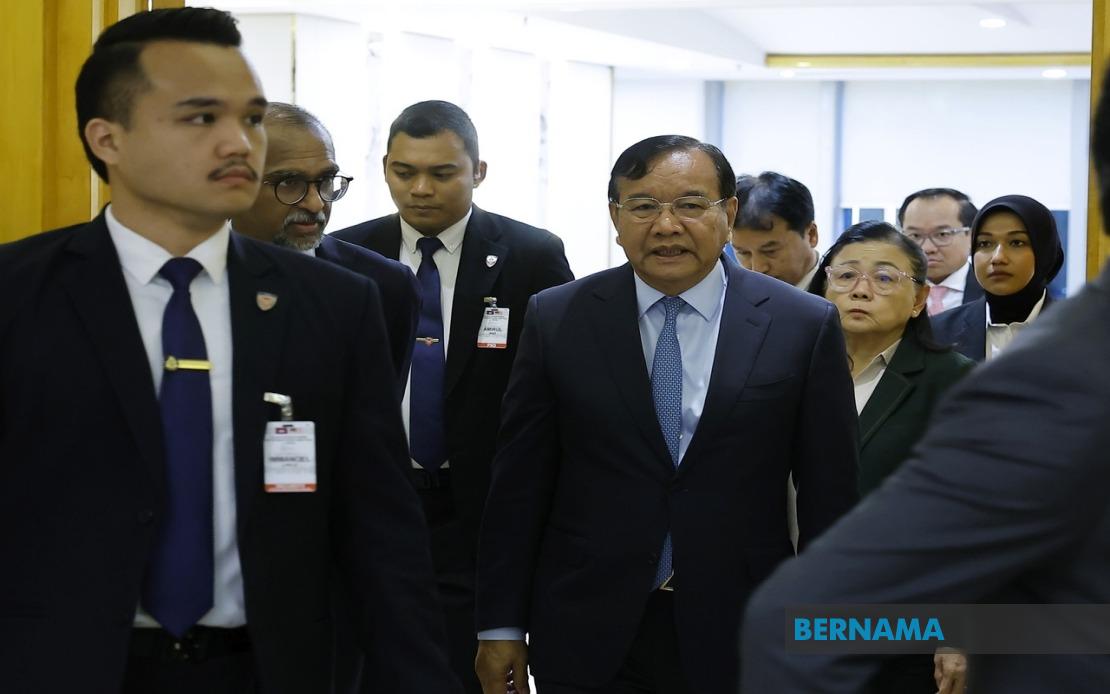
Cambodian Deputy Prime Minister and Minister of Foreign Affairs and International Cooperation Prak Sokhonn departed Malaysia on Sunday afternoon, concluding a two-day visit that underscores the deepening engagement between Kuala Lumpur and Phnom Penh. His departure from Kuala Lumpur International Airport (KLIA) Terminal 1 at 4.45 pm marked the end of a diplomatic mission focused on preparing joint celebrations for what will become a historic moment in their shared history.
The timing of Sokhonn's visit carries particular significance as both countries are laying groundwork for commemorating seven decades of diplomatic relations in 2027. This forward-looking dimension reveals how Malaysia and Cambodia are not merely maintaining their bilateral relationship but actively investing in its future through coordinated planning and symbolic gestures. The visit, which commenced on Monday, demonstrates the level of importance both governments attach to their regional partnership at a moment when Southeast Asia is recalibrating its diplomatic priorities.
During his stay, Sokhonn held substantive meetings with Malaysia's top leadership that addressed a contemporary agenda reflecting regional development priorities. His courtesy call on Prime Minister Datuk Seri Anwar Ibrahim at the Prime Minister's Office produced a reaffirmation of longstanding ties, but importantly, both leaders discussed concrete areas where cooperation could expand. The conversation touched on digital economy initiatives, artificial intelligence deployment, the halal industry's growth potential, food security concerns that affect both nations, and human capital development—all issues directly relevant to Southeast Asian economies seeking competitive advantage in the 21st century.
A key achievement of the visit was the co-chairing of the 3rd Malaysia-Cambodia Joint Commission for Bilateral Cooperation (JCBC) Meeting, which Sokhonn conducted with Foreign Minister Datuk Seri Mohamad Hasan in Kuala Lumpur. This session assumes outsized importance because it represents the formal resumption of this bilateral mechanism after a two-decade absence. The 20-year gap in this structured dialogue platform suggests that both countries are consciously reviving institutional frameworks that had fallen dormant, signalling a commitment to regularised engagement and systematic cooperation rather than ad-hoc diplomatic exchanges.
The economic dimensions of the bilateral relationship provide compelling context for why this diplomatic renewal matters. Trade between Malaysia and Cambodia has expanded dramatically, with 2025 figures showing bilateral commerce reaching RM5 billion (USD1.17 billion), representing a robust 27.4 per cent year-on-year increase. Malaysia's export performance to Cambodia proved particularly strong, with outbound shipments totalling RM4.13 billion (USD970 million), while Malaysian imports from Cambodia reached RM880 million (USD200 million). These figures demonstrate that the relationship extends far beyond ceremonial diplomatic exchanges into meaningful commercial integration.
Malaysia's investment footprint in Cambodia further illustrates the depth of economic interdependence between the two neighbours. As of 2024, Malaysia had accumulated USD3.20 billion (RM13.07 billion) in cumulative investments across 162 registered projects within Cambodia. This investment quantum positions Malaysia as the third-largest foreign investor in the Cambodian economy, a standing achieved through sustained commitment spanning multiple sectors and numerous corporate entities. This investor presence creates constituencies on both sides with vested interests in maintaining and deepening bilateral ties.
For Malaysian policymakers, the revival of the JCBC mechanism addresses a strategic gap in Southeast Asian engagement. Cambodia occupies an important position in the broader regional architecture, and maintaining strong bilateral relations serves Malaysia's interests in promoting stability and prosperity throughout the Mekong region. The partnership also resonates with Malaysia's broader economic diversification strategy, as Cambodian markets offer growth opportunities for Malaysian enterprises seeking expansion beyond domestic boundaries.
From Cambodia's perspective, renewed focus on the Malaysian relationship reflects its own strategic calculations. Malaysia represents an established, stable investor base and a developed market for Cambodian exports. The bilateral trade growth figures suggest that Cambodian goods and services have found receptive markets in Malaysia, creating employment and economic activity in Cambodia. The investment relationship also facilitates technology transfer and business development opportunities that contribute to Cambodia's longer-term development trajectory.
The forthcoming 70th anniversary celebrations in 2027 will provide both nations with an opportunity to reflect on shared history while projecting renewed commitment to collaborative futures. By initiating preparations now—more than two years in advance—both governments signal that they view this milestone not as mere commemoration but as a foundation-laying exercise for the next chapter of bilateral relations. Such forward planning typically results in institutionalised arrangements that persist beyond the anniversary itself.
The resumption of structured bilateral dialogue through the JCBC mechanism holds particular relevance for Malaysian and Cambodian businesses seeking clarity about their operating environment and future prospects. Regular high-level exchanges create forums where policy frameworks can be discussed, trade facilitation measures can be negotiated, and investment-related concerns can be addressed. This institutional architecture ultimately benefits the commercial communities on both sides by reducing uncertainty and providing platforms for problem-solving.
Regionally, the Malaysia-Cambodia partnership reinforces the broader Association of Southeast Asian Nations (ASEAN) framework by demonstrating that bilateral relationships can thrive even as regional mechanisms evolve. The two countries' emphasis on digital economy, artificial intelligence, and halal industry development reflects how contemporary bilateral cooperation incorporates emerging technologies and new economic paradigms, positioning both nations for competitive advantage in rapidly transforming regional markets.

