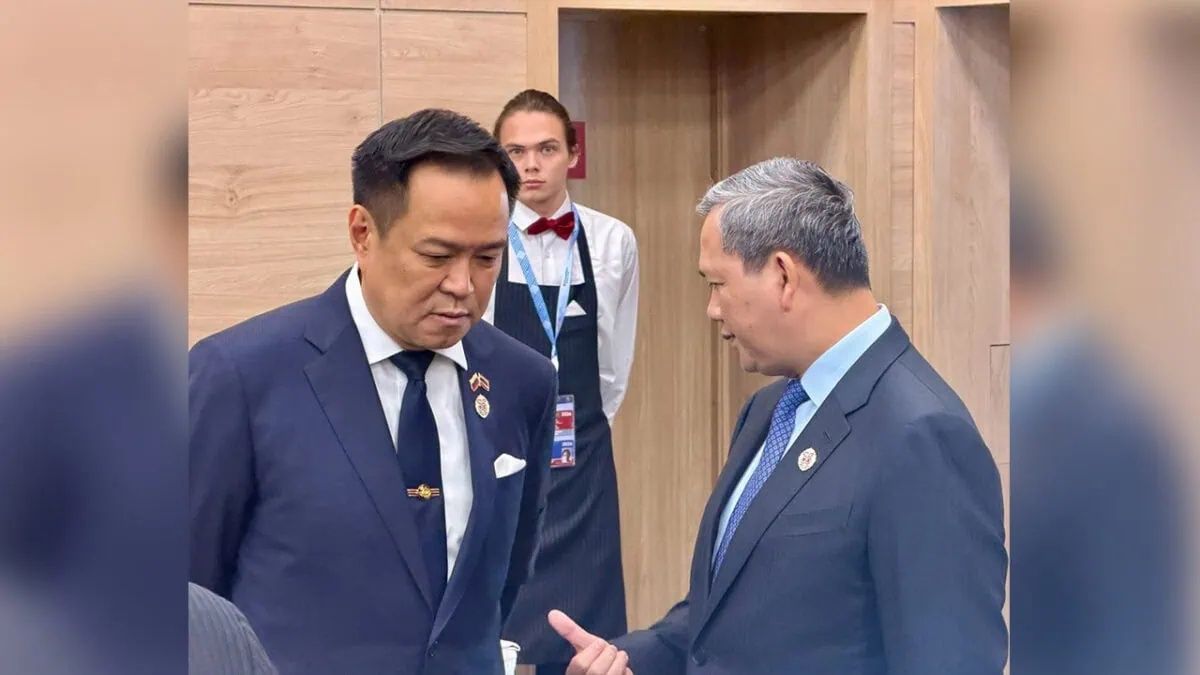
Cambodian Prime Minister Hun Manet has called for Thailand to move swiftly on appointing leadership to its Joint Boundary Commission and resuming border demarcation work that has languished for years, signalling Phnom Penh's eagerness to advance resolution of territorial disputes through established diplomatic channels. The appeal came during what both governments characterised as a casual discussion between Manet and Thai Prime Minister Anutin Charnvirakul on the margins of an Asean-Russia engagement in Kazan, Russia, where time constraints limited the scope of their exchange.
Through a social media statement on Friday, Manet emphasised Cambodia's unwavering commitment to resolving contentious border matters through peaceful means and within the bounds of international law. He underscored that Cambodia remains invested in pursuing multiple avenues for addressing disagreements with Bangkok, reflecting a nuanced strategy that acknowledges the complexity of territorial disputes spanning both land and maritime zones. The Cambodian leader's remarks carried particular weight given the sensitivity of border issues in both nations, where public opinion on territorial integrity remains volatile and politically significant.
For land boundaries, Cambodia has consistently favoured bilateral engagement conducted through the Joint Boundary Commission, a mechanism established under prior bilateral agreements. Manet reiterated this preference while simultaneously exerting diplomatic pressure on Thailand to move from institutional inertia to concrete action. He specifically referenced a Joint Statement signed on December 27, 2025, which he indicated contained provisions obligating Thailand to designate a JBC chief and initiate joint survey and demarcation operations. This reference to specific diplomatic instruments demonstrates that Cambodia is not merely requesting cooperation but holding Thailand to commitments already inscribed in formal bilateral accords.
Meanwhile, Cambodia pursues a parallel track for maritime boundary disagreements through the compulsory conciliation mechanism enshrined in the UN Convention on the Law of the Sea, to which both nations are signatories. This dual-pronged approach—bilateral negotiation for terrestrial boundaries and UN-based processes for sea zones—reflects Cambodia's attempt to leverage different legal frameworks suited to each territorial context. The strategy also signals Phnom Penh's confidence in international law and institutional processes, potentially positioning Cambodia favourably should disputes escalate to international forums.
Thailand's official narrative of the Kazan encounter, as conveyed by Anutin to domestic media, portrayed the meeting as perfunctory rather than substantive, with the prime minister dismissing it as merely "pulling each other aside by the elbow" amid the congested schedule of international gatherings. This characterisation—whilst consistent with describing a brief informal chat—may also reflect Bangkok's desire to minimise the appearance of yielding to external pressure or making significant concessions. Thai governments often move cautiously on border matters given the weight these issues carry domestically.
Anutin confirmed that both leaders reiterated mutual opposition to conflict and acknowledged the mechanisms available for managing border disagreements. He affirmed Thailand's commitment to honouring international obligations including UNCLOS provisions, the Joint Boundary Commission framework, and the General Border Committee. Thailand's insistence on framing these as established mechanisms underscores Bangkok's preference for structured, legally-grounded processes rather than ad hoc negotiations that might set unpredictable precedents.
A particularly revealing moment occurred when Anutin laughed off questions regarding reopening border checkpoints, noting that such discussions would provoke domestic anger in Thailand. This remark illuminates the domestic political dimensions constraining both governments' flexibility on border issues. Thai public sentiment appears resistant to actions perceived as conciliatory on territorial matters, leaving Anutin politically vulnerable should he be seen as accommodating Cambodian positions. This domestic constraint likely explains why Bangkok moves cautiously on appointing JBC leadership or accelerating demarcation work, despite international pressure.
The divergence between Manet's emphasis on urgent action and Anutin's stress on maintaining established frameworks reflects deeper strategic differences. Cambodia appears invested in demonstrating movement and progress, potentially to satisfy domestic constituencies expecting their government to actively defend and define national borders. Thailand, by contrast, seems content with the status quo of slow-moving institutional mechanisms that preserve the status quo without forcing difficult political choices. This disconnect underscores why border demarcation efforts have stalled—Bangkok's incentive structure privileges stability and avoidance of domestic controversy over accelerated resolution.
These developments carry significance for the broader Southeast Asian region, where unresolved maritime and terrestrial boundaries remain flashpoints for potential interstate friction. Cambodia and Thailand's commitment to peaceful mechanisms and rejection of unilateral action provides a model for managing disputes without military brinkmanship. However, the glacial pace of actual progress suggests that institutional frameworks alone cannot overcome fundamental political obstacles to resolution. Both nations face domestic audiences with strong views on territorial integrity, making compromise difficult even when mutual interest in peace exists.
The border dynamics between the two countries also intersect with larger regional competitions for influence and resources. As Southeast Asian nations assert greater autonomy in managing their relationships, Cambodia's invocation of international legal mechanisms signals its willingness to engage with the rules-based international order. Thailand's preference for bilateral frameworks reflects Bangkok's traditional orientation toward managing regional affairs through direct dialogue and established diplomatic relationships rather than multilateral institutions.
Looking forward, whether Thailand moves to fill the JBC chief position will serve as a concrete indicator of Bangkok's genuine commitment to advancing border demarcation. If Thailand appoints a chief and begins active surveys, it would signal that domestic political constraints are loosening and that bilateral progress remains possible. Conversely, continued delays would suggest that Thai leaders view the status quo as preferable to engaging in work that might demand uncomfortable domestic conversations about territorial boundaries. The Kazan exchange, whilst cordial, has done little to bridge this fundamental gap in urgency and motivation between the two governments.
For Malaysia and other Southeast Asian observers, the Cambodia-Thailand situation illustrates the enduring complexities of managing border disputes in a region where territorial matters remain deeply connected to national identity and sovereignty. The reliance on formal mechanisms and international law reflects a conscious choice to avoid military confrontation, yet the effectiveness of such frameworks depends ultimately on political will. As Cambodia and Thailand navigate their relationship, their approach will likely influence how other regional border disputes—including Malaysia's maritime disagreements with several nations—are framed and pursued through multilateral and bilateral channels.

