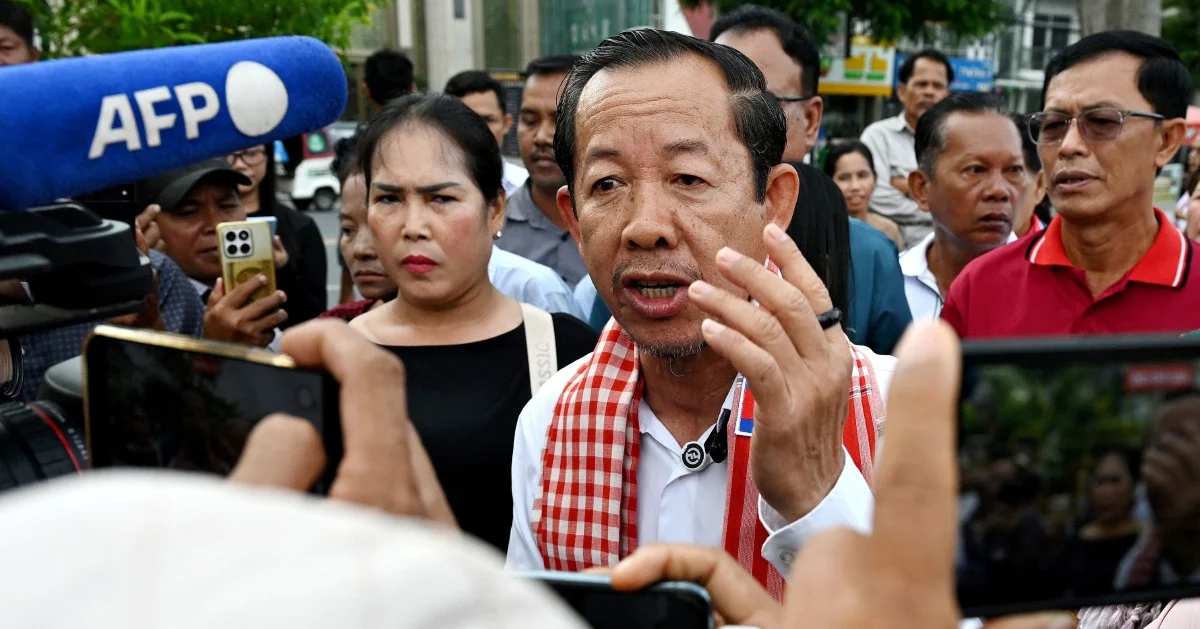
Cambodia's Supreme Court delivered a mixed but ultimately restrictive ruling on Friday regarding opposition politician Rong Chhun, suspending an imposed prison sentence while maintaining a sweeping prohibition on his participation in future elections. The decision, confirmed through Rong Chhun's legal representation, represents a complex judgment that preserves some measure of personal liberty while simultaneously foreclosing any pathway for him to contest electoral seats—a distinction that underscores the persistent constraints on political competition in the kingdom.
Rong Chhun, a prominent figure within Cambodia's opposition movement, had faced both incarceration and electoral disqualification through separate legal proceedings. The Supreme Court's choice to suspend the prison term suggests a degree of moderation in the judiciary's approach, potentially reflecting international scrutiny or domestic concerns about the legitimacy of the court system. However, the simultaneous affirmation of the election ban negates much of this leniency by effectively removing him from meaningful political participation regardless of whether he serves time in prison.
The election ban carries profound implications for Cambodia's democratic trajectory. Opposition leaders who face permanent disqualification cannot contest seats, mobilise constituencies, or build institutional power bases through legitimate electoral channels. This mechanism creates a system where political opponents can be neutralised without the explicit optics of imprisonment, allowing authorities to claim judicial independence while achieving the same practical outcome—the elimination of challengers from the democratic process.
For the broader Southeast Asian region, Cambodia's handling of opposition figures provides an instructive case study in how electoral authoritarian systems operate. Rather than outright bans on opposition parties, governments increasingly employ targeted restrictions against individual leaders, citing legal infractions or perceived violations to justify exclusions that prevent electoral competition without appearing to dismantle democratic institutions entirely. This approach offers plausible deniability while achieving similar suppressant effects.
The suspending of Rong Chhun's prison sentence may reflect pragmatic calculations by Cambodia's leadership. Imprisoning prominent opposition figures generates international complaints, invokes human rights scrutiny, and occasionally triggers diplomatic consequences or sanctions discussions. By suspending the sentence, authorities signal flexibility to international observers while the election ban accomplishes the primary objective of removing him from the electoral arena—where the real competition for state power occurs. The court can present this as a balanced, measured approach that protects both justice and proportionality.
Rong Chhun's case must be understood within Cambodia's recent political history. The country has experienced increasing consolidation of power, with the ruling Cambodian People's Party facing diminished opposition challenge since broader crackdowns on dissent began in earnest following the 2013 elections. The Supreme Court's recent decisions have consistently aligned with government preferences, raising questions about judicial independence and the separation of powers that democratic systems require.
For Malaysian observers, Cambodia's trajectory offers cautionary lessons about institutional degradation. What begins as targeted restrictions against specific individuals can normalise practices that gradually undermine entire political systems. Opposition exclusions, once implemented for particular cases, establish precedents that become easier to invoke subsequently. The Malaysian legal and political systems, while facing their own pressures and criticisms, retain competitive elections where opposition parties and candidates participate directly. Maintaining these mechanisms requires sustained commitment to constitutional norms and institutional checks against executive overreach.
The suspension of Rong Chhun's prison term also reflects possible divisions within Cambodia's power structure or calculation that completely punitive measures risk destabilising the regime. International isolation carries economic costs, particularly for a nation dependent on foreign investment and trade relationships. ASEAN peer pressure, however muted, may register in elite calculations about the optics of justice system operations. The court's bifurcated decision—mercy on imprisonment, firmness on electoral participation—suggests careful calibration of these competing pressures.
For opposition movements across Southeast Asia, Rong Chhun's case demonstrates the evolving challenge of confronting structural disadvantages. Election bans often withstand legal appeals because courts themselves may be compromised or because the bans nominally derive from legal technicalities rather than explicit political targeting. Fighting back requires sustained international advocacy, building democratic capacity and institutions outside electoral contexts, and maintaining leadership visibility despite official disqualification.
The ruling also raises questions about the nature of legitimacy in Cambodian governance. Elections become increasingly cosmetic when leading opposition figures face systematic exclusion. The electorate cannot choose among the full range of available alternatives, and governments can claim democratic mandates despite restricted competition. This legitimacy deficit accumulates, potentially creating instability as excluded populations lose faith in institutional channels for expressing grievances or seeking change.
Cambodia's regional partners, including ASEAN members, face diplomatic choices regarding how to respond to such decisions. Public condemnation risks being dismissed as external interference, yet silence risks normalising restrictions that undermine the association's stated commitment to democracy and human rights. Most ASEAN governments navigate these tensions by issuing carefully calibrated statements that acknowledge concerns without demanding specific remedial actions.
Moving forward, attention will focus on whether Rong Chhun and other banned opposition figures develop alternative strategies for political engagement, whether Cambodia faces intensified international pressure regarding judicial independence, and whether the election ban precedent becomes increasingly routine. The Supreme Court's decision stands as a milestone in Cambodia's democratic trajectory—one that may appear marginal in isolation but contributes cumulatively to a system where electoral competition becomes increasingly constrained and the institutions that might check executive power grow progressively weaker.

