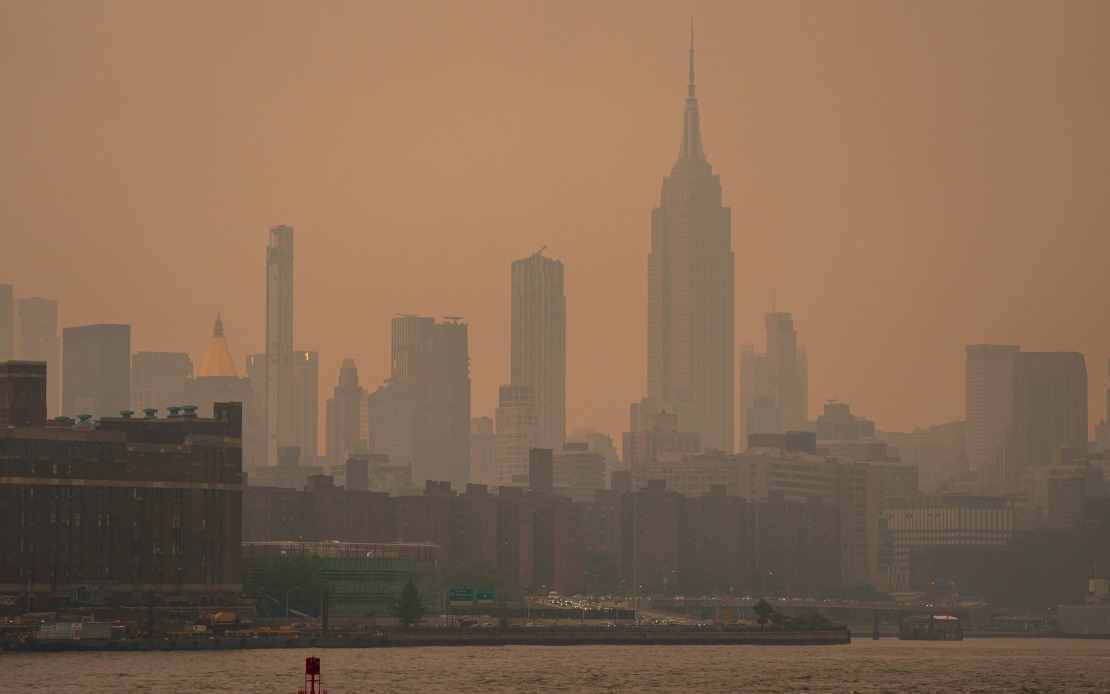
Mexican President Claudia Sheinbaum faced an unexpected logistical hurdle en route to Sunday's Argentina-Spain World Cup final in New Jersey when smoke drifting south from Canadian wildfires forced the cancellation of her commercial flight from Cancún. The deteriorating air quality over New York prompted authorities to ground her initial departure, which had already suffered a two-hour delay on Saturday. Rather than abandon the diplomatic engagement, Mexico's government pivoted swiftly, arranging for Sheinbaum to depart overnight aboard an aircraft operated by Mexico's Defence Ministry, ensuring she arrived in time for the match.
The disruption underscores an often-overlooked dimension of major sporting events: their vulnerability to environmental and weather-related disruptions that can complicate even the most carefully orchestrated state visits. Wildfires spanning Canada's interior regions have sent choking smoke across the US northeast in recent days, forcing airports and government agencies across the region to contend with hazardous air quality readings. For a sitting president attempting to arrive at a high-profile international fixture, such disruptions demand rapid contingency planning and alternative transportation arrangements that only governments with robust security and logistical infrastructure can effectively execute.
Sheinbaum's attendance itself carried considerable diplomatic significance. US President Donald Trump extended a surprise invitation to the Mexican leader, positioning the World Cup final in East Rutherford as an occasion for trilateral engagement among the three host nations. Canada's participation was represented by Prime Minister Mark Carney, completing a tripartite gathering of the three nations that jointly organized the tournament. For Mexico, this represented an opportunity to engage with the US administration during a period when bilateral relations have been strained by persistent disagreements over trade practices and transnational security challenges.
The relationship between Mexico City and Washington has experienced notable tension in recent months, with trade and border security matters creating friction between the neighboring governments. Sheinbaum's prior direct engagement with Trump had been limited, consisting of a single meeting during the World Cup draw held in Washington last December. The tournament's opening ceremony and matches provided a neutral setting for diplomatic contact, and the final offered a particularly prominent platform for bilateral discussion. Trump's invitation thus represented a calculated gesture toward rebuilding rapport at the leadership level.
For regional observers in Southeast Asia, Sheinbaum's determination to reach the World Cup final despite travel obstacles demonstrates the priority that North American governments attach to major sporting occasions as venues for statecraft. The diplomatic choreography surrounding international sports tournaments has become increasingly important as traditional forums for leader engagement compete for attention amid packed calendars. The willingness to deploy alternative aircraft and resources to ensure attendance reflects the perceived value of these events.
The Canadian wildfire smoke causing the initial disruption also illustrates how environmental challenges transcend political borders and can affect state-level operations with little warning. Climate-related disruptions to travel and logistics are becoming more frequent across the Americas, presenting planning challenges for government agencies and raising questions about infrastructure resilience. For a major sporting event spanning multiple nations, coordinating schedules and security arrangements across jurisdictions becomes exponentially more complex when environmental conditions shift rapidly.
Sheinbaum's overnight reroute also highlighted Mexico's capacity to mobilize alternative transport through its Defence Ministry when commercial aviation becomes unavailable. This capability distinguishes larger nations' responses to disruptions and demonstrates the security apparatus available to high-ranking officials when standard options fail. The decision to use military transport rather than delay or reschedule illustrated the political significance assigned to World Cup attendance.
The World Cup itself, as a trilateral venture involving Mexico, the United States, and Canada, was always positioned as more than a sporting occasion. Each nation brought distinct political and economic interests to the tournament's organization and execution. For Mexico, demonstrating effective leadership presence at high-profile events serves both domestic and international audiences, reinforcing presidential authority and diplomatic standing.
Looking at the broader context, Sheinbaum's attendance at the final alongside Trump and Carney created an unexpected moment of unity among three nations whose relationships have been complicated by trade disputes, border security concerns, and divergent policy priorities. Major sporting events regularly serve as backdrops for diplomatic engagement, offering informal settings where leaders can address contentious issues away from formal negotiating tables. The World Cup final, with its global audience and celebratory atmosphere, provided a venue where these conversations could occur with less adversarial framing than traditional bilateral summits might allow.
The smoke disruption, while logistically inconvenient, ultimately did not prevent Sheinbaum's participation. Her commitment to attending, despite transportation complications, sent its own signal about the importance Mexico places on this trilateral engagement. For Malaysian and Southeast Asian readers observing North American affairs, the episode demonstrated how environmental challenges are increasingly capable of disrupting even high-level diplomatic schedules, while also illustrating the flexibility that government resources can provide when commercial alternatives fail.
The incident also served as a reminder that major international events require backup planning and contingency arrangements extending far beyond stadium logistics. When environmental conditions or other unforeseen circumstances compromise primary travel plans, governments must have secondary options readily available. Sheinbaum's successful rerouting showcased this principle in action, ensuring that Mexico's presidential presence at a significant international gathering proceeded as planned despite nature's intervention.

