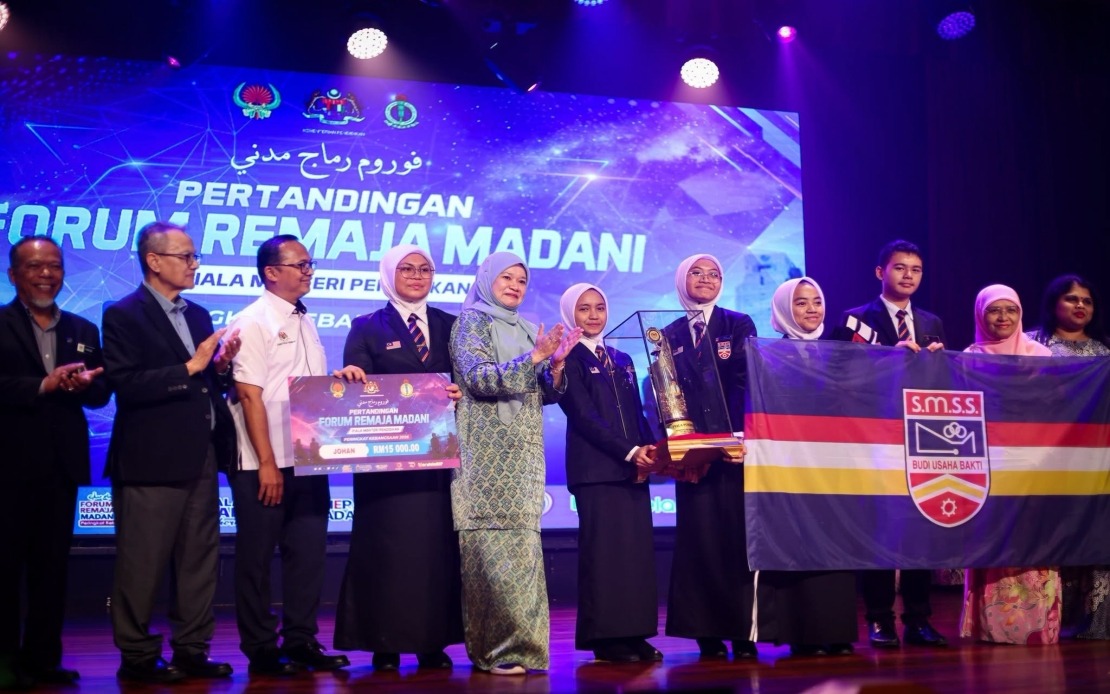
Education Minister Fadhlina Sidek has articulated a vision for Malaysian character education that moves beyond conventional notions of moral instruction, instead positioning young people as active participants in civic discourse. Speaking at the National MADANI Youth Forum, Fadhlina outlined an approach that balances self-expression with intellectual rigour and interpersonal courtesy. Her comments reflect a broader shift in educational philosophy that recognises the need to develop informed, assertive citizens capable of engaging constructively with competing ideas—a particularly relevant aspiration as Malaysia navigates an increasingly complex information environment and diverse society.
The minister's framework distinguishes itself by rejecting the passive model of character development that emphasises obedience and compliance. Rather than positioning educators as arbiters of approved thought, Fadhlina advocates for structured spaces where young people learn to formulate and communicate their own positions. This represents a meaningful departure from conventional practice in many Malaysian schools, where classroom discussions often centre on consensus-building or the transmission of established narratives. By contrast, the minister's vision recognises that meaningful character development requires students to grapple with substantive disagreements and articulate reasoned positions—skills essential for democratic participation and professional advancement in an increasingly globalised economy.
At the youth forum, Fadhlina observed participants developing these exact competencies: they articulated their thoughts, defended their arguments, and engaged with alternative perspectives. This practical demonstration of her educational philosophy underscores the importance of creating institutional settings where such intellectual maturation can occur. For Malaysian policymakers and school administrators, the message is clear: classrooms and youth programmes should function as laboratories for democratic practice, not repositories of pre-determined answers. The cultivation of such spaces requires intentional curriculum design, teacher training that emphasises facilitation over direction, and a cultural shift that positions disagreement as productive rather than disruptive.
Crucially, Fadhlina's emphasis on respectful engagement distinguishes her approach from an unconstrained relativism that treats all opinions as equally valid. Her formulation—young people should speak with confidence, think with rigour, and listen with courtesy—establishes a framework in which the quality of argumentation matters. This nuance addresses a genuine concern in contemporary discourse: that educational efforts to promote tolerance and free expression sometimes neglect the intellectual foundations necessary for meaningful disagreement. By insisting that confident speech must be coupled with knowledge and courtesy, Fadhlina articulates a vision of maturity grounded in both individual agency and civic responsibility.
The integration of Malay language promotion into this character education agenda reveals important connections between linguistic, cognitive, and civic development. Fadhlina argues that the Malay language strengthens when younger generations view it as a vehicle for expressing their own thoughts and engaging in substantive conversation. This perspective reframes language education from a matter of cultural preservation into a dynamic resource for contemporary communication and intellectual exchange. For Malaysia, a multilingual nation where English often dominates academic and professional discourse, ensuring that Malay remains a language capable of expressing complex, contemporary ideas requires deliberate effort. Schools must create contexts where students feel empowered to use Malay for critical discussion, debate, and analysis—not merely for ceremonial or formulaic communication.
The minister's distinction between directive and facilitative educational roles carries significant implications for teacher preparation and professional development in Malaysia. She states explicitly that educators should not determine what young people ought to say; instead, schools should ensure that when students speak, they possess both substantive knowledge and interpersonal maturity. This recalibration of the teacher's role—from authority figure dispensing correct answers to facilitator developing students' capacity for independent reasoning—requires substantial shifts in how teachers are trained, evaluated, and supported. Malaysian institutions that aspire to implement this approach will need to invest in professional development programmes that help educators relinquish directive control and develop the questioning techniques, listening skills, and patience necessary for genuine facilitation.
Fadhlina's observation that national maturity is measured not by unanimous agreement but by citizens' capacity for thoughtful disagreement offers a counternarrative to polarisation trends visible across the region. Southeast Asian democracies have grappled increasingly with divisive identity politics, misinformation, and breakdown in cross-community dialogue. By positioning mature citizenship as requiring both conviction and respect for alternative viewpoints, the minister implicitly argues that democratic stability depends not on enforced conformity but on institutional capacity to manage and even benefit from ideological difference. This has particular resonance for Malaysia, where religious, ethnic, and political fault lines frequently intersect and where intergenerational transmission of polarised identities threatens social cohesion.
The practical implementation of this educational vision will test Malaysian institutions' commitment to genuine reform. While the rhetoric of critical thinking and student-centred learning appears frequently in policy documents across Southeast Asia, translating such aspirations into classroom practice remains notoriously difficult. Teachers operating within examination-driven systems, constrained curricula, and hierarchical institutional cultures face genuine obstacles to facilitating the kind of open-ended intellectual inquiry Fadhlina describes. Moreover, parents accustomed to more traditional pedagogical approaches, administrators fearful of controversy, and policymakers concerned about political control of education may resist the shift toward genuinely dialogical classrooms. Success will require sustained commitment across multiple institutional levels and a willingness to tolerate temporary discomfort as schools transition from transmission to facilitation models.
The minister's framework also invites consideration of how character education relates to media literacy and digital citizenship—concerns largely absent from her remarks but increasingly pressing as young Malaysians navigate polarised online information ecosystems. Confidence in articulating views and critical thinking capacity matter little if young people lack the capacity to evaluate information sources, recognise manipulative rhetoric, and distinguish evidence from opinion in digital environments. As Malaysian educational institutions embrace Fadhlina's vision of empowered youth engagement, they would benefit from explicitly connecting character development to critical media literacy and digital ethics, ensuring that young people's growing confidence in self-expression is matched by sophisticated understanding of how knowledge is produced, validated, and sometimes distorted.
Moving forward, the success of this educational approach will depend partly on how Malaysian society responds when young people—equipped with confidence, critical thinking skills, and respectful communication practices—challenge established orthodoxies or express views that institutions, political actors, or community leaders find uncomfortable. The genuine test of commitment to Fadhlina's vision will come not when youth politely affirm existing consensus but when their informed, respectfully-articulated dissent encounters resistance. If schools and youth programmes successfully develop citizens capable of sophisticated disagreement while institutions and power-holders respond with openness and engagement, Malaysia may indeed build the mature, cohesive society the minister envisions. The alternative—empowering youth voices while simultaneously constraining what they may legitimately express—would render the entire enterprise hollow.

