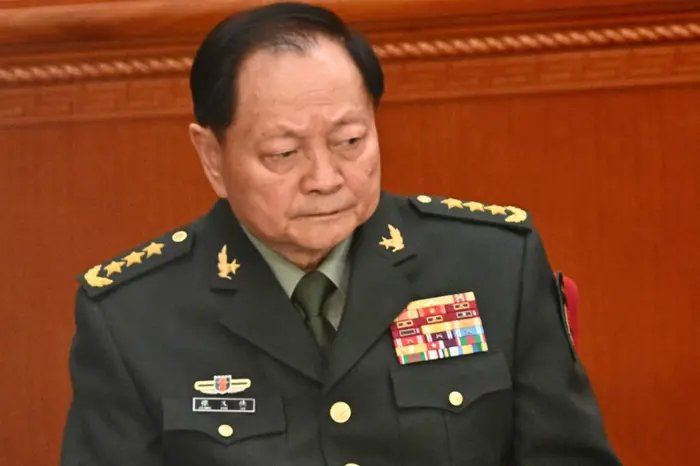
China has formally removed Zhang Youxia, one of the nation's highest-ranking military officials, from his position as vice chairman of the Central Military Commission (CMC), state media announced Friday. The decision came after a seven-month investigation into allegations of serious disciplinary and legal violations—a phrase commonly used in Beijing to describe corruption. The removal marks a significant shift in China's military leadership and underscores President Xi Jinping's sustained focus on rooting out misconduct within the armed forces, even among those at the very pinnacle of power.
Zhang's position had elevated him to China's most senior military rank. As the more prominent of two vice chairmen on the CMC, he represented one of the most powerful figures within the defence establishment, answerable only to Xi himself as chairman of the commission. His influence extended across strategic military planning and doctrine, making his sudden removal a consequential personnel change for the Chinese military structure.
The investigation into Zhang was first publicly disclosed in January, when the defence ministry simultaneously announced it was probing another high-ranking CMC member, Liu Zhenli, for identical infractions. Liu, who served as chief of staff of the CMC's joint staff department—the body responsible for overseeing combat operations and strategic planning—was also formally removed from his position on Friday. The paired announcements suggested a coordinated purge affecting multiple echelons of the military's command hierarchy.
Both officials were implicated in what the defence ministry described as violations of discipline and law, though authorities provided no specific details about the alleged misconduct. The terminology used in such investigations traditionally signals financial impropriety or abuse of position. For observers of Chinese politics, the vague phrasing reflects Beijing's preference for opacity in corruption cases, particularly involving senior officials whose downfall could undermine public confidence in state institutions.
Zhang's removal is particularly striking given his apparent proximity to Xi. Prior to his fall from grace, analysts and foreign observers had generally regarded Zhang as part of Xi's inner circle, suggesting the president trusted his judgment on military matters. That perception made his investigation and removal especially shocking to those monitoring China's power dynamics. The case demonstrates that no amount of factional alignment or perceived loyalty provides immunity from Xi's anti-corruption agenda when allegations of serious wrongdoing emerge.
Xi has made combating graft a hallmark of his leadership since assuming power in 2012, framing it as essential to maintaining Communist Party legitimacy and preventing state decay. The anti-corruption campaign has ensnared thousands of officials, from provincial administrators to central-government ministers, and has increasingly extended into the military. By removing prominent generals like Zhang, Xi signals that the armed forces are not exempt from scrutiny and accountability, a message crucial for maintaining order within an institution of over two million personnel.
The CMC serves as China's supreme military command body, responsible for overseeing all armed forces and military strategy. Its two vice chairman positions traditionally rank among the most influential posts in the country's security establishment. Zhang's removal thus creates a significant vacancy in military leadership that Xi must now address through reassignment or promotion. The timing of the formal removal—occurring roughly when investigations typically conclude in the Chinese system—suggests the investigation has reached a decisive point, though criminal charges or public trial remain uncertain.
The removal of both Zhang and Liu underscores broader trends within China's military modernization and governance. As the People's Liberation Army undergoes technological advancement and structural reforms, leadership continuity has sometimes given way to investigations and personnel changes. This churn, while disruptive in the short term, reflects Xi's determination to ensure the military remains under tight civilian control and free from the kind of factionalism that historically plagued Communist-era defence establishments.
For regional observers, particularly in Southeast Asia and beyond, the implications of Zhang's removal are complex. Military leadership changes in Beijing invariably affect defence policy orientation and military-to-military relationships with neighbouring countries. Zhang's departure removes a known quantity from strategic calculations involving the South China Sea, cross-strait military balance, and broader defence postures. His successor—yet to be announced—will bring potentially different priorities and strategic outlook to the CMC's deliberations.
The case also reflects the precarious position of China's senior military officers in an era of intense factional competition within the Communist Party. High-ranking generals must navigate competing interests while demonstrating unwavering loyalty to Xi, making them simultaneously powerful and vulnerable. Zhang's trajectory from perceived insider to accused official illustrates the risks inherent in senior positions, where a single investigation can rapidly overturn years of advancement and influence.

