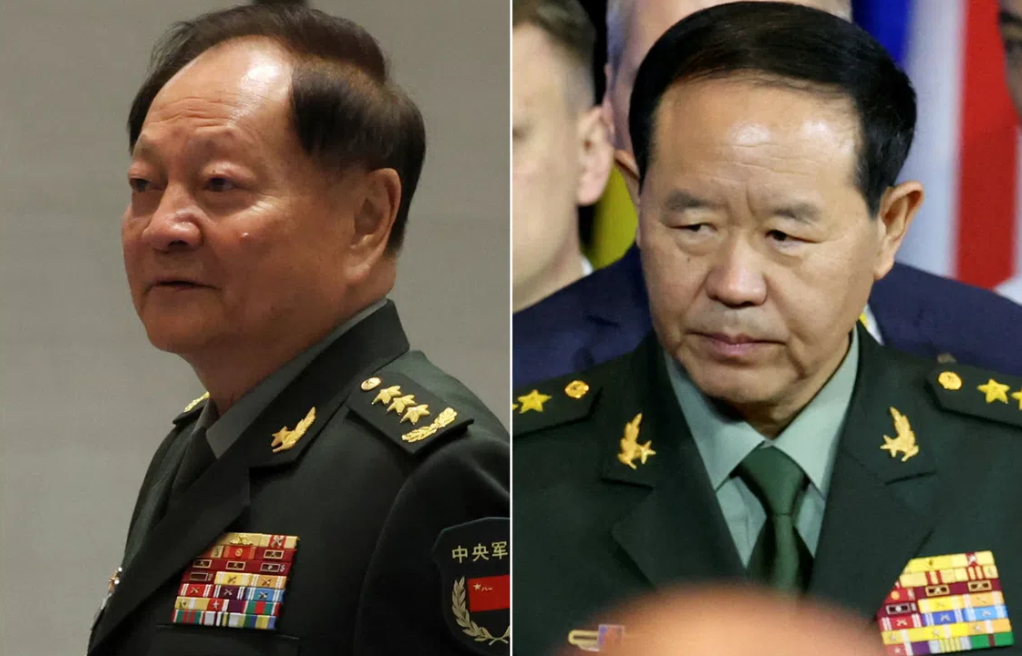
China's Communist leadership has removed two senior military figures from the Central Military Commission, the nation's highest defence authority, following investigations into alleged serious misconduct. The removals represent a further intensification of President Xi Jinping's extensive anti-corruption drive within the armed forces, a campaign that has fundamentally reshaped the military hierarchy over the past twelve years.
Zhang Youxia and Liu Zhenli have been stripped of their positions in the state Central Military Commission, with formal announcements made through official parliamentary channels. Zhang held particular prominence as vice-chairman of the commission and a member of the exclusive Politburo, making him second only to Xi in military authority. Liu's role as chief of staff of the CMC's Joint Staff Department placed him among the military's most operationally significant officials. Their simultaneous removal marks a significant consolidation of power within the military establishment.
The departures leave the seven-member commission with only two serving officials remaining, a striking reduction that underscores the scale of personnel changes within China's defence establishment. Xi Jinping himself is the sole active political figure maintaining active status on the body, signalling the degree to which the leadership has reconfigured the military's senior ranks. This concentration reflects both the thoroughness of the anti-corruption campaign and the centrality of military control to Xi's overall governance strategy.
The parallel system of Communist Party and state military commissions, though technically distinct entities, function as integrated structures in practice. Friday's announcement concerns the state commission positions, though Zhang and Liu have not yet been formally removed from their corresponding Party commission roles. This bifurcation between party and state bodies is typical of China's dual governance architecture, creating potential for staggered announcements and continued pressure on targeted officials.
Xi launched his comprehensive anti-corruption campaign in 2012, identifying the military as a primary focus area for institutional reform. The campaign has systematized the removal and investigation of numerous high-ranking officers and officials, fundamentally altering military command structures and power relationships. As recently as last month, Xi called on senior Communist Party leaders to intensify anti-corruption efforts specifically within the defence apparatus, signalling that this process remains far from complete.
The removals announced Friday extended beyond the two principal figures. The updated parliamentary roster excluded four additional military officers: Lieutenant General Zhong Shaojun, a former director of the CMC General Office; General Ju Qiansheng, previously commanding the military's Strategic Support Force; and two other senior figures. Separately, China's top political advisory body removed Zhao Zongqi, a former Western Theatre Command commander involved in the 2020 border clashes with India, from his advisory position on Wednesday.
These cascading personnel changes reveal the breadth of the military purge across multiple hierarchical levels and institutional structures. The involvement of officers from specialized commands, administrative departments, and operational units suggests a systematic review of military leadership rather than isolated cases. The Strategic Support Force, from which General Ju was removed, represents one of the military's most strategically significant branches, indicating that corruption investigations reach into the defence establishment's most sensitive areas.
The inclusion of Gao Shiwen, a civilian former mayor of Nanchang with aerospace industry background, indicates the scope extends beyond uniformed military leadership. Gao's prior employment at China Aerospace Science and Technology Corporation, a state-owned defence contractor, suggests investigations have touched defence industrial-military relationships. This pattern demonstrates how anti-corruption efforts span both military and civilian defence sector networks.
For regional observers including Malaysia and ASEAN nations, these military leadership changes carry strategic implications. A military being actively restructured and depleted of senior commanders during ongoing personnel investigations may affect operational capabilities, decision-making consistency, and institutional stability. Southeast Asian governments, already navigating complex relationships with Beijing involving trade, territorial disputes, and security concerns, must assess how military leadership transitions influence China's regional policies and military posture.
The anti-corruption campaign's severity raises questions about institutional resilience within the People's Liberation Army. Removing officers en masse from decision-making bodies creates knowledge gaps and disrupts established operational hierarchies. While theoretically designed to improve military governance and eliminate corruption, such extensive purges also introduce risks of reduced institutional memory, fractured command relationships, and potential instability during periods requiring rapid military response.
Xi's consolidation of military authority through corruption investigations reflects broader governance consolidation strategies. By systematically removing potential rivals and entrenched power bases from the defence establishment, the leadership maintains tight control over an institution critical to political survival. The military purge complements broader party discipline campaigns, creating an integrated system of authority concentrated around Xi's office.
Looking forward, the apparent continuation and expansion of military anti-corruption efforts suggests this process will persist as a defining characteristic of the current political era. Officials throughout the defence establishment and related sectors must anticipate that investigative scrutiny may eventually reach them. This creates an environment of institutional flux within China's military leadership, with implications extending throughout Asia's strategic environment as Beijing manages both internal military changes and external security relationships.

