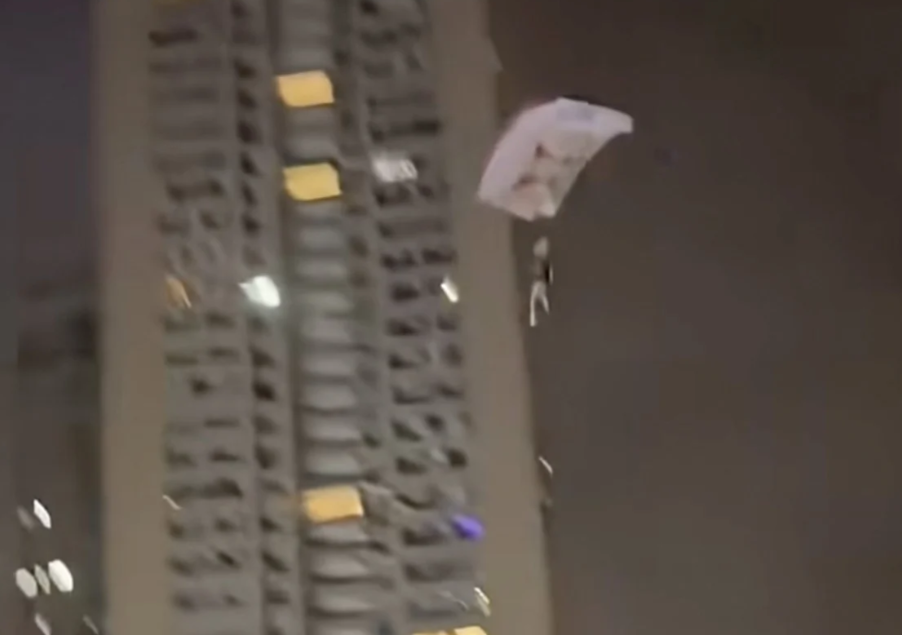
A 23-year-old man identified as Ren has been taken into custody by police in Chenghua district, Sichuan province, after executing a dangerous parachute jump from the roof of a high-rise apartment building. The incident occurred late on June 30 at 11pm, when Ren leaped from the structure in what authorities determined was a calculated attempt to generate increased traffic and engagement for his social media profiles. The following day, he uploaded footage of the stunt online, apparently unconcerned about the legal ramifications or genuine safety hazards his actions posed to residents below.
The video evidence proved damning, revealing Ren descending dangerously close to residential buildings and trees during his freefall, creating an obvious risk to anyone in the vicinity. Police investigators were swift to characterise his behaviour as a serious disruption to public order that endangered not only his own life but the safety of ordinary citizens going about their daily lives. As a result, Ren was placed under administrative detention for up to 15 days, the standard enforcement mechanism available to Chinese authorities in such cases. Beyond this immediate penalty, he has been comprehensively banned from all social media platforms, effectively removing his ability to continue leveraging online content for followers or income.
Ren, who operated under the social media handle "Parachute Coach Kakaxi" and had accumulated approximately 60,000 followers across major platforms, had apparently attempted similar stunts previously. Police investigations uncovered another video from May 2024 showing him performing an identical jump from another residential building, suggesting this was not an isolated incident but rather part of an escalating pattern of reckless behaviour. What made his claims particularly problematic was his self-designation as a parachute coach—a professional title he had no legitimate basis to claim. When authorities conducted formal verification, they confirmed Ren had never obtained any official coaching licence, meaning he was not only breaking laws regarding unauthorised aerial activities but also fraudulently misrepresenting his credentials to his followers.
The regulatory framework governing skydiving in China is unambiguous and reflects the government's concern about public safety in densely populated urban environments. Official policy permits skydiving only when explicit authorisation has been granted by relevant authorities, and jumps may only occur in specifically designated zones approved for such activities. High-density residential areas, particularly apartment blocks and commercial buildings in downtown districts, are strictly off-limits. The prohibition extends logically to other public infrastructure including bridges and major urban thoroughfares. Police warnings following Ren's arrest made clear that violation of these regulations would result in severe punishment, signalling an intent to deter copycat incidents.
The incident has provoked significant online discussion across mainland Chinese social media platforms, with most commentators expressing shock and disapproval of Ren's actions. One user highlighted the indiscriminate nature of the danger, pointing out that Ren's stunt endangered not only himself but potentially anyone beneath him on the ground—pedestrians, vehicle occupants, or residents in adjacent buildings who had done nothing to merit such risk. Another observer questioned Ren's judgment and motivations, expressing bewilderment that pursuit of online traffic and engagement could justify such recklessness. A third voice called for enhanced punishment, arguing that without sufficiently severe consequences, other aspiring influencers might attempt similar feats in search of viral attention and social media prominence.
Ren's case is emblematic of a broader and troubling trend across mainland China, where content creators increasingly push boundaries and risk their personal safety in pursuit of online attention and algorithmic visibility. The phenomenon reflects the intense competition for engagement and monetisation opportunities that characterises modern social media ecosystems, where novelty and shock value often drive viewership metrics. Just weeks before Ren's incident, police in Zhejiang province apprehended another individual who had filmed himself driving at 152 kilometres per hour on an expressway—well beyond the legal speed limit—while simultaneously using a mobile phone to record video content. This individual faced substantial penalties including the deduction of nine points from his driving licence's annual allowance of 12 points and a fine of 250 yuan, equivalent to approximately 35 US dollars.
The consequences of such behaviour extend beyond administrative penalties and social media bans. The case that perhaps most starkly illustrates the tragic potential of extreme online stunts is that of Wu Yongning, a prominent blogger who died in 2017 after collapsing from physical exhaustion while attempting to scale a 260-metre-high building in Hunan province during a live-streaming session. Wu had previously garnered widespread attention for his pattern of scaling high structures without any safety equipment whatsoever, justifying his dangerous activities by claiming the income from online sponsorships and donations helped fund medical treatment for his mother's illness. His death served as a sobering reminder that viral content pursuits can result in irreversible consequences, yet the phenomenon has persisted and arguably intensified.
The regulatory and social response to Ren's case reflects growing recognition among Chinese authorities that the intersection of social media culture and public safety requires active intervention. The 15-day detention, social media ban, and widespread publicising of the incident represent an attempt to create sufficient deterrent effects. However, experts might question whether such measures alone can effectively counter the profound economic incentives and psychological rewards embedded in social media engagement metrics. The architecture of major platforms—with their emphasis on follower counts, view tallies, and algorithmic amplification of sensational content—creates ongoing pressure for creators to escalate the novelty and shock value of their output.
For Malaysian and Southeast Asian audiences, the case offers pertinent lessons about online culture and digital safety governance. As social media penetration remains high across the region and aspiring content creators increasingly pursue income opportunities through platform engagement, the pressure to generate viral moments creates similar risks. The distinction between China's administrative detention system and the legal frameworks available in Malaysia and other ASEAN nations is significant, yet the underlying problems—influencers performing dangerous acts, insufficient platform accountability, and the gamification of risk-taking—manifest across the region. Ren's punishment serves as a cautionary example of how authorities are beginning to respond when online ambitions translate into genuine public safety hazards.

