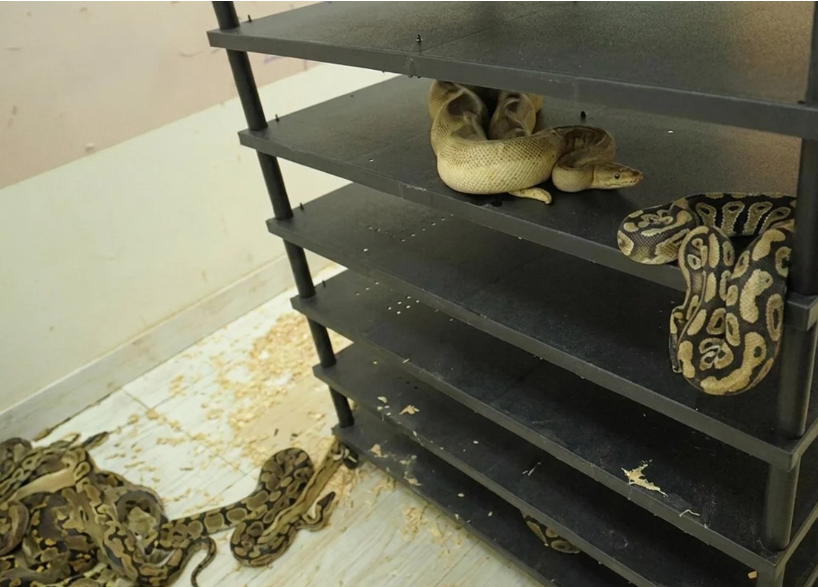
An unemployed man in Taizhou, Zhejiang province, has been sentenced to jail for operating a sprawling and unlicensed python breeding operation inside his residential apartment, authorities announced in late June through state broadcaster CCTV. The discovery of what would eventually become one of the region's most unusual wildlife crime cases began innocuously in March 2024 when an elderly resident found a large tawny python near a local mountain and reported it to police, setting off a chain of investigative events that would uncover a sophisticated illegal breeding network stretching across multiple provinces.
Pythons occupy a protected status under Chinese law, designated as Grade Two protected animals alongside species such as certain bears and big cats. This classification means that breeding, trading, transporting, or even possessing pythons without explicit government authorization constitutes a serious criminal offence. The regulations exist to prevent the depletion of wild populations and maintain ecosystem balance, yet enforcement across China's sprawling regions remains inconsistent. When the elderly citizen reported the escaped python, which was notably thick and unfamiliar to the region's typical wildlife, investigators initially puzzled over its origins before concluding that it must have escaped from an illegal breeding facility.
The breakthrough in the investigation came through an unconventional detective method. Police consulted with a professional snake handler who pointed out a critical vulnerability in the operation: pythons require carefully controlled environments with consistent temperatures between 20 and 30 degrees Celsius and high humidity levels. Maintaining these conditions year-round demands substantial and continuous electricity consumption, creating an unusual utility signature that would stand out among ordinary household usage patterns. Armed with this insight, officers conducted a systematic analysis of electricity bills for residents living near where the snake was discovered, narrowing their focus to those with consumption patterns far exceeding normal domestic needs.
This forensic accounting approach identified a man surnamed Guo as the primary suspect. Guo lived alone in a modest flat, was unemployed, and had no obvious legitimate reason for such elevated power consumption. Further surveillance revealed that a frequent visitor named Di regularly collected courier packages from local delivery stations. Officers tracking these deliveries discovered that Di was purchasing live white mice in bulk through online vendors—a telltale indicator of someone feeding reptile collections rather than keeping them as pets. Cross-referencing with online sellers confirmed that the mice purchased were typical food items for commercial or semi-commercial reptile operations.
Social media monitoring provided additional corroborating evidence. Guo had shared numerous photographs of snakes across his social accounts and made oblique references to selling specimens to interested buyers. Transaction records showed that Di had sold at least two pythons to another individual for 1,000 yuan, or approximately US$150 per snake, indicating a profit-driven sales operation rather than casual hobbyist breeding. The digital evidence combined with physical surveillance created a compelling case for law enforcement to move forward with arrests.
When police executed a search warrant at Guo's residence, officers were astounded by the scale of the operation. The flat had been transformed into a specialized breeding facility, with Guo having dismantled virtually all his personal furniture and confined himself to sleeping in a single bedroom while dedicating the remaining two bedrooms and the living room entirely to housing reptiles. Stacked plastic boxes, each containing individual pythons, occupied every available space in these rooms, creating a claustrophobic maze of containers. In total, police discovered and seized 309 pythons from the residence, which were subsequently transferred to a local zoo for proper care and eventual repatriation efforts.
During interrogation, Guo displayed little remorse and instead expressed genuine passion for his work with snakes. He revealed that his interest in python breeding had begun in 2014 when he purchased his first four specimens and had since dedicated himself to mastering the reproductive genetics of the species. In remarkable candour, Guo described himself as a "creature creator," expressing pride in his ability to cultivate pythons of various colour morphologies through selective breeding techniques. His enthusiasm for the work appeared to overshadow any concern regarding its illegality, suggesting that the operation stemmed more from obsessive hobby cultivation than purely financial motivation, though profit remained a significant factor.
The investigation expanded beyond Guo himself when detectives pursued leads on his supply chains and customers. A shop owner named Deng, who had sold Guo his initial four pythons a decade earlier, was arrested and found to be operating his own breeding facility with 47 pythons in his home. Di, the courier collector, faced charges as an accomplice to the sales operation. Together, Guo and Di had successfully sold approximately 80 pythons to customers, generating significant illicit revenue from the trade in protected species. The broader criminal network ultimately involved three individuals with responsibility for managing, breeding, and distributing a total of 436 pythons valued at over 30 million yuan, equivalent to approximately US$4.4 million at current exchange rates.
While a Taizhou court sentenced all three defendants to imprisonment, specific details regarding sentence lengths were withheld from public disclosure. Under China's Criminal Law, violations involving Grade Two protected animals carry maximum penalties of five years imprisonment, and sentencing typically varies based on factors including scale of operation, profit generated, and degree of environmental harm. For Guo's operation, which involved nearly 440 specimens and represented one of the largest unauthorized python breeding networks discovered in the province, sentences approaching the statutory maximum would be proportionate. The case demonstrates how vulnerability in protected species regulations can be exploited when enforcement mechanisms lack sophistication, though the authorities' innovative use of utility billing analysis signals evolving investigative tactics across China's wildlife crime units.
The incident carries broader implications for Southeast Asia, where python trafficking and unauthorized breeding operations flourish across multiple jurisdictions. Malaysia, Thailand, Indonesia, and Vietnam all face significant challenges from illegal wildlife trade networks, often involving the same python species and supply chains that feed international markets. The successful investigation in Taizhou highlights investigative methodologies that regional authorities could adapt and employ, particularly cross-referencing unusual resource consumption patterns with wildlife crime. For Malaysian readers and enforcement agencies, the case serves as a reminder that sophisticated illegal breeding operations often hide in plain sight within residential areas, requiring multi-agency coordination and willingness to pursue unconventional investigative threads. Regional cooperation on python trafficking, including information sharing on buyers, sellers, and transport routes, remains essential for protecting endangered reptile populations across Asia.

