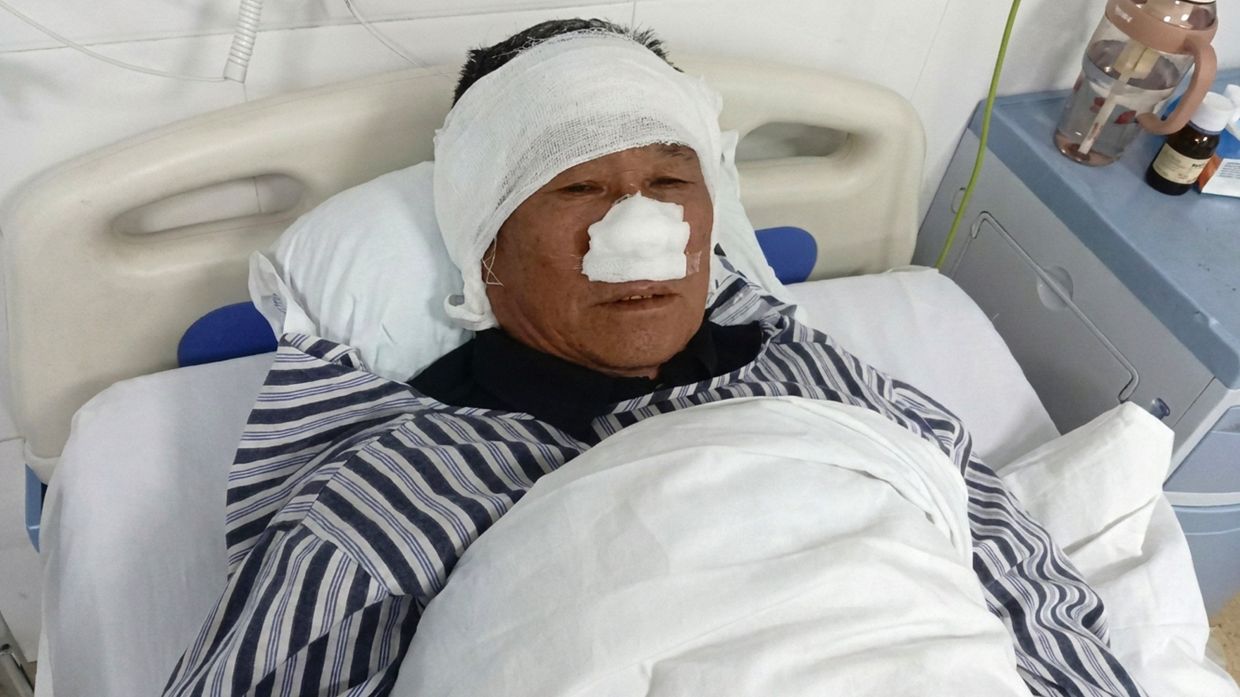
Zeng Fanlin, a 69-year-old from Chenzhou in Hunan province, has become the latest recipient of China's prestigious national hero designation following an act of extraordinary courage that left him permanently disfigured. In July, the Chinese government formally recognised Zeng among 86 individuals named for what it terms "heroism in a just cause", honouring his willingness to risk himself for a stranger's safety at a moment when most bystanders chose caution.
The incident that transformed Zeng's life unfolded in April when a man in his twenties entered the village and began attacking random people and kicking at doors in what witnesses described as an uncontrolled emotional outburst. The situation escalated dramatically when the assailant targeted a woman riding an electric bike, grabbing her by the throat and posing an immediate threat to her life. Faced with the terrifying prospect of strangulation, the woman was left vulnerable as fear gripped those nearby, who opted to contact emergency services rather than physically intervene.
Zeng's response was instantaneous and decisive. Despite being in his seventh decade and lacking any formal security training, he rushed toward the confrontation and tackled the attacker, quickly joined by two other villagers determined to restrain the increasingly dangerous man. The struggle proved vicious. During the violent scuffle, the assailant bit down on Zeng's face with sufficient force to sever a substantial portion of his nose. Rather than release his grip and seek medical attention, Zeng maintained his hold on the attacker until police officers arrived at the scene. His persistence ensured both the immediate safety of his victim and the suspect's subsequent apprehension.
The medical aftermath proved as challenging as the initial trauma. Doctors informed Zeng that most of his nose had been irreparably lost in the attack, presenting significant reconstruction difficulties with no guarantee of complete functional or cosmetic restoration. The medical team confronted genuine uncertainty about whether he would experience chronic complications and permanent scarring. Medical costs spiralled beyond 70,000 yuan—approximately US$10,000—a burden that would have proven catastrophic for many families but which local authorities stepped in to cover through government assistance.
Zeng's path to reconstruction involved multiple surgical interventions spanning months. Surgeons conducted at least two operations, employing sophisticated techniques including skin grafting from his scalp to reconstruct the missing facial structure. They successfully restored his nasal wings, restoring his ability to breathe naturally, though Zeng continues experiencing daily pain as tissue heals and adapts to its new configuration. Recovery specialists cautioned that the process would require a minimum of six months, during which he would need to manage substantial physical discomfort and psychological adjustment to his altered appearance.
Beyond government support, Zeng received additional recognition and financial assistance. The Alibaba Foundation, through its charitable initiatives, awarded him 20,000 yuan in recognition of his bravery, providing some compensation for his ordeal and lost earning capacity during recuperation. This recognition reflected broader societal appreciation for his actions, as his story gained prominence through local media coverage that highlighted both his selflessness and the challenging recovery process.
When speaking to journalists about his ordeal, Zeng demonstrated philosophical resilience. He reflected that in the context of having preserved another person's life, his own sacrifices paled in significance. This perspective was shaped substantially by his formative life experiences. Orphaned during childhood, Zeng grew up dependent on the kindness and support of his fellow villagers. Later, he benefited from government educational subsidies that enabled him to attend school without financial burden. This history of receiving help from others had instilled in him a powerful sense of obligation to reciprocate whenever opportunity arose.
Zeng's sense of social responsibility extended beyond this singular dramatic incident. Before his retirement from official village administration, he served as a volunteer mediator, dedicating himself to resolving disputes and tensions between community members through dialogue and negotiation. His daughter characterised him as someone possessed of an instinctive aversion to injustice—a man genuinely incapable of passively observing wrongdoing. She referenced his 2016 intervention when he helped local police apprehend a thief, demonstrating that his hero status was earned through consistent pattern of civic engagement rather than representing any isolated anomaly.
Under China's criminal justice framework, the suspect faces serious legal consequences. Laws governing intentional grievous bodily harm prescribe sentences ranging from three to ten years imprisonment, with aggravating factors potentially leading to enhanced penalties. The investigation remained ongoing at the time of Zeng's recognition, though authorities indicated the attacker had lost emotional control, which might influence sentencing considerations while not necessarily reducing his culpability.
Zeng's recognition carries broader implications for understanding contemporary Chinese civil society expectations. The decision to honour him officially reflects state validation of citizen intervention in emergencies and preference for society members actively protecting one another rather than remaining passive observers. His case has resonated particularly within online communities, where commentators emphasised that perpetrators of violence should face proportionate punishment while simultaneously calling for societal protection of those who voluntarily put themselves at risk defending others. The narrative arc—from childhood vulnerability to adult heroism—presented a compelling story about cycles of mutual obligation and the transformative power of community solidarity that resonates beyond China's borders.

