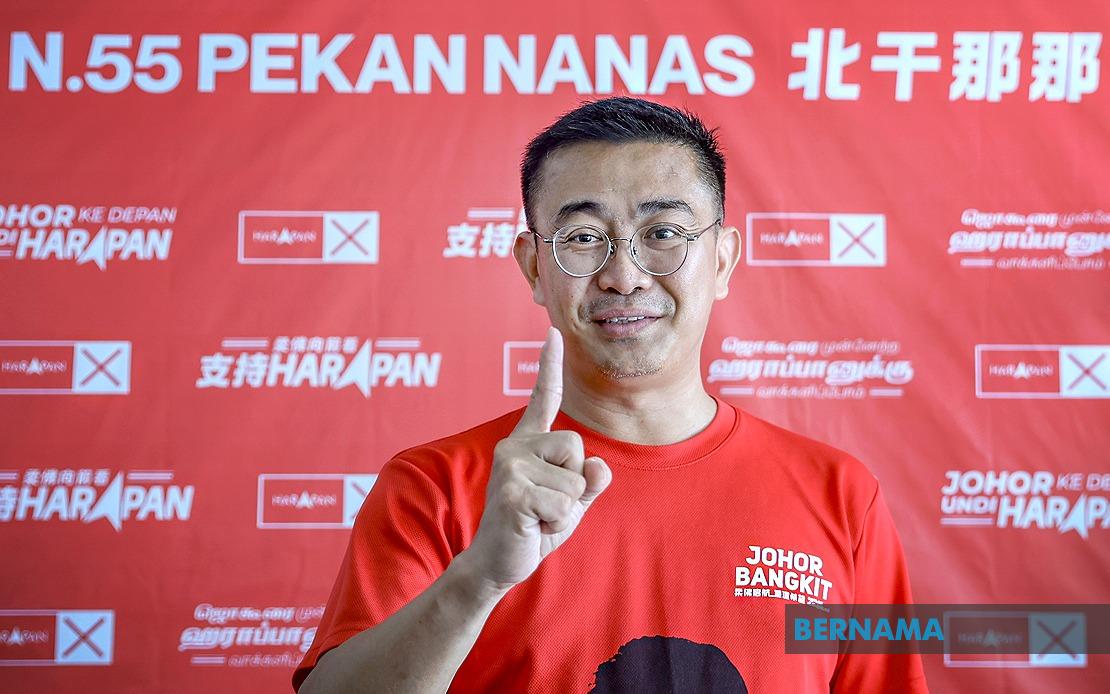
As campaigning intensifies for Saturday's Johor state election, the proposed Pekan Nanas-Ulu Choh bypass has become a focal point of political friction, with Pakatan Harapan (PH) candidate Yeo Tung Siong questioning why a long-promised traffic relief project continues to gather dust. Cikgu Yeo, contesting the Pekan Nanas seat for a fresh mandate, has publicly challenged the state government's explanations for repeated delays, arguing that infrastructure needs in his constituency have been subordinated to other development priorities.
The controversy centres on a bypass connecting Jalan Sawah in Pekan Nanas to Ulu Choh—a piece of infrastructure that local residents have awaited for years as traffic congestion has become increasingly problematic. During his tenure as Pekan Nanas assemblyman from 2018 to 2022, Yeo pressed the matter consistently during State Legislative Assembly proceedings, advocating for its inclusion in the state's capital expenditure plans. His persistence yielded tangible results when the project was eventually incorporated into the Johor Budget 2021 under the broader Johor Infrastructure package designated for road and bridge development, with land acquisition subsequently commencing.
Yet despite these initial steps forward, the project has stalled. According to official state government responses tabled during 2024 State Assembly sessions, the bypass faced postponement in both 2023 and 2024, with authorities citing escalating construction costs and the necessity to increase the project ceiling as primary obstacles. The government framed these delays as necessary adjustments in response to market pressures and competing infrastructure demands across the state. However, Yeo's challenge to this narrative hinges on a troubling discrepancy: Johor recorded a fiscal surplus of RM95.38 million in 2024, suggesting that budgetary constraints may not provide the full explanation for the project's continued suspension.
The practical ramifications of the bypass's non-completion have extended beyond mere inconvenience for residents. Heavy vehicles, particularly sand lorries and commercial transport, continue funnelling through Jalan Sawah in the absence of an alternative route, perpetuating congestion that disrupts daily life and commerce in Pekan Nanas. For a constituency already grappling with traffic management challenges, the absence of this bypass represents a failure to address an identified infrastructure gap—one that has only worsened as economic activity in the region continues to grow.
Yeo's critique carries particular weight within the context of Malaysian electoral politics, where infrastructure delivery remains a critical metric by which voters assess government competence. By questioning the government's prioritisation decisions while highlighting the state's apparent fiscal capacity, he has shifted the narrative from one of technical inevitability to one of political choice. This framing resonates with constituents who perceive their concerns as deprioritised relative to developments elsewhere in Johor. For Malaysian voters accustomed to campaign promises regarding infrastructure improvements, the contrast between a state surplus and a stalled project embodies frustrations about the gap between electoral rhetoric and actual delivery.
The straight contest between Yeo and incumbent Barisan Nasional (BN) assemblyman Tan Eng Meng adds electoral stakes to the bypass question. Yeo's positioning of the project's resumption as dependent upon his return to the State Assembly frames the upcoming election as a referendum on his advocacy effectiveness. Should voters credit his previous efforts in securing the project's initial inclusion in the 2021 budget, they might view renewed support as an investment in continuing that momentum. Conversely, if the current government can articulate convincing explanations for the delays or announce a definitive timeline for resumption, it may neutralise this criticism.
The broader implications of this dispute extend beyond a single constituency, offering insights into resource allocation patterns within Johor. A state with documented fiscal surpluses making decisions to postpone approved infrastructure projects raises questions about the criteria governing investment priorities. Whether decisions reflect genuine technical constraints, political considerations, or shifting strategic priorities remains opaque to public scrutiny—a gap that Yeo has effectively exploited through his questioning.
The Johor state election itself encompasses 56 seats contested by 172 candidates, with approximately 2.73 million eligible voters participating in the poll. Within this larger electoral drama, localised issues such as the Pekan Nanas bypass demonstrate how infrastructure development decisions crystallise into political contests at the constituency level. The project's history—from conception through initial budgetary approval to subsequent postponement—illustrates the often-tortuous path of infrastructure initiatives in Malaysian state politics, where competing demands, shifting fiscal circumstances, and electoral cycles intersect.
For Southeast Asian regional observers, Johor's experience reflects broader patterns in infrastructure governance across the region. States and governments frequently face pressure to demonstrate development progress through visible projects, yet financial constraints, bureaucratic delays, and competing priorities create gaps between announcements and execution. The Pekan Nanas bypass, despite its local significance, exemplifies these structural tensions. Cikgu Yeo's challenge to the government's explanations suggests that constituents are increasingly sophisticated in interrogating the gap between fiscal capacity and project delivery, demanding accountability not merely for what projects are announced but for the timeliness and rigour with which they are implemented. As Malaysia's federal and state governments continue pursuing infrastructure-intensive development agendas, such scrutiny of implementation authenticity will likely shape electoral calculations and governance priorities.

