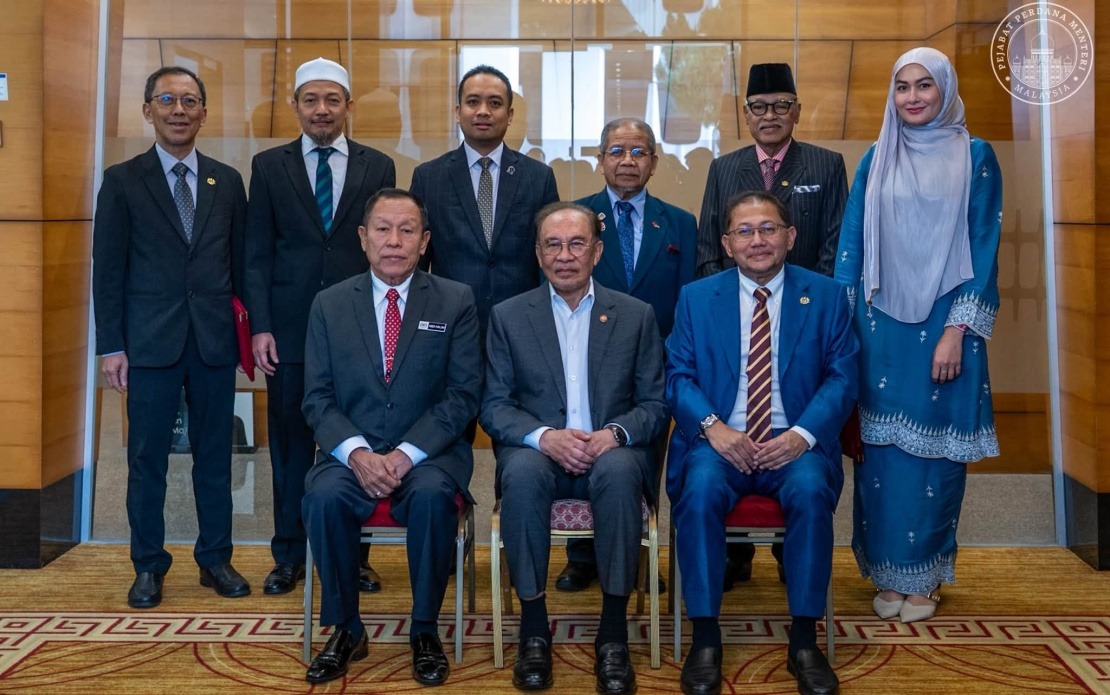
Prime Minister Datuk Seri Anwar Ibrahim has underscored the fundamental principle that Malaysia's anti-corruption agenda cannot succeed through isolated institutional efforts, instead demanding a comprehensive alliance spanning multiple sectors and stakeholders across the nation. Speaking in Parliament, he highlighted how the collective marshalling of resources, expertise, and moral authority from enforcement bodies, legislative chambers, the business community, and ordinary citizens represents the only viable pathway toward meaningful progress against entrenched corrupt practices that have historically undermined public trust and national development.
The Prime Minister's intervention comes at a particularly significant juncture, as he formally presented appointment instruments to newly selected members of two constitutionally mandated oversight bodies tasked with advancing Malaysia's anti-corruption framework. These appointments, made following consultation with the Yang di-Pertuan Agong, signal the government's renewed commitment to strengthening institutional architecture designed specifically to challenge systemic misconduct at senior levels. Anwar conveyed to the incoming appointees the necessity of reinforcing their professional commitment to an agenda that transcends partisan divisions and appeals to shared values of integrity and national interest.
The Special Committee on Corruption (JKMR), established under Section 14 of the Malaysian Anti-Corruption Commission Act 2009, operates as a deliberative body designed to provide independent scrutiny and constructive criticism that enhances the overall effectiveness of anti-corruption initiatives. Its composition deliberately balances representation from both government and opposition parliamentary members drawn from the Senate and Dewan Rakyat, creating a forum where competing political interests must engage substantively rather than obstruct progress. This structural arrangement reflects an understanding that corruption transcends ideological boundaries and that bipartisan consensus on enforcement priorities strengthens implementation and public credibility.
Complementing this parliamentary oversight mechanism is the Anti-Corruption Advisory Board (LPPR), established under Section 13 of the same legislation, which draws its membership from individuals selected by the King on grounds of demonstrated integrity and distinguished achievement in public service or professional practice. This board's composition emphasises merit-based appointment of persons who have earned widespread respect for ethical conduct, thereby anchoring the anti-corruption apparatus in civilian expertise rather than concentrating power within governmental hierarchies. The diversity of professional backgrounds represented on both bodies reflects an implicit acknowledgment that corruption manifests across sectors—from public administration through to private enterprise—and requires the perspective of specialists conversant with institutional vulnerabilities specific to their domains.
The appointment process itself carries symbolic weight in Malaysia's evolving political landscape. By conducting these appointments through Parliament and securing royal consent, Anwar has demonstrated procedural transparency that contrasts with historical patterns of opaque institutional governance. For regional observers and domestic constituencies alike, this visible commitment to constitutional process signals an attempt to rebuild institutional legitimacy following years of high-profile corruption cases that eroded public confidence in the independence and impartiality of investigative and prosecutorial agencies.
The PM's remarks on the necessity of "close cooperation between enforcement agencies" underscore recognition that Malaysia's anti-corruption architecture has historically suffered from fragmentation, with various bodies operating without adequate coordination or unified strategic direction. The Malaysian Anti-Corruption Commission, which remains the primary investigative agency, requires sustained political backing and resource allocation to pursue complex financial crimes effectively. Yet enforcement capacity alone proves insufficient without complementary efforts from revenue authorities, financial intelligence units, and international partners capable of tracking transnational flows of illicit proceeds. Malaysia's position as a major financial and trading hub renders it both vulnerable to money laundering and investment flows with corruption origins, and strategically positioned to disrupt such schemes through coordinated action.
The inclusion of private sector and societal participation in Anwar's anti-corruption framework acknowledges that government institutions alone cannot identify and combat the full spectrum of corrupt transactions. Businesses operating within Malaysia encounter demands for improper payments, kickbacks, and collusive arrangements that distort market competition and inflate costs for consumers. Corporate governance failures and inadequate whistleblower protections have historically enabled misconduct to flourish within commercial enterprises. By explicitly inviting private sector engagement in anti-corruption efforts, the government signals expectation that business leaders must internalize ethical standards and implement internal controls rather than viewing compliance as a burden imposed by regulators.
Civil society organisations, civic groups, and media institutions play similarly indispensable roles in sustaining public vigilance and maintaining pressure for accountability. Malaysia's relatively robust civil society landscape—compared to several regional neighbours—offers potential for organised constituencies to monitor official conduct, scrutinise procurement processes, and amplify cases of suspected malfeasance. Yet such engagement requires enabling space, legal protections for those exposing wrongdoing, and institutional responsiveness to civil society input. The PM's explicit acknowledgment of society's role potentially signals openness to expanded participation, though translating rhetorical commitment into protective mechanisms and meaningful channels for civic input remains an ongoing implementation challenge.
The stakes of effective anti-corruption governance extend beyond narrowly defined categories of criminal conduct. Pervasive corruption erodes investor confidence, discourages legitimate business activity in favour of rent-seeking behaviour, and distorts resource allocation toward projects selected for their susceptibility to illicit profit rather than genuine economic or social benefit. For a middle-income nation like Malaysia aspiring toward high-income status, the efficiency losses and institutional degradation flowing from endemic corruption represent significant obstacles to competitiveness and inclusive growth. Southeast Asian peers, particularly Singapore and increasingly Vietnam, have demonstrated that credible anti-corruption enforcement can coexist with economic dynamism, and that institutional integrity constitutes a competitive advantage in attracting capital and talent.
The newly appointed members of both oversight bodies inherit a complex mandate requiring navigation between zealous prosecution and arbitrary targeting, between necessary enforcement and political manipulation of investigative machinery for partisan advantage. Malaysia's recent history includes examples of both inadequate pursuit of powerful suspects and weaponisation of anti-corruption investigations for factional political purposes. Balancing these pathologies requires individuals possessed of genuine independence, professional competence, and moral courage to resist pressures from multiple quarters. The quality and integrity of persons selected for these roles will ultimately determine whether the institutional framework Anwar has invoked translates into sustained progress or becomes merely ornamental oversight lacking genuine influence over enforcement priorities and resource allocation decisions that substantively shape anti-corruption outcomes.

