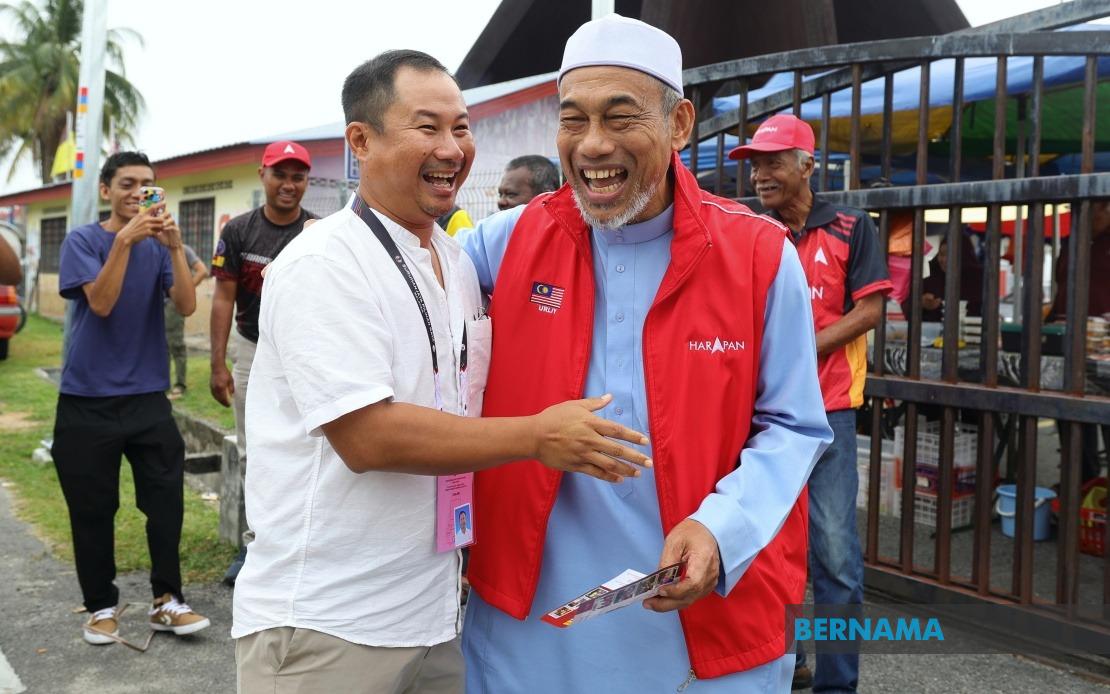
The Negeri Sembilan State Election campaign took on a notably human dimension this week when two family members encountered one another on the campaign trail in Jelebu, each pursuing the same state seat through competing political alliances. Datuk Bakri Sawir, the incumbent state representative backed by Pakatan Harapan, and Danni Rais, fielded by Perikatan Nasional, found themselves at the Kuala Klawang weekend market simultaneously, drawing curious onlookers who seized the chance to engage with both candidates as the election race intensified into its second week.
The parallel campaign appearances created an unusual scene at the bustling market venue. Voters and traders witnessed both men working the crowds independently, with some members of the public seizing photographic opportunities as the cousins traversed overlapping sections of the marketplace. What could have descended into tension instead unfolded as a surprisingly affable interaction, with both candidates maintaining separate campaign efforts while managing to share light-hearted exchanges rather than harsh rhetoric. The atmosphere remained notably composed throughout their presence, suggesting a mutual understanding about maintaining electoral decorum despite their opposing political positions.
Bakri's perspective on the familial contest reveals an approach grounded in pragmatism rather than personalising the political rivalry. In comments to the media, he deliberately downplayed any dramatic dimension to facing a cousin across the ballot, instead framing the election as a straightforward opportunity for both candidates to present their respective platforms and records to constituents. His emphasis on service delivery rather than conflict suggests a campaign philosophy focused on substantive issues affecting the Klawang electorate rather than scoring points through personal attacks or family drama that Malaysian politics sometimes generates.
The incumbent's commitment to procedural propriety underscores his messaging. When local authorities at the Jelebu District Council objected to campaign flags erected on stadium fencing, Bakri's camp immediately complied with the directive and removed the offending materials. This swift deference to regulatory authority becomes particularly significant when considered alongside his public statement linking legal respect to broader expectations of good governance. His rhetorical question—how can political leaders expect citizens to follow regulations if they themselves disregard them—articulates a principle of governmental legitimacy that resonates across Southeast Asian political discourse, where institutional credibility remains contested in many jurisdictions.
Bakri has also positioned himself as an advocate for campaign-wide discipline, explicitly calling on party machinery across the electoral field to maintain orderly conduct throughout the polling period. This appeal for systemic respect for election rules reflects awareness that individual candidate behaviour sets institutional tone. Such messaging matters in contexts like Negeri Sembilan, where state elections often involve multiple competing interests and where maintaining voter confidence in process integrity directly affects democratic legitimacy. The state's relatively compact electorate means personalised campaigning and direct voter engagement dominate, making candidate demeanour particularly consequential for public perception.
The Klawang state seat presents a three-way competitive dynamic that adds complexity beyond the simple incumbent-challenger binary. Alongside Bakri and Danni, the seat will feature Muhammad Adib Musa representing Bersatu, transforming the contest into a genuine triangular race. With 13,355 registered voters on the electoral roll, the seat represents a modest-sized constituency where personal networks and community relationships carry significant weight. The presence of three candidates means the possibility of victory without commanding a majority, introducing uncertainty into outcome predictions and potentially elevating the importance of campaign tone and voter persuasion over simple mobilisation.
The Election Commission has structured the voting process across two stages to accommodate ongoing administrative requirements. Early voting is scheduled for July 28, providing flexibility for voters with scheduling constraints or those travelling during the standard polling period. The main election day falls on August 1, giving campaigns approximately two weeks from the market encounter to consolidate support and address any outstanding voter concerns. This timeline compresses the campaign period compared to federal elections, requiring candidates to maximise their messaging efficiency and public visibility within a relatively brief window.
Negeri Sembilan's state elections occur within Malaysia's broader political context of coalition competition between Pakatan Harapan and Perikatan Nasional, with individual state contests serving as barometers for national political sentiment. Results in seats like Klawang contribute to analysts' assessments of these coalitions' comparative strength and appeal across different regional demographics. The state's Minangkabau-majority composition and relatively mixed socioeconomic profile make Negeri Sembilan results particularly instructive for understanding coalition performance among moderate-income, ethnically diverse constituencies.
The civility demonstrated between Bakri and Danni offers a counterpoint to increasingly polarised campaign environments observed elsewhere in the region. Malaysian politics has experienced periods of intense personal acrimony and inflammatory rhetoric, particularly during federal elections and campaigns involving urban constituencies. The Klawang dynamic—where cousins from opposing camps manage humour and mutual respect despite genuine electoral competition—suggests that local-level politics can sometimes sustain collegial relationships even amid partisan division. This pattern reflects how personal relationships and community bonds can moderate political conflict in smaller-scale contests.
For Negeri Sembilan voters, the Klawang choice between three distinct candidates from three major political blocs provides genuine ideological and programmatic alternatives. Bakri's incumbent record offers continuity and demonstrated state assembly experience. Danni represents Perikatan Nasional's coalition positioning and alternative governance vision. Muhammad Adib Musa's Bersatu candidacy reflects that party's complicated positioning between the two larger coalitions, neither fully aligned with Pakatan nor fully integrated into Perikatan's core structure. Voters can differentiate candidates not merely on personal grounds but on coalition affiliation and political philosophy.
The conduct of this particular campaign—characterised by procedural compliance, mutual respect, and substantive focus on service delivery—establishes standards against which Malaysian electoral politics might be evaluated. While individual candidate behaviour hardly transforms systemic challenges or addresses structural questions about representation and accountability, the demonstrated capacity for political opponents to compete vigorously while maintaining civility suggests that Malaysian democracy retains resources for managing partisan competition without sacrificing institutional respect. As results from the Negeri Sembilan State Election emerge on August 1, observers will assess not merely electoral outcomes but whether campaigns conducted with such apparent decorum translate into strengthened public confidence in democratic processes.

