Sunlight is something most of us take for granted—a daily fixture that brightens our mornings and marks the passage of seasons. But for Penang-born artist Puteri Mas Aishah Ramyusnali, this everyday phenomenon represents something far more profound: a tool for artistic creation that fundamentally transforms how we perceive our connection to the natural world. At 24, she has dedicated herself to cyanotype, an ancient photographic process that harnesses ultraviolet radiation to produce striking blue-toned images, and in doing so, has discovered a medium that challenges conventional thinking about art's role in society.
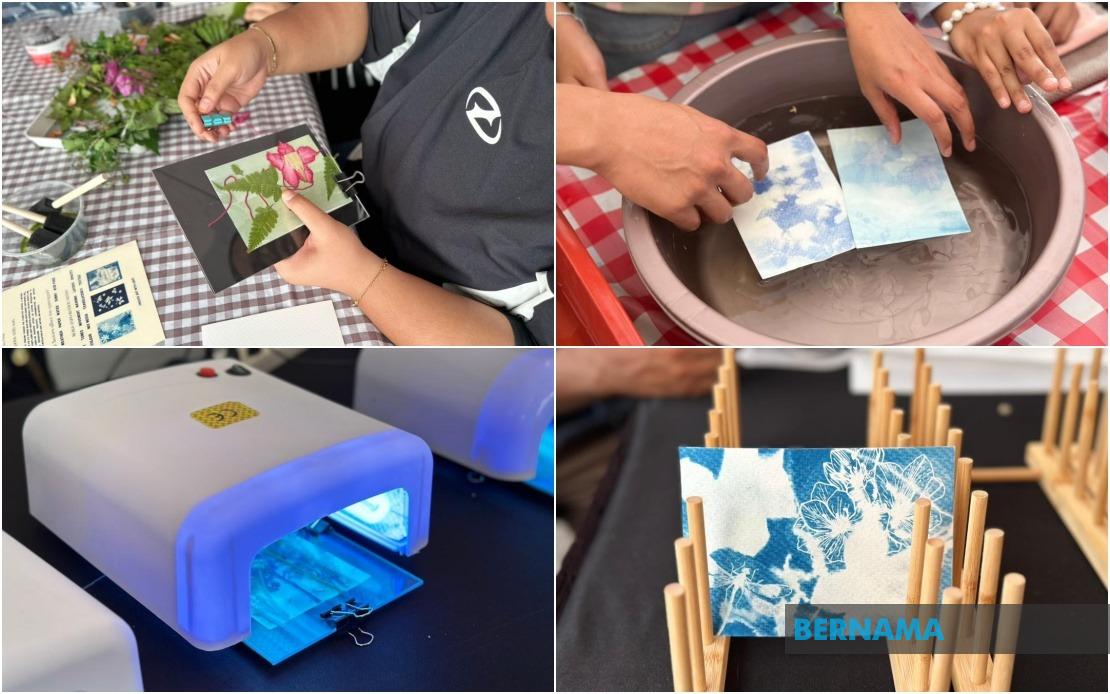
Cyanotype is a decidedly analogue craft that stands in sharp contrast to the digital image-making dominating contemporary visual culture. The process itself demands attentiveness to environmental variables that most modern creators can afford to ignore. Puteri Mas Aishah places organic materials—leaves, flowers, or other natural objects—directly onto paper coated with light-sensitive iron compounds, then exposes this arrangement to sunlight for between 10 and 15 minutes. The duration and intensity of exposure depend entirely on weather conditions and the strength of ultraviolet radiation at any given moment. After the objects are removed, the treated paper undergoes a washing sequence using acidic and alkaline solutions, gradually revealing the characteristic prussian blue impressions beneath. This methodical dance with natural forces stands as a deliberate counterpoint to instant gratification in image production.
What distinguishes Puteri Mas Aishah's approach is her recognition that cyanotype operates as more than mere technique—it functions as a philosophical framework for reconsidering humanity's relationship with environmental systems. Over the three years since she began exploring this medium, she has developed a heightened awareness of factors that shape creative outcomes yet remain invisible in most artistic practices. Weather patterns, daily UV intensity fluctuations, water quality and availability, even seasonal variations in sunlight duration—these elements now form the actual substance of her creative decision-making. Higher ultraviolet levels produce more vivid and saturated blues, while overcast skies yield softer, more muted tones. This dependency on natural conditions introduces an element of uncertainty and collaboration with nature that resists the human impulse toward complete control.
As a Master of Fine Arts and Technology student at Universiti Teknologi MARA, Puteri Mas Aishah has positioned herself at the intersection of traditional craft and contemporary academic inquiry. Her institutional context allows her to theorize the implications of her practice while maintaining hands-on engagement with the medium itself. The combination proves particularly valuable given her emerging role as a public educator. During industrial training, she discovered an unexpected calling when tasked with introducing cyanotype to general audiences through participatory workshops. Initially apprehensive about facilitating learning without direct supervision, she found that overcoming this hesitation opened doors to deeper artistic engagement. This turning point—moving from solitary practice to pedagogical responsibility—marks a significant evolution in how she understands her role within the broader creative ecosystem.
Since that pivotal experience, Puteri Mas Aishah has established herself as an active workshop facilitator and collaborative partner with art institutions across the greater Klang Valley region. She has worked with multiple studios and galleries in Shah Alam, Selangor, consistently choosing to position cyanotype not as an obscure historical footnote but as a contemporary practice relevant to present concerns about environmental sustainability and human impact. Her workshops, including one conducted as part of the RIUH Pi HAWANA Carnival at the PICCA Convention Centre in Butterworth, serve simultaneously as technical demonstrations and consciousness-raising exercises. Participants leave not merely having produced an attractive blue print, but having experienced firsthand the tangible constraints and conditions that govern creative expression when human intention must negotiate with natural systems.
The implications of this work extend well beyond the art world's conventional boundaries. In Malaysia's rapidly urbanizing context, where technological mediation increasingly distances people from direct environmental engagement, cyanotype offers something genuinely countercultural. The process demands that practitioners track weather reports not as abstract data but as practical information affecting their creative productivity. It requires them to develop patience, since results cannot be rushed or replicated precisely. It connects them viscerally to water systems, since the washing stage proves essential to image development. These seemingly technical details accumulate into a transformed consciousness regarding environmental interdependence.
Puteri Mas Aishah articulates a vision for cyanotype's social function that deserves serious consideration, particularly among younger generations increasingly skeptical of art's relevance. She explicitly hopes that young people will come to regard artistic practice as a medium for environmental connection rather than as decorative luxury. This reframing challenges the persistent cultural assumption that art occupies a marginal position in practical human concerns. Instead, she proposes that engagement with creative processes—especially those requiring attention to ecological systems—constitutes a legitimate pathway toward understanding our place within natural networks. Art becomes not something separate from everyday existence but thoroughly woven through it.
The broader context of cyanotype's contemporary revival reflects global interest in slowness, materiality, and analog alternatives to digital ubiquity. Artists and enthusiasts worldwide have rediscovered this 19th-century process, recognizing in it both aesthetic qualities and philosophical dimensions absent from pixel-based image production. However, Puteri Mas Aishah's contribution distinguishes itself through her grounding in a specifically Malaysian context and her commitment to accessibility through public workshops rather than elite artistic circles. By demonstrating cyanotype's potential to schoolchildren and community members in Penang and Selangor, she democratizes a practice that could easily remain confined to gallery spaces and academic institutions.
Moving forward, the challenge Puteri Mas Aishah faces involves sustaining momentum for this medium among younger creators while deepening the analytical frameworks supporting cyanotype's social and environmental significance. The technique itself proves sturdy and reproducible, but its proliferation depends on cultivating practitioners who understand it not as nostalgic revival but as urgent response to contemporary disconnection from natural systems. Her positioning as both artist and educator positions her well to shape this trajectory. Whether through continued workshop facilitation, collaborative projects with environmental organizations, or academic research, she possesses the combination of technical mastery and philosophical commitment necessary to transform cyanotype from curious anachronism into meaningful contemporary practice.

