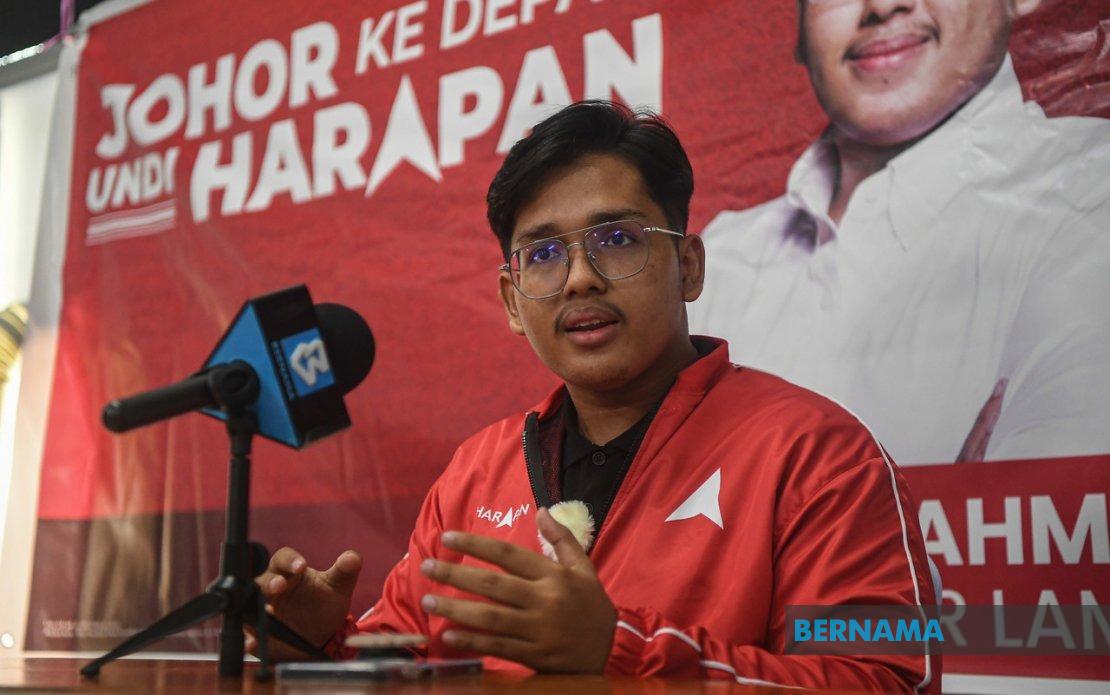
Danish Hossman Abd Rahman, Pakatan Harapan's candidate for the Johor Lama state seat, has made closing the development gap a centrepiece of his election campaign, arguing that rural constituencies like his have been systematically neglected in favour of more urbanised areas. The 23-year-old candidate is running under the banner "Wajah Baharu, Johor Lama"—A New Face, Johor Lama—and has outlined an ambitious agenda focused on economic revitalisation and attracting significant investment to stimulate local growth. His pitch appeals directly to younger constituents who currently face limited opportunities within the constituency and must seek livelihoods elsewhere.
At the heart of Danish's platform is a recognition that the Johor Lama constituency, which encompasses Felda settlements and rural communities in the Kota Tinggi area, faces a persistent employment challenge. Young people from these communities are forced to migrate to bustling urban centres such as Johor Bahru, or venture across the border into Singapore, simply to secure stable jobs. This pattern of outward migration has drained local talent and weakened community cohesion. Danish contends that bringing investment and development directly to Johor Lama would fundamentally change this calculus, allowing young people to build careers and raise families in their home villages rather than abandoning them for economic necessity.
The candidate emphasises that effective delivery of his vision hinges on strengthened coordination between state and federal governments. He argues that development initiatives often fail not because of a lack of resources or ambition, but because of fragmented governance structures where state and federal entities work at cross-purposes. By fostering deeper collaboration, Danish believes the government can implement policies and projects more smoothly and efficiently, ensuring that rural constituencies receive their fair share of infrastructure investment and economic stimulus. This emphasis on institutional coordination reflects a pragmatic understanding of how Malaysian governance actually functions.
Danish has been particularly vocal about regional disparities within Johor itself. He contends that development attention has been disproportionately concentrated on corridors such as Johor Bahru, Tebrau, and Kulai, while Felda settlements have languished comparatively neglected. This selective focus, in his view, perpetuates inequality and pushes younger residents toward the very migration patterns that weaken rural economies. His campaign effectively inverts the conventional narrative: rather than telling constituents to seek opportunity elsewhere, he is proposing that opportunity be brought home.
Beyond purely economic matters, Danish has identified a practical administrative shortcoming that affects daily life in the constituency. Kota Tinggi currently lacks an Immigration Department branch office, forcing residents to undertake time-consuming journeys to Johor Bahru, Kulai, or Mersing for routine passport applications and immigration services. This bureaucratic inconvenience, while seemingly minor, reflects broader neglect of the area's administrative infrastructure. Establishing a dedicated immigration centre locally would streamline processes, reduce travel costs and time burdens, and signal that the government recognises Kota Tinggi as worthy of essential public facilities. Danish's proposal addresses a concrete grievance that resonates with everyday experience.
From a campaign mechanics perspective, Danish is deploying a hybrid strategy that blends traditional grassroots engagement with digital outreach. He maintains regular face-to-face contact with constituents, attending community gatherings and listening directly to local concerns—an approach that builds personal relationships and trust. Simultaneously, he is leveraging social media platforms to amplify his message and reach the 32,000 voters in the Johor Lama constituency more broadly. This two-channel method recognises that Malaysian voters, especially younger ones, inhabit both physical and digital spaces, and effective campaigning must meet them in both.
Social media feedback has apparently been encouraging, suggesting that his messaging around youth employment and rural development is resonating with constituents. The digital component of his campaign allows rapid iteration and direct interaction with voters without the filter of traditional media gatekeeping. For a 23-year-old candidate, digital fluency is a natural advantage, and Danish is using it to project an image of freshness and accessibility that contrasts with older political machinery.
The Johor Lama contest has shaped up as a three-way race, with Danish facing incumbent Norlizah Noh of Barisan Nasional and Aisah Esa representing Perikatan Nasional. This configuration means the contest is genuinely competitive, with victory potentially available to any of the three candidates depending on how effectively each mobilises their base and persuades swing voters. For Danish, the challenge is converting his appeal to younger voters and his specific development proposals into sufficient electoral support to overcome incumbency advantage and the residual organisational strength of the two established coalitions.
The wider context of the 16th Johor state election, scheduled for July 11, adds significance to contests like Johor Lama. State elections in Johor carry implications for federal politics, as results here can shift momentum and perceptions ahead of potential national elections. A strong showing by PH in rural constituencies like Johor Lama would suggest the coalition is successfully broadening its appeal beyond urban centres, a critical requirement for any future national victory. Conversely, weakness in such seats would indicate that PH remains geographically concentrated and vulnerable to Barisan Nasional's traditional strength in rural areas.
Danish's campaign thus operates on multiple levels simultaneously: as a local contest for the Johor Lama seat; as a test of PH's capacity to compete in rural Johor; and as a data point in the broader national political landscape. His emphasis on bringing investment and employment to neglected rural communities, while addressing practical administrative gaps, speaks to genuine grievances that extend beyond his constituency. If his messaging and approach prove successful, they may offer a template for how opposition parties can effectively challenge incumbent governments at the state level by focusing on concrete, locally relevant issues rather than abstract national narratives.

