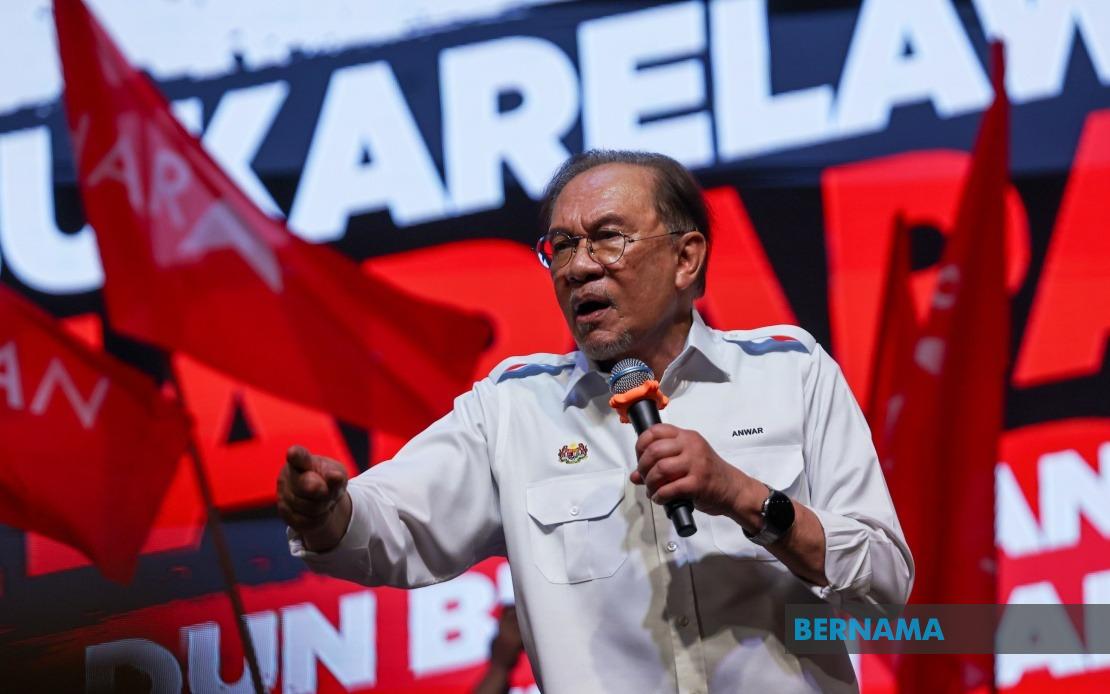
Prime Minister Datuk Seri Anwar Ibrahim moved to counter a persistent political narrative this week, asserting that the Democratic Action Party has consistently upheld the constitutional rights of the Malay community despite accusations from rival quarters suggesting otherwise. Speaking at a grassroots gathering in Muar, Anwar rejected characterisations of DAP as a racially discriminatory organisation, framing instead the party's record of cooperation within the ruling coalition as evidence of genuine commitment to Malaysia's plural society. The remarks came as the Unity Government attempts to consolidate support ahead of the July 11 Johor state election, in which 172 candidates are vying for 56 assembly seats.
Anwar, who leads both the coalition and DAP's primary partner Pakatan Harapan, grounded his defence in concrete policy examples. He highlighted DAP's absence of objection to the government's gazettal of 20.23 hectares in Bandar Malaysia as Malay Reserve Land—a tangible instance of the party not obstructing protections enshrined in the federal constitution. This example carries particular weight in Malaysian politics, where disputes over Bumiputera privileges and land rights remain emotionally charged and electorally significant, especially in states like Johor with substantial Malay-Muslim majorities. By citing this specific instance, Anwar sought to demonstrate that DAP's multiracial positioning does not translate into active opposition to traditional communal safeguards.
The Prime Minister's broader argument centred on his vision of equitable governance transcending communal divisions. He acknowledged that the government continues expanding support for Bumiputera entrepreneurship through vehicles like Perbadanan Usahawan Nasional Berhad, and that DAP raises no objection to these initiatives. Yet he stressed his simultaneous obligation to ensure that development programmes benefiting other communities—particularly impoverished Chinese and Indian Malaysians—are neither blocked nor marginalised. This framing presents inclusive development not as a zero-sum competition where one community's gain necessitates another's loss, but as a governing philosophy capable of advancing multiple constituencies simultaneously.
Anwar articulated a vision of development that extends beyond narrow communal benefit to encompass shared national prosperity. He emphasised that economic expansion, whilst measurable in growth statistics, must translate into tangible improvements in living standards across Malaysian society. Housing security, commercial infrastructure for small traders, foundational public services, and educational quality emerge in his discourse as concerns transcending ethnic or religious boundaries. The Prime Minister suggested that Malaysia's current economic momentum presents an opportunity to distribute gains more equitably, resisting the concentration of wealth among political elites and their connected interests.
Central to Anwar's address was a moral dimension to political leadership rarely articulated in contemporary Malaysian politics. He explicitly cautioned younger Malaysians against viewing political office as a pathway to personal enrichment or the accumulation of private advantage. Instead, he reframed politics as a service vocation demanding ethical stewardship of public power. This rhetorical move attempts to elevate political discourse above transactional calculations and communal self-interest, appealing to younger voters and civil society actors increasingly skeptical of patronage-driven politics. Whether such messaging resonates amid Malaysia's ingrained patron-client networks remains uncertain.
The timing of Anwar's intervention reflects the electoral pressures facing the Unity Government in Johor, traditionally a stronghold of the opposition Barisan Nasional coalition. Johor's political complexion—with a Malay-Muslim majority exceeding 70 percent—makes messaging around Malay and Islamic rights particularly consequential. Recent weeks have witnessed intensified attempts by opposition parties to portray the DAP-led PH component as indifferent or hostile to Bumiputera interests, a narrative that gains particular traction in states where Malays constitute overwhelming demographic majorities. Anwar's defence thus serves dual purposes: reassuring the broader coalition of DAP's bona fides whilst simultaneously inoculating government candidates against charges of communal insensitivity.
The Bandar Malaysia land gazettal carries additional symbolic weight beyond its immediate acreage. The development represents a high-profile urban project with substantial financial commitments and international visibility, making it a legitimate subject of political contestation. DAP's acquiescence to Malay Reserve designations within this context signals pragmatic acceptance of constitutional frameworks that some party members have historically questioned. For opposition critics, such acquiescence demonstrates DAP's true powerlessness within the coalition; for government supporters, it illustrates principled commitment to constitutional pluralism.
Anwar's emphasis on economic distribution reflects genuine challenges confronting the Malaysian government as growth rates have slowed from pandemic-era rebounds and inflationary pressures continue eroding purchasing power. Public perceptions of inequality, whilst not uniformly measured, inform voter sentiment across demographic groups. The Prime Minister's framing suggests that shared prosperity, rather than communal redistribution, offers the most politically sustainable path to governance legitimacy. This approach implicitly challenges opposition narratives of zero-sum ethnic competition whilst potentially alienating constituencies believing their communal interests demand prioritisation.
The Johor state election serves as a crucial barometer for Unity Government stability and electoral viability ahead of the 2025 general election cycle. A strong performance would validate Anwar's inclusive governance model and demonstrate DAP's acceptability to peninsular Malaysian voters; conversely, significant losses might embolden those questioning the coalition's coherence. Early voting commences July 7, with the main poll scheduled for July 11, offering preliminary indicators of voter sentiment within days. The constituency-level results will reveal whether Anwar's framing of multiracial development and constitutional acceptance translates into sufficient support across Johor's diverse electorate to sustain government control.

