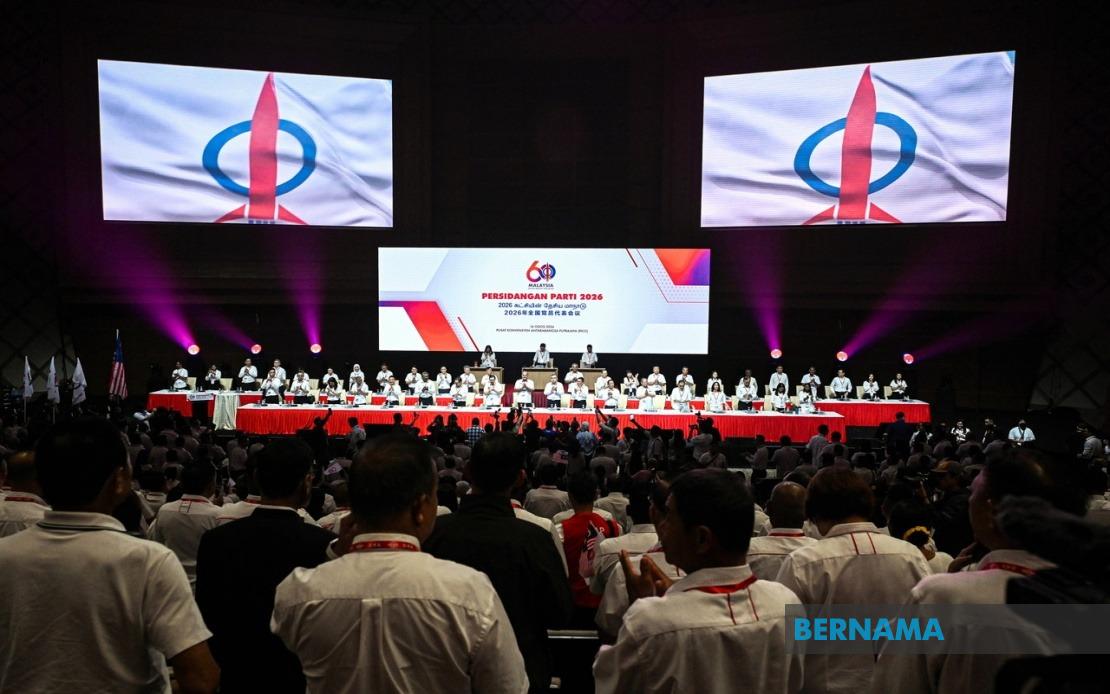
The Democratic Action Party has received substantial grassroots backing for its continued role within the Unity Government coalition, as delegates gathered at its national conference in Putrajaya underscored the party's commitment to institutional reform and governance. This endorsement came during a pivotal debate at the DAP 2026 National Conference held at Putrajaya International Convention Centre, where fourteen representatives from different states articulated their reasoning for maintaining the party's position within Prime Minister Datuk Seri Anwar Ibrahim's administration. The motion to remain in federal government through the end of the 16th parliamentary term represents a critical decision point for the party, one that carries implications for the broader Pakatan Harapan coalition and Malaysia's political trajectory in the coming years.
The delegates who voiced their support emphasized that departure from government would undermine the mandate granted by voters during the most recent general election. Their arguments centred on the practical reality that meaningful reform requires access to executive power and legislative authority. Perak delegate Jason Ng Thien Yong articulated this perspective directly, noting that despite setbacks in certain state-level contests, maintaining a position within the federal administration allows the party to implement substantive changes to Malaysia's institutions. This reasoning reflects a pragmatic calculation that electoral losses at state level do not necessarily justify abandoning the machinery of national governance, particularly when critical reforms remain incomplete.
The cost-of-living challenge emerged as a significant motivation for continued participation, with delegates viewing sustained government involvement as essential for advancing policies designed to ease the financial burden on Malaysian households. Combined with commitments to combat corruption and protect minority rights within Malaysia's multi-racial framework, these policy objectives appeared to resonate with the delegates as achievable only through continued governmental presence. The emphasis on maintaining policy stability also touched on fears that early withdrawal could trigger premature elections or political uncertainty, outcomes which delegates suggested would prove damaging to both the country and the party itself.
Pahang veteran Leong Ngah Ngah appealed to delegates to adopt a mature perspective when weighing the decision, characterizing the Unity Government's three-year track record as substantively successful in delivering reforms that had been promised to voters. This framing positioned continued participation as both strategically sound and ethically defensible, given the government's demonstrated achievements in institutional renewal. The argument carried implicit weight given Leong's standing as an elder statesman within the party, suggesting that experience and institutional memory favoured continuation rather than withdrawal.
Selangor delegate Muhammad Shakir Amerr Mohideen brought a forward-looking element to the discussion, expressing confidence that quality governance performance could help DAP recover electoral ground lost in previous state contests. This reflected optimism that voters respond positively to effective administration and visible delivery on commitments, even when short-term electoral fortunes have proven challenging. By extension, this logic suggested that maintaining visibility and responsibility within a functioning government offered better prospects for restoring voter confidence than opposition posturing might provide.
Melaka's Jason Tze-Xi Nathan introduced a communications dimension to the debate, suggesting that remaining in government proved easier to justify to constituents than explaining a withdrawal would be. This speaks to the political difficulty of explaining coalition departure to ordinary citizens who may hold mixed views about government performance and the party's role within it. The optics of abandoning executive responsibility, particularly when critics might characterize it as self-interested or strategic rather than principled, presented reputational risks that appeared to weigh on delegates' thinking.
The territorial dimension of DAP's coalition role received attention when Sabah delegate Yap Wui Lip stressed the importance of advocating for Malaysia Agreement 1963 rights implementation while remaining within government structures. This framing positioned DAP's continued participation as compatible with vigorous advocacy for regional autonomy and indigenous rights protections, suggesting that the party need not remain silent on contentious issues simply by virtue of governmental membership. The argument implied that constructive engagement from within coalitions could prove more effective than principled opposition from outside.
Across the party's strongholds and weaker territories alike, the geographic breadth of supporting delegates—representing Kelantan, Terengganu, Sarawak, Kedah, Negeri Sembilan, Johor, Kuala Lumpur, Perlis, and Penang—indicated that support transcended regional divisions or factional interests. This distribution suggested genuine conviction rather than concentrated support from particular state organizations, lending weight to the narrative that grassroots sentiment favoured continuation.
Secretary-General Anthony Loke's closing remarks carefully calibrated expectations around the party's likely vote. He characterized approval for remaining in government as conditional rather than absolute, explicitly stating that continued participation would not constitute a blank cheque to either the Central Supreme Committee or the Prime Minister. This framing attempted to preserve the party's capacity for internal criticism and reform advocacy even should delegates vote for continuation, suggesting that DAP understood its role as constructive agent rather than passive partner.
The formal voting process would involve all 4,264 delegates representing 1,704 eligible party branches, employing secret ballot procedures to protect individual delegate preferences from pressure or scrutiny. This scale of participation, combined with the secret voting mechanism, lent legitimacy to whatever outcome emerged, whether continuation or withdrawal. The timing of this conference coincided with DAP's 60th anniversary celebrations, a context that invited reflection on the party's historical trajectory and its role within the broader Pakatan Harapan coalition alongside PKR and Amanah.
For Malaysian political observers and regional analysts, the apparent delegate support for continued government participation carries significance beyond DAP's internal dynamics. The decision affects the stability of the Unity Government administration, influences the timing and context of the next general election, and shapes the competitive positioning of the major coalitions as Malaysia approaches the mid-point of the parliamentary term. Maintenance of coalition cohesion becomes increasingly valuable as 2025 transitions to 2026, the latter representing a potential election year depending on Prime Minister Anwar's strategic calculations.
The delegates' evident concern about premature elections reflected broader anxieties about political instability and its economic consequences, concerns that would resonate across Malaysia's business community and among voters exhausted by prolonged political contestation. By voting to remain in government through the full term, DAP would signal commitment to completing its reform agenda and allowing the Unity Government administration sufficient time to demonstrate its full programme's results to voters before facing renewed electoral judgment.

