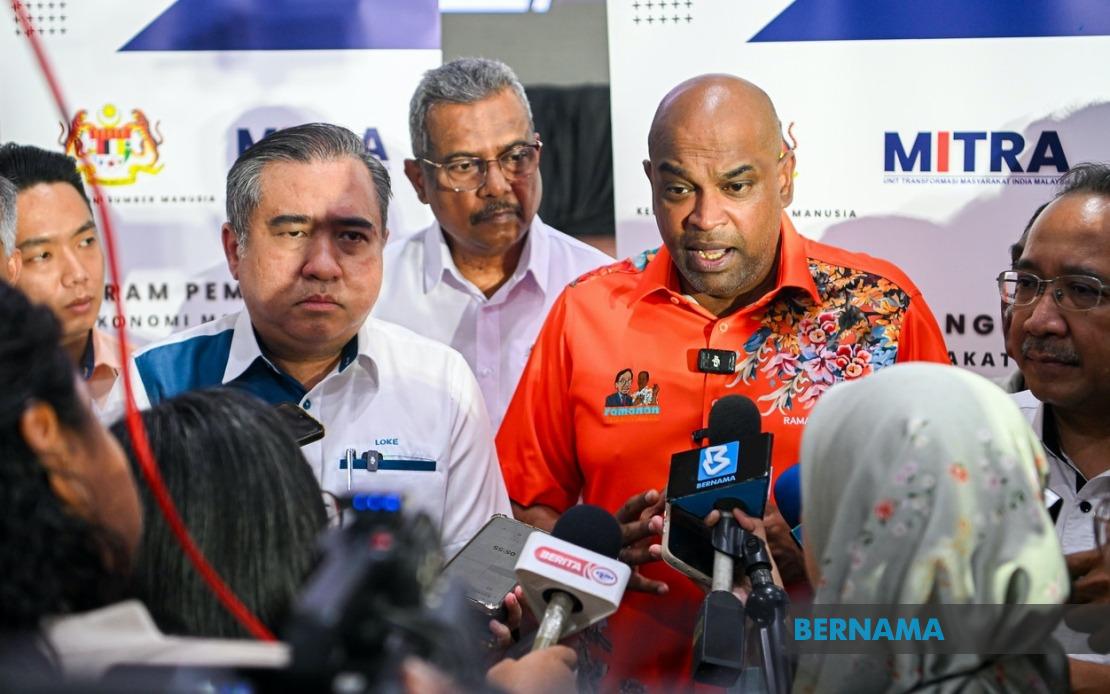
Transport Minister Anthony Loke has pushed back firmly against longstanding allegations that the Democratic Action Party exercises undue influence over the government's direction, characterising such claims as a worn political tactic designed to undermine public confidence in the Pakatan Harapan coalition. Speaking in Seremban on July 7, the DAP secretary-general clarified that decision-making processes at both federal and state levels operate through structured consultation among all coalition component parties rather than dictation by any single organisation.
Loke's remarks come amid a pattern of opposition rhetoric accusing the government of operating under DAP control—a narrative that has persisted since Pakatan Harapan took office. The Transport Minister suggested that critics resort to this particular charge because they lack substantive policy grievances to raise. He indicated that the coalitional framework inherently accommodates diverse perspectives and that every partner organisation participates actively in shaping the government's agenda.
According to Loke, the federal administration ensures that UMNO, PKR, and DAP all have opportunities to articulate their positions before Prime Minister Datuk Seri Anwar Ibrahim renders final decisions. This consultative arrangement reflects the nature of coalition governance, where no single party possesses absolute authority. The Transport Minister emphasised that while each coalition member voices its concerns and policy preferences, ultimate decision-making authority rests with the Prime Minister rather than devolving to individual parties.
The same collaborative model, Loke explained, extends to Negeri Sembilan's state administration under Menteri Besar Datuk Seri Aminuddin Harun. In both spheres of government, coalition partners are granted meaningful input before policy positions become finalised. This consistency between federal and state governance arrangements underscores the coalition's commitment to inclusive decision-making across its territorial jurisdiction.
Loke simultaneously addressed another recurring political grievance: claims that Malay interests face jeopardy under Pakatan Harapan rule. He rejected such assertions as another recycled political strategy, arguing that Negeri Sembilan's governance record directly contradicts this narrative. The state continues under Malay leadership, with the Menteri Besar position held by a member of the Malay community, contradicting the premise that the coalition marginalises traditional Malay political influence.
Furthermore, Loke contended that government policies and programmes implemented since Pakatan Harapan assumed state administration in 2018 have consistently prioritised the interests of all communities, including the Malay population. The protection of communal interests operates across multiple policy domains—economic, social, and educational—rather than abandoning any particular group to negligence or deliberate harm. The Transport Minister challenged his critics to identify specific instances where Malay welfare or institutional protections have deteriorated under the current arrangement.
The dispute over DAP's supposed influence reflects deeper anxieties within Malaysian politics regarding the balance of power within multiethnic governance coalitions. Opposition parties have weaponised the allegation that non-Malay parties dominate decision-making as a mechanism for mobilising Malay-Muslim constituencies. By repeatedly deploying this accusation, critics attempt to suggest that traditional Malay-centric political structures have eroded, even when institutional evidence suggests otherwise.
Loke's response demonstrates the coalition's defensive position against what it characterises as bad-faith political attacks. Rather than accepting the premise that coalition governance inevitably privileges certain partners over others, he reframes the discussion around consultative processes and collective responsibility. This rhetorical strategy aims to present the coalition as fundamentally inclusive rather than hierarchical, thereby neutralising arguments that particular communities face systematic marginalisation.
The exchange also illuminates tensions within Malaysia's post-2018 political landscape, where established power structures have genuinely shifted but where perceptions of change frequently outpace or distort factual developments. The presence of DAP within the federal government represents a genuine departure from pre-2018 configurations, yet this structural reality does not necessarily translate into the dominance some claim. Loke's insistence that consultative processes determine outcomes rather than unilateral party control suggests that coalitional mathematics create complexity that simple accusations of DAP supremacy fail to capture.
From a Malaysian political perspective, these recurrent allegations and counter-allegations reflect the broader challenge of sustaining multiethnic coalitions while addressing communal anxieties about representation and influence. Opposition parties leverage Malay concerns about DAP participation to construct electoral narratives, while Pakatan Harapan emphasises institutional safeguards and consultative processes to demonstrate that genuine power-sharing operates in practice. Loke's remarks represent an attempt to reshape public understanding of how the coalition actually functions, moving discussion away from partisan accusations toward institutional analysis.

