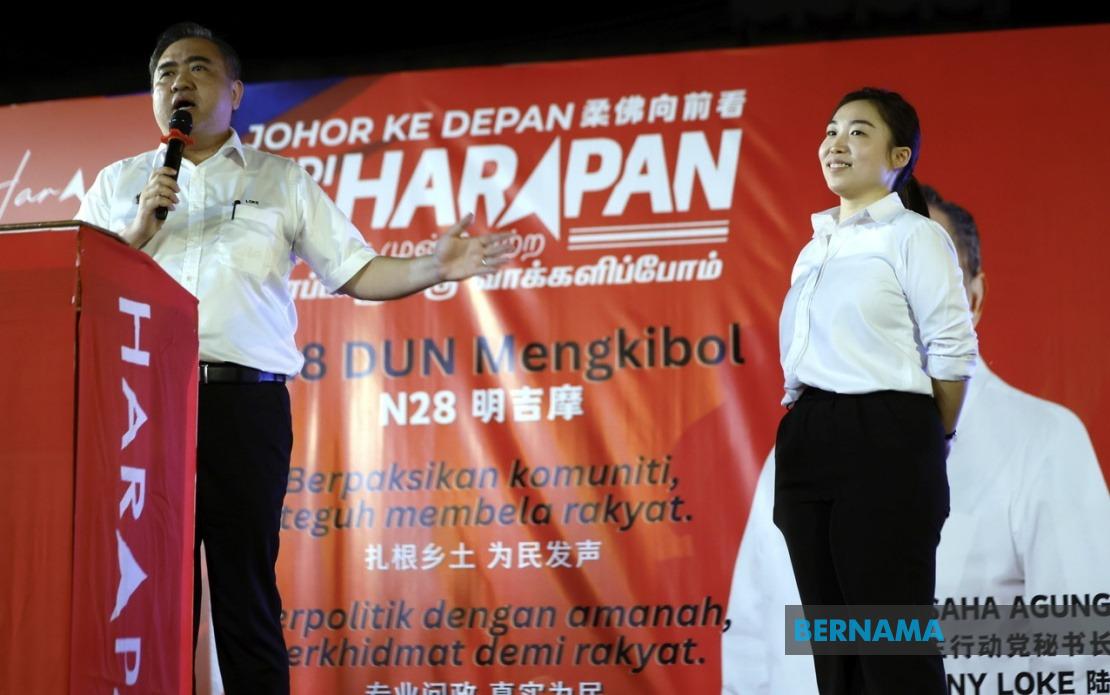
The Democratic Action Party has tapped Chu Poh Yee, a 33-year-old lawyer, to contest the Mengkibol state assembly seat in the upcoming Johor state election. The announcement, made at a ceremony in Kluang on June 18, signals a strategic shift for the party in one of its traditionally held constituencies, as it looks to inject fresh momentum into its campaign across the southern state.
Chu's nomination comes as the party moves incumbent assemblyman Chew Chong Sin upward in its political pipeline. Chew, who has represented Mengkibol for two consecutive terms, will step aside from the state seat to pursue a parliamentary candidacy. DAP party secretary-general Anthony Loke revealed that party strategists have identified Chew as a strong potential parliamentary contender, particularly given that the current Labis MP, Pang Hok Liong, has signalled his intention to retire from electoral politics. This arrangement reflects a calculated effort by DAP's central leadership to retain the incumbent's experience at a higher level of government whilst simultaneously introducing new representation at the state level.
The selection of Chu underscores the party's stated commitment to enhancing female representation within its candidate slate. Loke emphasised that the party leadership had reached unanimous agreement on her nomination, describing her as possessing compelling credentials that align with DAP's electoral strategy in Johor. Her background in legal practice, particularly her involvement in assisting local elected representatives with legal aid matters, provided party officials with confidence in her ability to serve constituent interests.
Loke highlighted Chu's educational pedigree and linguistic capabilities as significant assets for her candidacy. He stressed that her fluency across multiple languages would enable her to communicate effectively with the ethnically diverse electorate of Mengkibol. More substantively, Loke underscored that Chu maintains deep personal and community ties to the constituency, a factor the party leadership evidently views as crucial for electoral viability. This combination of professional competence, linguistic skill, and local rootedness suggests DAP believes it can consolidate support in a seat it has held, whilst simultaneously addressing broader party objectives around gender balance.
The announcement forms part of a broader candidate selection process that has consumed considerable internal deliberation within DAP's Johor machinery. Loke confirmed that the party's candidate selection committee has now finalised its list of nominees for the 17 state seats it will contest across Johor. This portfolio comprises a mixture of defensive and offensive strategic plays: ten seats currently held by DAP incumbents including Mengkibol, four seats previously lost to rival parties that the party believes it can recapture, and three additional constituencies representing new target areas for DAP expansion.
The cadence of candidate announcements will unfold across several phases, revealing the party's phased communication strategy as it builds momentum toward polling day. Loke stated that four additional candidates would be unveiled the following Saturday for the seats of Tiram, Johor Jaya, Senai and Bukit Permai. This measured approach to candidate disclosure allows DAP to maintain media attention and sustain public engagement with its campaign narrative across successive news cycles, preventing a single announcement from saturating coverage.
The remaining slate of candidates will be presented jointly with the broader Pakatan Harapan coalition's nominees, a move coordinated through Prime Minister's Office. This orchestrated announcement represents the culmination of intensive inter-party negotiation within the PH alliance, where coalition partners have sought to divide constituencies to maximise combined electoral prospects whilst minimising internal conflict over seat allocation. The involvement of the Prime Minister in the final candidate rollout signals the national significance attached to the Johor state election, particularly given that Johor remains a significant political battleground in Malaysia's competitive electoral landscape.
For Chu Poh Yee personally, her emergence as a candidate represents a transition from behind-the-scenes legal work supporting elected representatives to frontline electoral competition. Her professional experience in handling legal aid cases alongside her educational credentials position her as an intellectually credible candidate capable of articulating policy positions on governance and public service delivery. Whether this profile resonates with voters across Mengkibol's diverse precincts will become apparent once campaigning intensifies following official polling date announcement.
The broader significance of this candidacy selection extends beyond a single constituency contest. DAP's deliberate emphasis on Chu's gender in framing her nomination reflects evolving internal party culture around women's political participation and representation. Malaysian political parties have faced persistent criticism regarding the limited promotion of female candidates, with women consistently underrepresented in state and federal legislative bodies. By foregrounding Chu's candidacy as an example of the party's commitment to gender balance, DAP signals responsiveness to calls for greater women's political participation, even as the party contests seventeen of Johor's considerably larger total of state seats.
The strategic elevation of Chew to parliamentary consideration also carries implications for DAP's broader positioning within Johor politics. By identifying strong state-level performers and channelling them toward federal-level candidacies, the party demonstrates confidence in the depth of its talent pool and its ability to project influence beyond individual constituencies. This approach, if successful, could establish a pattern of political advancement that enhances the party's long-term institutional strength across multiple electoral tiers.
As the Johor state election campaign enters its substantive phase with candidates now being formally announced, voters across constituencies like Mengkibol face choices between incumbent and challenger candidates offering contrasting visions of governance and representation. The election itself will test whether voters favour continuity with experienced representatives, as with Chew at the federal level, or prefer fresh perspectives and new candidates aligned with evolving party strategies. The outcomes across Johor's seventeen contested seats will significantly influence the overall composition of the state assembly and the distribution of political power across the peninsula's most populous state.

