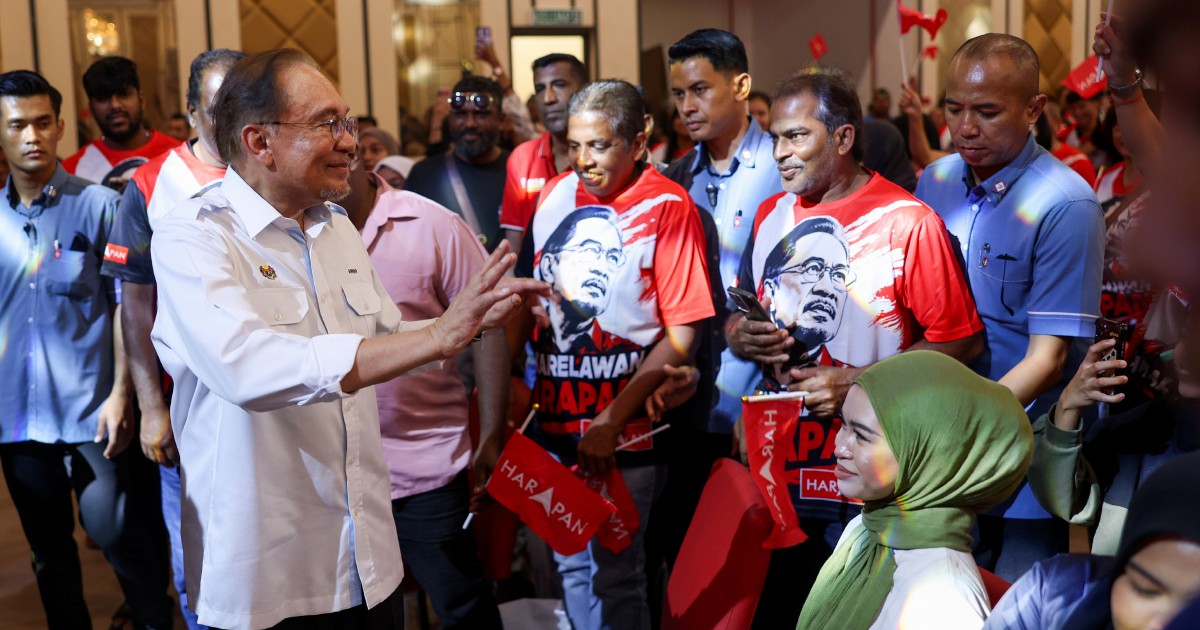
Prime Minister Datuk Seri Anwar Ibrahim moved to counter persistent criticism of the Democratic Action Party during remarks in Muar, defending the predominantly Chinese party by emphasising its historical respect for constitutional protections affecting the Malay-Muslim majority. His intervention reflects ongoing sensitivities within Malaysia's political landscape regarding the role of non-Malay-Muslim parties in governance, a debate that has intensified since the formation of the unity administration following the 2022 general election.
Anwar's defence of DAP carries particular weight given his position as head of a coalition that brings together parties with historically divergent constituencies and ideological orientations. The Prime Minister sought to address concerns circulated among segments of the electorate questioning whether non-Malay-Muslim participation in cabinet-level governance might undermine constitutional provisions enshrined in Article 153 of the Federal Constitution. These provisions grant special rights to Malays and Bumiputeras, including reserved places in the civil service, educational institutions, and commercial opportunities, arrangements that have been foundational to Malaysia's post-independence social contract.
The timing of Anwar's remarks underscores a consistent communication challenge facing the unity coalition. Throughout the administration's tenure, opposition figures and certain political commentators have periodically raised allegations that DAP, as the largest non-Malay party in Parliament, harbours agenda incompatible with constitutional protections. These claims, though rejected by DAP leadership repeatedly, continue to circulate particularly among rural constituencies and within social media discourse, suggesting residual anxieties about minority representation in positions of influence.
Anwar's explicit statement that DAP has never disputed Malay rights represents a calibrated reassurance directed at sceptical voters who may harbour concerns about the coalition arrangement. Rather than engaging in defensive posturing, the Prime Minister chose to anchor his argument in the factual record, implying that scrutiny of DAP's actual positions and legislative conduct would reveal no fundamental conflict with constitutional guarantees. This approach reflects confidence that the party's historical behaviour and current institutional role can withstand scrutiny among informed observers.
The unity government framework itself has been predicated on precisely this kind of consensus, with participating parties accepting Malaysia's constitutional settlement as a non-negotiable foundation. DAP's participation in successive administrations, including ministerial appointments with responsibility for economic and development portfolios, has proceeded without formal attempts to modify constitutional provisions affecting Malay-Muslim interests. This continuity may be what Anwar was signalling when emphasising that respectful coexistence remains achievable within the existing constitutional architecture.
For Malaysian readers accustomed to periodic eruptions of racial and religious tension in political discourse, Anwar's comments carry significance beyond the immediate political calculation. His willingness to vocally defend a non-Malay-Muslim party against character attacks, rather than allowing such criticism to fester unchallenged, represents a normative choice about how inter-communal politics should operate. The statement implicitly argues that substantive policy disagreements need not transform into questions about fundamental loyalty or commitment to constitutional arrangements.
The broader implications extend to Southeast Asia's wider experience with multi-ethnic governance. Malaysia's constitutional settlement, while contested, has proven more durable than comparable arrangements in neighbouring countries. The unity government's capacity to function despite ideological differences and historical antagonisms between component parties may demonstrate that consensus on constitutional fundamentals can accommodate tactical and policy disagreements. For regional observers, this suggests that explicit recommitment to foundational constitutional principles may be necessary for inclusive coalitions to operate effectively.
Anwar's remarks also reflect the practical reality that any government seeking to address Malaysia's mounting economic challenges cannot afford prolonged intercommunal tension. The coalition partners, regardless of their different constituencies and historical positions, must present sufficient unity to execute complex economic and fiscal policies. DAP's participation in economic decision-making, whether in parliament or through ministerial portfolios, involves substantive engagement with questions affecting all communities. Excluding or marginalising non-Malay parties from such discussions would arguably produce inferior policy outcomes while intensifying communal resentment.
The defence of DAP simultaneously conveys a message about governance standards that Anwar appears committed to maintaining. By insisting that accusation of racism must be grounded in actual evidence of policy positions or conduct, rather than accepted based on rhetorical assertion, he establishes boundaries around acceptable political discourse. This normative claim—that political debate should engage facts rather than unfounded character attacks—extends beyond the immediate subject of DAP's intentions and speaks to institutional expectations the administration wishes to establish.
Critical observers might note that Anwar's statement, while addressing one dimension of coalition tensions, does not fully address persistent questions about policy influence or decision-making processes within the government. Clarifying whether constitutional guarantees remain truly inviolable despite DAP's presence, and establishing transparent mechanisms for handling issues that touch on communal interests, might provide more concrete reassurance than assertions about the party's past record. Nevertheless, his public reaffirmation that all coalition partners remain committed to Malaysia's constitutional settlement serves as an important anchoring statement for a government navigating complex inter-communal dynamics.
Moving forward, sustaining the unity coalition's legitimacy likely depends on continued articulation of these principles, combined with visible commitment to honouring constitutional protections and ensuring that all communities perceive the government as dealing fairly with their interests. Anwar's intervention suggests recognition that such affirmation cannot be taken as automatic but requires periodic reinforcement, particularly when political opponents actively seek to exploit or exacerbate communal sensitivities.

