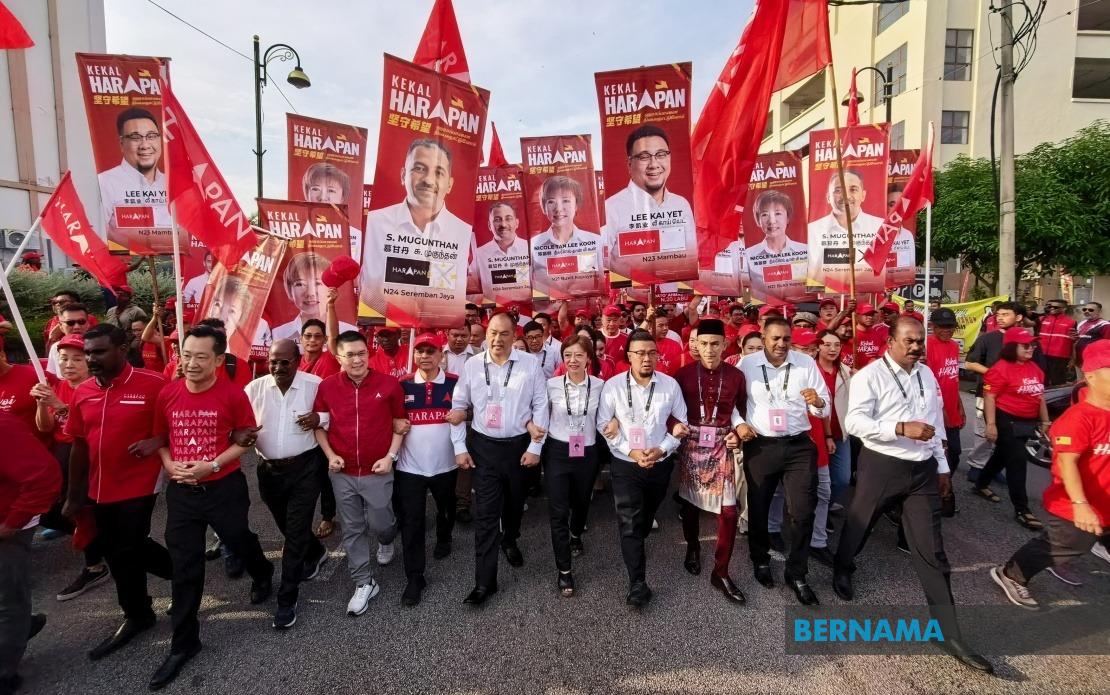
The political contest in Negeri Sembilan is intensifying as nominations close for the 16th state election, with the Rahang constituency emerging as a particularly crowded battleground. Siaw Meow Keong, the Negeri Sembilan DAP treasurer who has represented the seat since 2023, will seek to retain his position through a four-cornered contest involving representatives from across the political spectrum. The nomination deadline, which concluded at the Seremban City Council Hall this morning, confirmed a diverse field of challengers that reflects the complex electoral landscape now dominating Malaysian state politics.
Packatan Harapan has reposed its confidence in Siaw to defend the constituency against a notably competitive set of opponents. Ranged against the incumbent are Yap Siok Moy, the Rasah MCA Wanita chief representing Barisan Nasional, S. Thinagaran fielded by Parti Sosialis Malaysia, and Tang Jay San contesting for Bersatu. The sequence in which candidates filed their nomination papers—with Thinagaran at 9.06 am, Tang at 9.10 am, Siaw at 9.12 am, and Yap at 9.13 am—reveals the intensity of last-minute preparations as the formal nomination window closed. Returning officer Mohamad Najib Mustafa oversaw the process, which lasted precisely one hour before announcing the final roster of eligible contestants.
Rahang's four-way contest exemplifies a broader fragmentation in Negeri Sembilan's electoral environment, where no single coalition can assume dominance. The addition of Bersatu, which has increasingly emerged as an independent force in state politics across Malaysia, signals the shifting alliances that have characterised the post-2018 political realignment. The presence of PSM in this particular race further demonstrates how smaller parties are attempting to carve out space in constituencies where mainstream coalitions appear vulnerable or where specific demographic or community interests warrant alternative representation.
Elsewhere in Negeri Sembilan, the competition takes different forms reflecting local political dynamics. In Bukit Kepayang, Nicole Tan Lee Koon, who leads the DAP's Wanita wing in the state and is the sitting representative, faces a direct bilateral confrontation with Lee Boon Shian of Perikatan Nasional. This straight fight represents a starker choice for voters compared to multi-sided contests, potentially reshaping how campaign strategies develop in that constituency. The absence of a Bersatu or BN challenger in Bukit Kepayang suggests either local negotiation between non-PH parties or calculations about resource allocation in an increasingly crowded electoral calendar.
Three additional constituencies will witness three-cornered battles that showcase the intricate interplay of competing interests. In Labu, PH's Datuk Ahmad Faez Abdul Razak must contend simultaneously with Mohamad Hanifah Abu Baker of Bersatu and Siti Nur Umaira Hasim representing Barisan Nasional. Mambau presents an equally complex scenario, where PH's Lee Kai Yet faces challenges from Bersatu's N. Sarawanan and Perikatan Nasional's Eric Michael. The Seremban Jaya constituency rounds out this pattern, with PH's S. Mugunthan opposing Datuk T. R. Thinalan of BN and R. Mahendran of Bersatu in another three-way split.
The fragmentation across multiple constituencies indicates a state election where no outcome can be predetermined by standard coalition arithmetic. For Malaysian political observers, Negeri Sembilan's situation reflects the broader destabilisation of the two-bloc system that dominated national politics through the 1990s and 2000s. The rise of Bersatu as a force competing separately from both Pakatan Harapan and Barisan Nasional, combined with Perikatan Nasional's continued independent positioning, means that even in state elections, voters face genuinely complex choices rather than simple coalition-based decisions.
The electoral commission has scheduled early voting for July 28, with the main polling day set for August 1. This timeline provides candidates with a compressed campaign period of approximately two weeks to mobilise support and communicate with constituents. In an era of social media and rapid information dissemination, this condensed schedule may advantage candidates with well-established local networks and substantial financial resources for targeted digital outreach. For smaller parties like PSM, the brief window presents particular challenges in gaining visibility against better-funded competitors.
From a regional perspective, the Negeri Sembilan election carries implications beyond the state itself. The results will offer indicators of voter sentiment toward current coalitional arrangements and whether the Perikatan Nasional framework has achieved meaningful traction in peninsular states where Pakatan Harapan remains competitive. The performance of Bersatu in multiple constituencies will be particularly scrutinised, as the party continues calibrating its position within the broader political ecosystem. Should BN demonstrate unexpected strength in three-cornered contests, it would suggest the opposition coalition's support base may be more fragmented than recent polling suggests.
For Malaysian readers outside Negeri Sembilan, this state election serves as an important bellwether. The state has historically demonstrated political volatility and voter responsiveness to changing circumstances, making it a valuable microcosm for understanding longer-term trends in Malaysian electoral behaviour. The outcome could influence calculations about future coalition arrangements at the national level and provide evidence regarding whether the current political configuration can command stable voter support or whether further realignment remains likely.
The four-cornered and three-cornered contests further illustrate how Malaysian electoral dynamics have fundamentally transformed since 2020. Gone are the days when most contests pitted Pakatan Harapan against Barisan Nasional in straightforward head-to-head confrontations. Contemporary elections now feature multiple viable alternatives, requiring voters to make more nuanced choices and increasing the strategic complexity for all competing parties. How candidates in constituencies like Rahang navigate this new environment and how voters ultimately respond will provide valuable data for understanding the future trajectory of Malaysian state and national politics.

