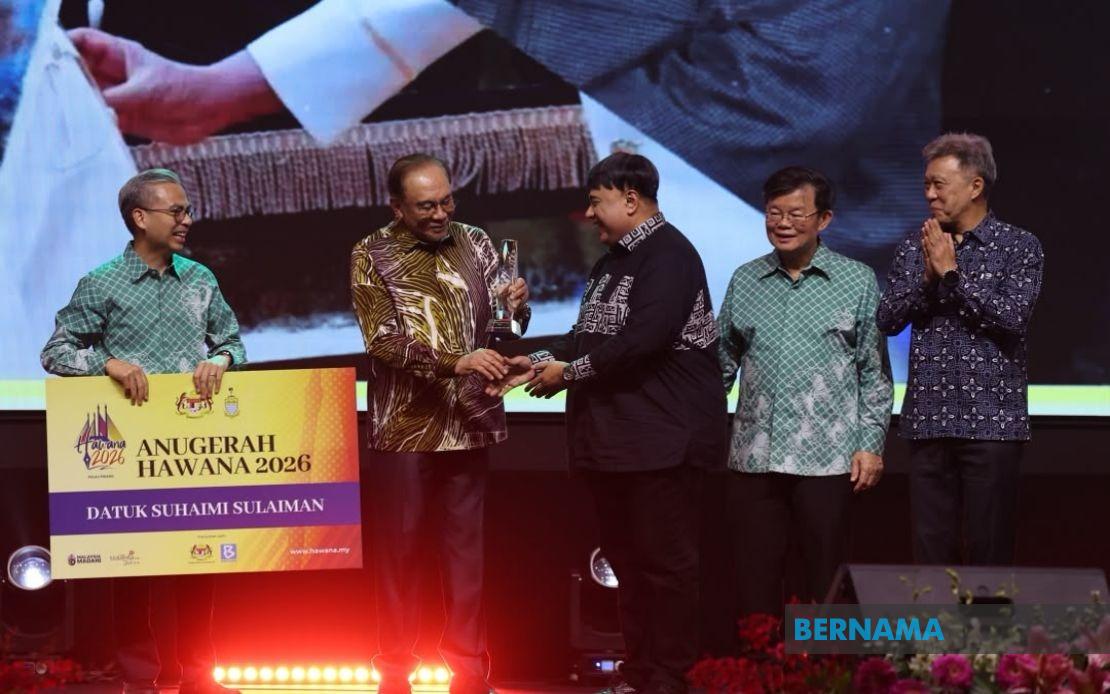
Datuk Suhaimi Sulaiman, a towering figure in Malaysian broadcasting and journalism, received the National Journalists' Day (HAWANA) 2026 Award in Butterworth on June 20, marking formal recognition of his more than three decades of service to the country's media sector. The ceremony, held at PICCA @ Arena Butterworth Convention Centre, underscored the esteem in which the former Broadcasting Malaysia (RTM) director-general is held by Malaysia's political and media establishment.
Prime Minister Datuk Seri Anwar Ibrahim personally conferred the award, a gesture that reflects the significant standing of Suhaimi within both journalistic circles and government corridors. The presence of Penang Chief Minister Chow Kon Yeow, Communications Minister Datuk Fahmi Fadzil, and Malaysian National News Agency (Bernama) chairman Datuk Seri Wong Chun Wai demonstrated the institutional weight attached to honouring achievements in the fourth estate. The HAWANA 2026 Grand Finale drew together senior media figures, including Bernama's chief executive officer and HAWANA 2026 Working Committee chairman Datin Paduka Nur-ul Afida Kamaludin, and editor-in-chief Arul Rajoo Durar Raj.
Suhaimi's career trajectory embodies the evolution of Malaysian media over the past thirty years. His tenure at RTM, the national broadcaster, coincided with periods of significant technological and regulatory change within the industry. From the consolidation of television news operations to the gradual shift towards digital distribution, his leadership positioned state broadcasting as a crucial repository of journalism during transitions that challenged traditional media business models. His recognition today serves as acknowledgment that institutional stewardship during such transformative periods carries lasting value.
In remarks to Bernama following the presentation, Suhaimi characterised the award as both an honour and a continuing responsibility. Rather than treating the accolade as a capstone to his career, he framed it as motivation to remain engaged with the evolving media landscape, particularly the acceleration of artificial intelligence applications in newsrooms across Malaysia and the region. This forward-looking perspective resonates with contemporary challenges facing journalists worldwide as they grapple with AI-generated content, algorithmic newsfeeds, and questions about human editorial judgment.
The former RTM chief emphasised that media professionals must adopt a learning mindset in an era when technological competence has become as essential as traditional reporting skills. Suhaimi's willingness to position himself as a continuing student of the industry, despite his seniority and track record, subtly challenges the notion that expertise in traditional broadcasting automatically translates to mastery of digital-first environments. His comments implicitly acknowledge that the media landscape of the 2020s demands constant adaptation and acquisition of new competencies from even the most experienced practitioners.
The emphasis on artificial intelligence in Suhaimi's remarks carries particular resonance for Southeast Asian newsrooms. Unlike established Western media outlets with substantial technical resources, Malaysian publishers and broadcasters often lack in-house expertise to develop proprietary AI solutions for journalism. The challenge of integrating AI tools responsibly while maintaining editorial standards and public trust requires exactly the kind of institutional wisdom and ethical grounding that figures like Suhaimi bring from decades of experience. His articulation of this challenge helps frame the conversation within the industry about technology adoption not as innovation for its own sake, but as a means to strengthen journalism.
The HAWANA award itself holds significance within Malaysian journalism circles as the profession's premier recognition of outstanding contributions. Named to honour the concept of freedom and responsibility in journalism, HAWANA represents the media industry's capacity for self-reflection and acknowledgment of merit. By bestowing the award on Suhaimi, the journalism community and government jointly affirm that leadership in state broadcasting remains a respected and valued role, even as private media outlets and digital platforms proliferate and fragment the audience.
Suhaimi's background at RTM gives his comments about industry challenges particular weight. The national broadcaster occupies a unique position within Malaysia's media ecosystem, balancing mandates for public service with commercial viability and political sensitivities. Leadership of such an institution requires navigating complex terrain between editorial independence and institutional accountability. The recognition extended to Suhaimi implicitly validates his approach to managing these tensions during his tenure.
For Malaysian journalists and media students observing this honour, Suhaimi's career and award carry instructive messages about longevity and institutional influence in the profession. His trajectory demonstrates that deep engagement with broadcasting institutions can yield career satisfaction and eventual recognition, even as the media landscape undergoes radical transformation. The award thus functions not merely as personal accolade but as endorsement of a particular model of journalistic service grounded in institutional development and mentorship.
Looking forward, the prominence given to artificial intelligence in Suhaimi's response to receiving the award signals likely directions for discussion within Malaysian journalism circles over coming years. As newsrooms grapple with automation of routine tasks, algorithmic distribution of content, and new forms of synthetic media, the kind of ethical guidance and historical perspective that experienced figures like Suhaimi can offer becomes increasingly valuable. His framing of the AI challenge as fundamentally a matter of continuous learning and adaptation provides a measured counterpoint to both techno-optimism and blanket technophobia in the industry.

