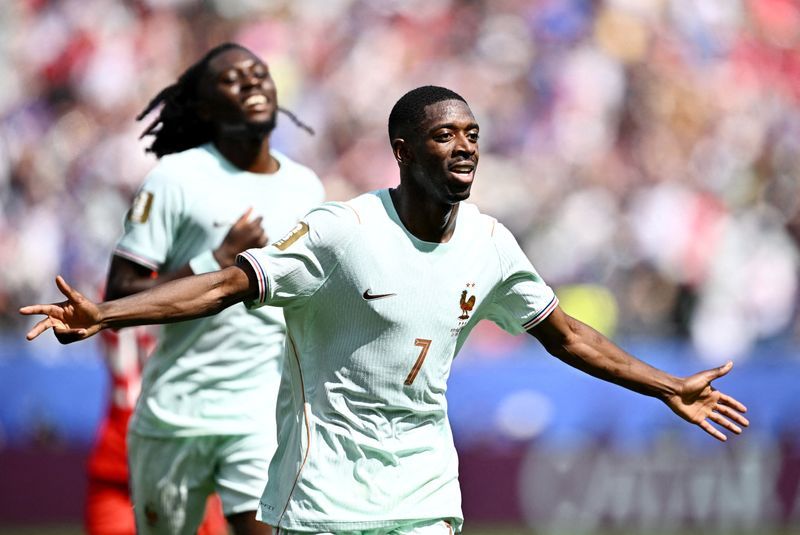
Ousmane Dembele turned on a masterclass of clinical finishing as France dispatched a depleted Norway 4-1 on Friday in Foxborough, Massachusetts, claiming top spot in their World Cup group and advancing to the knockout stage with considerable momentum. The Paris Saint-Germain winger's extraordinary performance—three goals in just 25 minutes—underscored the gulf in class between a full-strength French side and opponents fielding a heavily rotated lineup, and delivered a powerful statement about Les Bleus' credentials as genuine tournament contenders.
France's squad had entered the clash already assured of progression, as had Norway, but the stakes of finishing first held tangible significance. The mathematics of the North American tournament schedule meant that group winners faced a lighter travel burden and potentially more favourable Round of 32 opponents. Coach Didier Deschamps' men were determined to seize that advantage, particularly given the coach's absence from the touchline as he returned home to attend his mother's funeral. The players channelled their desire to honour their manager into a performance of relentless attacking intent from the opening whistle.
Norway's decision to rest virtually their entire first-choice XI—with the glaring exception of one player—proved catastrophic when confronted with France's intensity. Coach Stale Solbakken chose to field a largely second-string complement after his side's midweek encounter with Senegal, a strategic gamble that backfired spectacularly. Most notably, the omission of Erling Haaland, the tournament's most feared goal-scorer, and captain Martin Odegaard robbed Norway of their creative driving force and leadership, leaving them vulnerable to sustained French pressure.
The hosts' dominance announced itself immediately. Kylian Mbappe, himself in contention for the tournament's Golden Boot award, nearly opened the scoring within 20 seconds, his angled effort striking the crossbar with such precision that it suggested France's forward line would prove irresistible. Mbappe's role in orchestrating proceedings extended beyond his own shooting prowess; his vision and movement created space and opportunity for teammates, none more profitably than Dembele, who became the focal point of France's attacking philosophy on the night.
Dembele's first goal arrived in the sixth minute after receiving a sweeping cross-field pass from Mbappe. His decision-making was assured, cutting inside then outside his marker with balletic ease before unleashing a precisely angled drive beyond goalkeeper Egil Selvik. The winger struck again fourteen minutes later when Mbappe fed him once more, Dembele creating sufficient separation to dispatch a dipping effort that left the Norwegian goalkeeper helpless. By the 32nd minute, he completed his hat-trick with a curled low shot into the bottom corner, joining only Just Fontaine and Mbappe in the exclusive pantheon of France players to achieve the feat at World Cup level.
Dembele's treble arrived in the second-fastest time in World Cup history, surpassed only by Austria's Erich Probst, who scored three goals against Czechoslovakia in 1954 after 24 minutes. The statistical rarity of the achievement underscored the extraordinary nature of his performance, delivered against opponents who offered token resistance rather than serious competitive opposition. While Thelo Aasgaard pulled one goal back almost immediately to briefly inject some respectability into Norway's account, France's superiority had already been established beyond reasonable doubt.
Norway showed occasional glimpses of competitive spirit in the second half, most notably when Jorgen Strand Larsen stepped forward to take a penalty, only to see his soft effort easily saved by Mike Maignan. Oscar Bobb later forced Maignan into another save as the Scandinavians briefly exposed vulnerabilities in the French defensive structure, suggesting that with their full complement of players, the margin might have been closer. However, such speculation remained academic; with their first eleven benched, Norway simply lacked the quality to make a compelling contest of matters.
Desire Doue added France's fourth goal in the closing moments with a header following a cross from substitute Bradley Barcola, extending the comfortable margin and cementing the hosts' group-stage dominance. The victory concluded France's preliminary phase campaign on the strongest possible note, with their attacking players demonstrating the kind of ruthless efficiency that tournaments are won by. Dembele's performance in particular announced him as a player operating at peak performance, capable of decisive interventions when opportunities arise.
Group I's conclusion meant France would likely face Sweden in the Round of 32, while Norway, finishing as runners-up, drew the task of confronting Ivory Coast in their knockout encounter. The draw illustrates how group position carries concrete consequences beyond bragging rights, shaping opponents and travel itineraries across the tournament's complex multinational geography. For France, avoiding potentially stiffer competition while minimising logistical disruption represented meaningful advantages as they target their third World Cup title. Dembele's explosive evening provided powerful testimony that the defending runners-up possess the attacking resources to trouble any opponent standing between them and another final.

