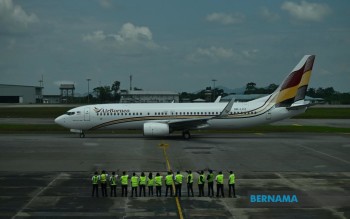
Deputy Prime Minister Datuk Seri Fadillah Yusof marked a significant moment in Malaysian aviation by receiving AirBorneo Airways' inaugural commercial flight at Kuala Lumpur International Airport on July 20. The historic arrival of flight MY5005 from Kuching to KLIA Terminal 1 represented not merely a routine air service launch but rather a milestone in Sarawak's long-standing effort to establish greater autonomy over its regional connectivity infrastructure. Sarawak Premier Tan Sri Abang Johari Tun Openg travelled aboard the inaugural service alongside state ministers and dignitaries, underscoring the political significance attached to this development.
The establishment of AirBorneo as a commercial carrier reflects deeper strategic ambitions within Sarawak's governance structure. Datuk Amar Mohamad Abu Bakar Marzuki, who chairs AirBorneo while simultaneously serving as Sarawak's state secretary, articulated this vision during the KLIA ceremony. He positioned the airline launch as central to Sarawak's economic future, characterising air connectivity as an essential lifeline that binds communities, facilitates commerce, and unlocks opportunities for residents. This framing demonstrates how state governments in Malaysia are increasingly viewing aviation infrastructure as pivotal to broader developmental objectives rather than merely a transport utility.
AirBorneo's transition to commercial operations represents a significant operational advancement for the carrier. The airline has introduced two wet-leased Boeing 737-800 aircraft, marking its entry into the commercial jet segment and enabling capacity well beyond what smaller turboprop operations could provide. This fleet composition positions AirBorneo to serve trunk routes with competitive frequency and efficiency, directly challenging incumbent carriers on key Malaysian domestic corridors. The decision to lease rather than purchase aircraft demonstrates pragmatic risk management, allowing the state-owned enterprise to scale operations without enormous upfront capital commitments while market demand develops.
Beginning July 21, 2026, AirBorneo will operate a twice-daily schedule between Kuching and Kuala Lumpur, providing hourly frequency during peak periods. This represents substantial capacity injection into a route previously dominated by established carriers. Economy fares commence at RM375 for one-way travel, with Business Class beginning at RM736. These price points position AirBorneo competitively within Malaysia's domestic market structure, where regional carriers have typically undercut full-service offerings while positioning themselves as quality alternatives to budget operators. The pricing strategy suggests AirBorneo aims to capture market share from multiple competitor segments simultaneously.
Chief Executive Officer Megat Ardian Mohd Aminuddin characterised the launch as a transformative inflection point for AirBorneo's development trajectory. He emphasised commitments to safety, reliability, and passenger experience quality, language that subtly positions the newcomer as a professional operator rather than a marginal entrant. This messaging matters for consumer perception in a market where brand trust influences purchasing decisions, particularly among business travellers who form a crucial revenue segment for domestic carriers. The emphasis on stakeholder support reflects awareness that successful airline operations depend on cooperation from airport operators, ground handlers, regulatory authorities, and fuel suppliers.
The Kuching-Kuala Lumpur route represents merely the opening chapter of AirBorneo's expansion strategy. State officials envision progressive network development extending to additional domestic points and ultimately international services. Singapore has been identified as the flagship international destination, a logical choice given geographic proximity, established business ties between Sarawak and Singapore, and Singapore's status as a major regional aviation hub. This international orientation differentiates AirBorneo from purely domestic regional carriers and signals ambitions to position the airline within broader Southeast Asian aviation networks.
For Malaysian aviation markets, AirBorneo's emergence introduces meaningful competitive dynamics on traditionally concentrated routes. The Kuching-Kuala Lumpur corridor has historically featured limited airline competition, with major carriers operating scheduled services supplemented by regional operators. Introduction of a state-backed airline with modern aircraft and substantial marketing resources should stimulate competitive responses from incumbents, potentially benefiting consumers through expanded capacity and promotional offerings. The competitive pressure may concentrate on pricing and service frequency rather than cost-cutting that compromises safety or reliability standards.
From a regional perspective, AirBorneo's launch demonstrates broader trends within Southeast Asian aviation where state governments increasingly invest in airline operations as economic development instruments. Similar patterns exist in other ASEAN nations where governments have supported carrier development to strengthen regional connectivity and assert greater control over air transport corridors. These initiatives sometimes achieve commercial sustainability and meaningful service contributions; others require ongoing subsidy or consolidation. AirBorneo's success will partly depend on management execution but also on evolving demand patterns across Sarawak, which has experienced variable economic cycles despite substantial natural resource wealth.
The political symbolism surrounding AirBorneo's launch warrants examination. Sarawak's decision to establish a state-owned airline reflects assertive state governance, positioning the regional administration as an active economic participant rather than passive transport market observer. This approach resonates with Sarawak's historical emphasis on state autonomy within Malaysia's federal structure. By creating aviation infrastructure under state control, Sarawak authorities arguably advance political narratives emphasising regional self-determination and economic management capacity. The presence of federal ministers at KLIA ceremonies suggests tacit federal endorsement of the initiative, indicating alignment rather than tension between national and state-level aviation strategies.
Passenger and business communities will observe AirBorneo's operational performance closely during early service phases. Key metrics including on-time performance, customer service standards, aircraft availability, and booking system reliability will shape perceptions of the carrier's operational maturity. Regional business travellers, government officials, and leisure passengers transitioning between Sarawak and Peninsular Malaysia will constitute the core market during initial operations. Service quality consistency will determine whether one-time trial passengers convert to regular customers, influencing revenue sustainability and expansion feasibility.
Looking ahead, AirBorneo's trajectory intersects with broader Malaysian aviation sector dynamics. The domestic market accommodates multiple carriers across different competitive tiers, from full-service legacy operators to budget carriers and regional specialists. AirBorneo appears positioned as a quality-focused regional carrier with state backing, occupying a distinct segment. Long-term viability will depend on maintaining service differentiation, managing costs within competitive parameters, and capitalising on growth opportunities as Sarawak's economy evolves. Federal regulatory frameworks governing aviation safety, airspace access, and airport operations will significantly influence operational economics and expansion possibilities.

