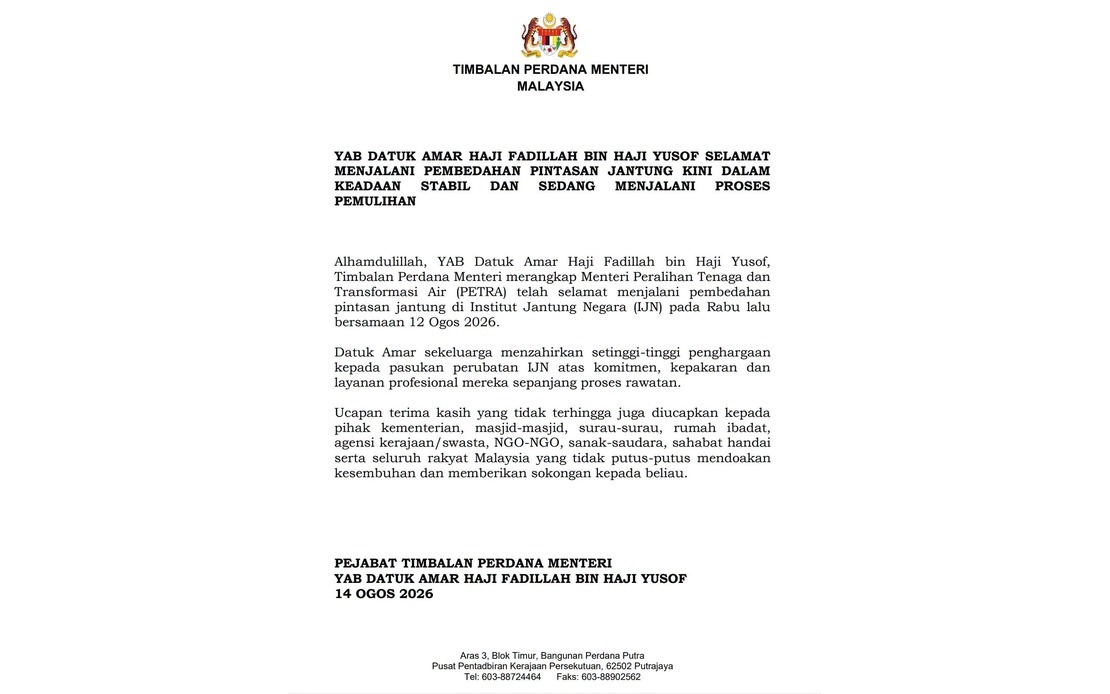
Deputy Prime Minister Datuk Seri Fadillah Yusof, who doubles as Energy Transition and Water Transformation Minister, has made encouraging progress following a double coronary artery bypass procedure conducted at the National Heart Institute on August 12. His medical team has confirmed that his recovery is proceeding according to schedule, with the senior leadership at IJN expressing satisfaction with his postoperative trajectory and overall clinical status.
The surgical intervention came after Fadillah was admitted to IJN on July 28 for assessment of coronary artery disease. Following a coronary angiogram performed the next day, a multidisciplinary team of cardiologists and cardiac surgeons determined that bypass grafting would offer him the most suitable treatment pathway. The decision to proceed with surgery reflected the severity of his arterial blockages and the anticipated benefits of surgical revascularisation over alternative approaches.
Two of IJN's most experienced cardiothoracic surgeons, Prof Datuk Seri Dr Mohamed Ezani Md Taib and Prof Datuk Seri Dr Mond Azhan Yakub, led the surgical team, supported by Clinical Fellow Dr Ahmad Mahir Shamsuddin. The operation was conducted utilising IJN's Enhanced Recovery After Surgery protocol, a systematic approach that emphasises early mobilisation, reduction of postoperative complications, and expedited rehabilitation. This protocol has become standard practice at leading cardiac centres globally and typically results in shorter hospital stays and fewer adverse outcomes compared to conventional recovery methods.
One of the most striking indicators of Fadillah's successful recovery emerged just 24 hours after his transfer from the intensive care unit to the general ward. On August 13, as part of his early mobilisation programme, he completed 2.8 kilometres of cycling exercise under medical supervision, a remarkable achievement that demonstrates the efficacy of modern cardiac surgical techniques and perioperative management. This level of activity at such an early stage following major heart surgery would have been unthinkable in previous decades and underscores the advances that have transformed cardiac surgery from a procedure with prolonged convalescence into one permitting rapid functional recovery.
The Deputy Prime Minister's family released a statement expressing profound gratitude to the IJN medical team, specifically acknowledging their commitment, technical expertise, and dedication to his care throughout the admission and surgical process. Beyond the hospital setting, the family also extended appreciation to religious institutions, government and private sector agencies, non-governmental organisations, and the broader Malaysian public for their prayers and expressions of support during this challenging period.
From a national governance perspective, Fadillah's successful surgery and rapid recovery represent positive developments for government continuity. As Deputy Prime Minister, he holds a pivotal position in Malaysia's ministerial structure, and his early mobilisation suggests a reasonable timeline for resuming duties, should his physicians recommend such a transition. The PETRA portfolio—encompassing energy transition and water transformation—represents strategically critical areas for Malaysia's long-term economic and environmental future, making the timing of his incapacity and recovery a matter of broader national interest.
The case also highlights the sophistication of Malaysia's healthcare infrastructure, particularly within the realm of cardiac surgery. The National Heart Institute has established itself as a regional centre of excellence, attracting patients from across Southeast Asia and utilising techniques and protocols consistent with international best practice. The presence of highly qualified cardiothoracic surgeons capable of managing complex cases with excellent outcomes reflects decades of investment in medical training and institutional development.
Fadillah's experience also raises awareness within Malaysia about coronary artery disease, which remains a leading cause of morbidity and mortality across the region. Though the Deputy Prime Minister's case is now well-known due to his public position, countless Malaysians experience similar presentations requiring diagnostic angiography and potential revascularisation. The successful resolution of his condition, combined with the rapid functional recovery he has demonstrated, may serve to reassure the public about the efficacy of modern cardiac interventions when pursued in appropriate settings by qualified specialists.
The Enhanced Recovery After Surgery protocol employed in Fadillah's case represents a paradigm shift in perioperative cardiac medicine. Rather than the traditional model of prolonged bed rest and gradual mobilisation, contemporary practice emphasises early movement, aggressive respiratory physiotherapy, and rapid return to normal activities. This approach requires close coordination between surgeons, anaesthetists, cardiologists, physiotherapists, and nursing staff but yields measurable benefits in terms of reduced complication rates, shorter hospital stays, and improved long-term functional outcomes.
Looking forward, Fadillah will require ongoing cardiac rehabilitation, which typically extends for several weeks following discharge and may be conducted either in hospital outpatient settings or through community-based programmes. This phase focuses on progressive exercise conditioning, cardiovascular risk factor management, dietary optimisation, and psychological support. The success of this rehabilitation phase is often as critical as the surgery itself in determining long-term outcomes and the patient's ability to return to demanding professional responsibilities.
The incident also underscores the importance of cardiovascular screening and preventive care in high-pressure professional environments. Senior government figures often work under conditions of considerable stress and irregular schedules that may increase cardiac risk. The early detection of Fadillah's coronary artery disease during what appears to have been a period of symptomatic concern allowed for timely intervention before a potentially catastrophic acute event such as myocardial infarction could occur. This preventive medical perspective—identifying and treating disease in its earlier stages rather than managing acute complications—remains an underutilised opportunity in many healthcare systems across Southeast Asia.

