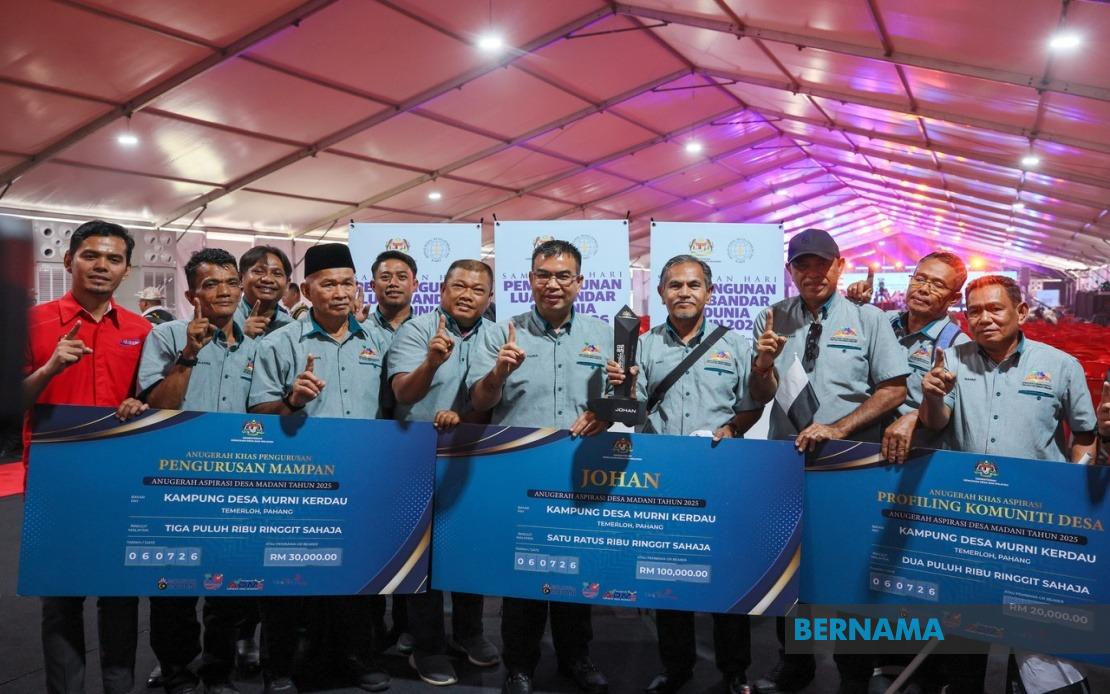
Desa Murni Kerdau, a progressive rural settlement in Temerloh, Pahang, has secured three major accolades at the World Rural Development Day 2026 celebration, an event held at Tun Abdul Razak Stadium in Jengka Sentral on July 6. The village's sweep of awards underscores the growing recognition across Malaysia of innovative approaches to rural governance and economic development, signalling a shift towards bottom-up community empowerment in regions often overlooked by urban-centric development models.
The trio of honours bestowed upon the settlement included the prestigious 2025 MADANI Rural Aspiration Award Champion designation, alongside the Rural Community Profiling Aspiration Special Award and the Sustainable Management Special Award. Deputy Prime Minister Datuk Seri Dr Ahmad Zahid Hamidi presented the flagship MADANI award, while Deputy Minister of Rural and Regional Development Datuk Rubiah Wang handed over the two supplementary recognitions. The tiered presentation structure reflects the awards' varying significance within Malaysia's rural development framework.
According to Mohamad Fazrul Ahmad, who chairs the Village Development and Security Committee (JPKK) at Desa Murni Kerdau, the collective recognition validates the sustained institutional commitment to transparent governance, effective leadership and inclusive community advancement. Speaking immediately after the ceremony, he emphasised that such accolades do more than burnish a village's profile; they demonstrate measurable progress against nationally established benchmarks for rural excellence. The triple win positions the settlement as a model case study within Malaysia's rural development agenda.
The Ministry of Rural and Regional Development's decision to spotlight Desa Murni Kerdau reflects broader policy priorities around diversifying rural economies and promoting self-sufficiency at the grassroots level. By orchestrating ceremonies such as the World Rural Development Day celebration, the ministry aims to incentivise villages nationwide to adopt comparable governance standards and economic strategies. For Southeast Asian observers, Malaysia's systematic recognition framework offers a blueprint for how centralised governments can encourage decentralised innovation without imposing top-down mandates.
Desa Murni Kerdau's economic footprint extends well beyond subsistence farming. The village has incubated approximately 20 entrepreneurs operating across diverse sectors spanning small and medium industries, agricultural ventures and automotive enterprises. This entrepreneurial diversity insulates the community against mono-economic vulnerability and creates multiple income streams for residents. The presence of functioning SMEs within a traditionally agrarian setting demonstrates how rural areas can participate meaningfully in Malaysia's broader manufacturing and services economy without requiring wholesale urban migration.
The settlement has leveraged its cultural heritage and preserved village character to develop "Kampung Stay," a rural tourism offering that has gained traction among domestic and regional travellers seeking authentic Malaysian experiences. This tourism product represents value-added development—transforming traditional settlement patterns and hospitality customs into income-generating assets while maintaining community cohesion. For Southeast Asian rural development practitioners, Desa Murni Kerdau's tourism model illustrates how heritage conservation and economic modernisation need not conflict.
Physically, Desa Murni Kerdau comprises approximately 200 residential units housing over 600 residents, a scale that facilitates governance without overwhelming administrative capacity. This mid-sized settlement sits within an optimal range for community organising—large enough to support institutional diversity and economic differentiation, yet compact enough that residents maintain direct connections to decision-making processes. The village's architectural and demographic characteristics may explain why it has achieved coordination across governance, entrepreneurship and tourism dimensions simultaneously.
Acknowledging the ministry's recognition effort, Mohamad Fazrul articulated a commitment to distributing monetary award proceeds among residents and channelling funds towards infrastructure and community welfare initiatives. This pledge reflects contemporary best practice in rural development, where external validation and prize monies serve catalytic rather than substitutional functions. By reinvesting rewards into local improvement projects, Desa Murni Kerdau sustains momentum and demonstrates that prizes function as tools for further advancement rather than destination endpoints.
The awards carry implications for how Malaysia approaches rural policy during a period of accelerating urbanisation and rural depopulation. Rather than accepting rural decline as inevitable, the government's award apparatus seeks to spotlight and replicate success cases, creating positive demonstration effects. Neighbouring villages and rural administrators throughout Pahang and beyond may now benchmark their governance and development strategies against Desa Murni Kerdau's recognised practices, potentially triggering competitive upgrading across multiple settlements.
Regionally, Malaysia's systematised approach to rural recognition contrasts with less structured governance environments across Southeast Asia. The World Rural Development Day framework and the MADANI awards scheme provide measurable criteria and transparent processes, reducing patronage distortion and enhancing legitimacy. For policymakers in neighbouring countries navigating comparable rural challenges, Malaysia's institutional scaffolding offers transferable lessons about institutionalising excellence while maintaining flexibility for local adaptation.
Desa Murni Kerdau's trajectory also illuminates the relationship between administrative capacity and economic outcomes. The village's success across governance, entrepreneurship and tourism simultaneously suggests that effective village-level institutions create enabling environments where multiple development pathways can flourish concurrently. Rather than sequential development—infrastructure first, then entrepreneurship, then tourism—the settlement achieved integrated advancement, indicating mature institutional function.
Looking forward, Desa Murni Kerdau's triple award status positions it as a knowledge resource within Malaysia's rural development ecosystem. The village may attract study visits from other settlements, field practitioners and researchers seeking to understand how traditional communities can modernise economically while preserving social coherence. This knowledge transfer dynamic, facilitated by award ceremonies and official recognition, amplifies the multiplier effects of the original prizes far beyond the immediate beneficiary.
The awards ultimately validate a particular vision of rural Malaysia's future—one where villages remain vital economic and social units, where entrepreneurship flourishes beyond metropolitan boundaries, and where heritage and modernity coexist productively. As Desa Murni Kerdau integrates prize winnings into ongoing community projects, it continues writing the narrative of contemporary rural development in Malaysia and offers insights to an attentive Southeast Asian audience.

