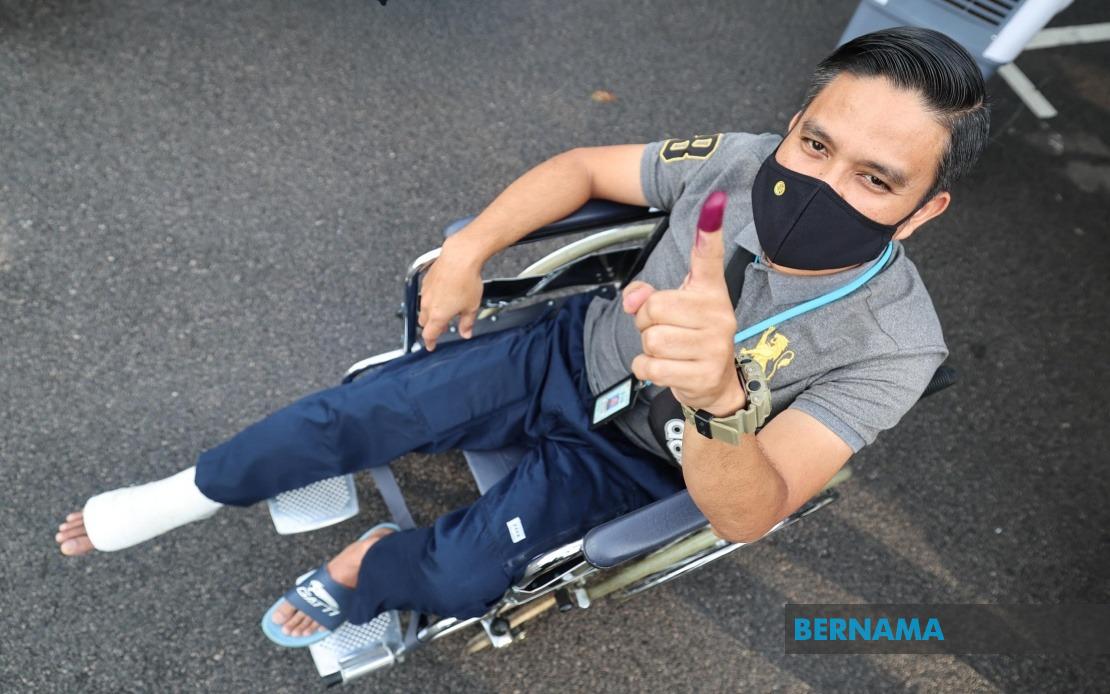
A 40-year-old police sergeant in Johor demonstrated unwavering civic commitment by casting his vote from a wheelchair during early polling for the 16th state election, just days after sustaining a significant sports injury. Sergeant Syahrizal Musa, attached to the Internal Security and Public Order Department at Johor Police Contingent Headquarters (IPK), travelled from his quarters in Tampoi on July 7 to participate in early voting despite medical restrictions confining him to wheelchair mobility until mid-July.
Syahrizal's injury, a minor tear to his Achilles tendon, occurred while playing sepak takraw the previous week. Having been an active participant in the traditional Southeast Asian sport throughout his life, and even representing the police contingent in multiple tournaments, the sudden incapacity presented a formidable barrier to mobility. Medical professionals advised him to remain on leave through July 16, effectively limiting his physical independence during the critical voting period. Nonetheless, he proceeded with his voting intention, enlisting a colleague to transport him from his residence to the polling centre.
When questioned by reporters at the early voting venue, Syahrizal articulated his perspective on the significance of electoral participation. He stressed that his temporary physical limitation did not constitute sufficient reason to forgo his fundamental right as a citizen. Reaching the polling centre represented not merely a procedural exercise but an affirmation of personal responsibility toward national governance. His determination to vote despite obvious discomfort underscored a deeply held conviction about the importance of individual engagement in democratic processes.
Reflecting on his extended tenure with Malaysia's police force, Syahrizal highlighted the consistency of his voting participation across his 22-year career. He indicated that this represented the first instance during which he had cast a ballot while confined to a wheelchair, yet such circumstances had not diminished his commitment to the practice. This perspective carries particular weight given the demands typically associated with police service, which often prioritise operational duties and public security over other considerations. His willingness to surmount physical obstacles illustrates how institutional culture can foster strong civic values among law enforcement personnel.
The sergeant's journey to Johor IPK from Tampoi, though relatively modest in distance, required logistical planning and determination given his compromised mobility. Police quarters accommodate numerous personnel and their families, and his decision to arrange transport rather than defer participation demonstrated prioritisation of his civic obligation. This narrative resonates with broader themes concerning how individuals navigate competing pressures and limitations to fulfil fundamental democratic responsibilities.
Johor's 16th state election represented a significant electoral undertaking, with comprehensive provisions established to facilitate voting among different demographic cohorts. Early voting accommodated members of the Malaysian Armed Forces, their spouses, Royal Malaysia Police personnel, their families, and General Operations Force members—collectively numbering 24,751 eligible early voters across 64 designated polling centres on that single day. This administrative framework recognised that security and armed personnel often operate under operational schedules that complicate standard election-day participation. The inclusion of such provisions reflects recognition that democratic engagement must accommodate diverse occupational and service-related circumstances.
The broader Johor election campaign involved 172 candidates competing for 56 state assembly seats, with approximately 2.7 million registered ordinary voters scheduled to exercise their franchise on the following Saturday. This scale of electoral activity placed Johor among the more substantial state-level contests within Malaysia's electoral calendar, with consequences extending beyond provincial administration to influence regional political dynamics and factional alignments within major political coalitions. Early voting mechanisms, by enabling advance participation among specific demographic categories, ensure that such individuals could contribute to electoral outcomes without requiring exception or deferral from their professional obligations.
Syahrizal's public articulation of his voting experience appeared calculated to encourage broader Malaysian participation in electoral processes. He explicitly advocated for fellow citizens to recognise and exercise their democratic franchise, framing such participation as instrumentally necessary for determining the state's and nation's collective future trajectory. This messaging emerges particularly valuable in contexts where voter turnout has declined or remained sub-optimal, or where population segments demonstrate declining engagement with electoral institutions. A serving police officer making such statements carries institutional weight and credibility, suggesting that encouragement toward civic participation emanates from someone embedded within state apparatus rather than external political advocates.
The Perak-born sergeant's decision carries symbolic significance within Malaysian political culture. Police personnel, while entitled to vote like other citizens, remain bound by professional constraints that sometimes create tension between occupational obligations and personal political expression. That an officer would so openly prioritise voting participation despite obvious physical hardship sends a message about the priority accorded to democratic engagement within security force institutions. Such examples contribute to broader national narratives about institutional alignment with democratic norms and values.
Syahrizal's nine years serving at Muar IPD before his 2014 transfer to Johor IPK anchored him within Johor's police community, establishing local connections and familiarity with electoral constituencies. His trajectory reflects typical career development within the force, involving geographic mobility and departmental reassignments across decades of service. Such professional histories often generate strong community ties and investment in local outcomes, rendering his determination to vote alongside his professional transition understandable within that context.
The accessibility provisions demonstrated through the arrangement of early voting centres at secure police installations addressed practical requirements for personnel unable to vote during standard polling periods. By converting institutional infrastructure—the Johor IPK headquarters—into dedicated electoral venues, authorities simplified participation logistics while maintaining security protocols. This approach illustrates how accommodating diverse voting circumstances need not compromise administrative integrity or security frameworks. For Syahrizal specifically, proximity between his workplace and voting location simplified the logistics of participating while recovering from injury, demonstrating how thoughtfully configured systems can facilitate rather than obstruct democratic participation.

