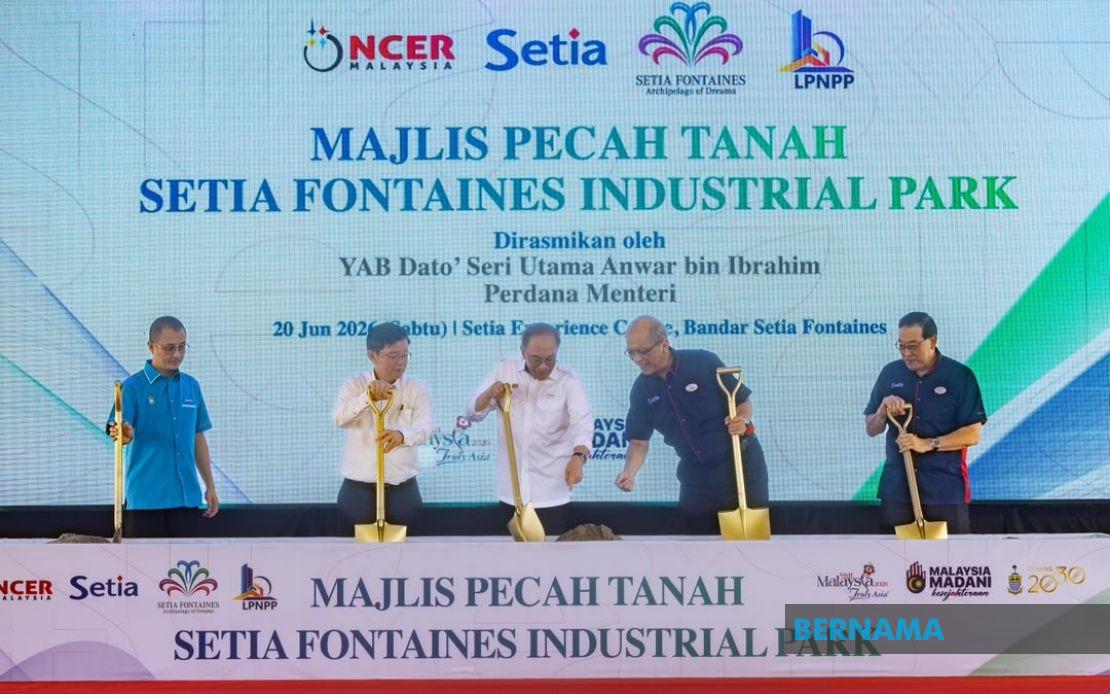
Prime Minister Datuk Seri Anwar Ibrahim has issued a direct challenge to major government-linked entities and private corporations to actively integrate economic opportunities for middle- and lower-income Malaysians into their development initiatives. Speaking at the groundbreaking ceremony for the Setia Fontaines Industrial Park in Kepala Batas, Anwar underscored that the responsibility extends across all major investment players, from sovereign wealth fund Khazanah Nasional Berhad to the Employees Provident Fund and private sector developers. His intervention signals growing concern within the highest levels of government that rapid expansion and capital inflows risk exacerbating inequality if not deliberately structured to reach ordinary Malaysians.
The Prime Minister's remarks reflect a substantive shift in how Malaysia's leadership is framing development discourse. Rather than treating economic growth as an inherent good measured merely by investment volumes and GDP expansion, Anwar has positioned inclusive opportunity-creation as a non-negotiable condition for project approval. This approach targets a fundamental tension in Malaysian development: the country's ability to attract foreign capital and domestic investment frequently outpaces its capacity to ensure those gains translate into tangible employment and wealth-building for non-elite segments of the population. By explicitly linking project endorsement to inclusive outcome criteria, Anwar is attempting to reshape how major corporations think about community engagement and value distribution.
The focus on Seberang Perai development carries particular regional significance. The industrial park initiative is framed as part of broader efforts to rebalance economic activity across Penang state, specifically accelerating growth in Seberang Perai to match the momentum seen on Penang Island and in the state's southern zones. This geographic imperative reflects longstanding concerns about uneven development, where certain areas capture disproportionate investment while neighbouring regions lag. By making inclusive opportunity a prerequisite for such mega-projects, Anwar is attempting to ensure that infrastructure and employment benefits disperse more evenly across constituencies and demographic groups.
Anwar articulated a sophisticated argument about the relationship between investment volume and social cohesion. He cautioned that impressive statistical indicators of economic activity mask potential harm if growth mechanisms systematically exclude particular population segments. This framing acknowledges that Malaysia's middle and lower-income groups have experienced periods of expansion that generated few tangible improvements in their circumstances, while wealth concentrated among connected elites and foreign investors. By demanding that development projects explicitly address this dynamic, Anwar is signalling that the government will increasingly scrutinise how wealth generated from public-backed or public-benefiting projects gets distributed through the economy.
The emphasis on employment quality and technological advancement suggests Anwar envisions a manufacturing transition that could substantially reshape regional labour markets. As Malaysia pivots from lower-value assembly operations toward advanced technology production, the gap between available jobs and worker readiness threatens to widen precisely when opportunity should be expanding. Seberang Perai, traditionally reliant on conventional industrial sectors, faces particular vulnerability if this transition proceeds without deliberate workforce preparation. Anwar's insistence on aligning industrial park development with educational institutions represents an attempt to prevent the scenario where sophisticated facilities exist alongside populations inadequately equipped to access resulting employment.
The collaboration framework outlined by Anwar—linking industry players, technical and vocational education providers, and universities including Universiti Sains Malaysia—represents an integrated approach to skills development. Rather than expecting the market to self-correct, or relying on workers to independently acquire expensive training, this model places responsibility on development actors to anticipate skills needs and work backward through the education system. This is particularly relevant for Penang, where USM's engineering and technical programmes could theoretically feed directly into advanced manufacturing roles, yet institutional silos and poor coordination often prevent such natural synergies from materialising.
Anwar's comment that technology evolves within one to two years captures a core anxiety about workforce development in emerging sectors. Traditional education cycles struggle to keep pace with industrial evolution, creating a permanent skills gap. By positioning continuous alignment between industry and educational institutions as non-negotiable rather than aspirational, Anwar is attempting to institutionalise what should theoretically be standard practice but rarely is in Malaysian context. This reflects recognition that middle and lower-income workers face the harshest consequences when skills they acquired become obsolete, lacking the financial buffers to retrain or transition smoothly.
The distinction between professional employment existence and professional employment accessibility deserves emphasis. Anwar explicitly identified a scenario many Malaysian communities experience: growth creates positions they cannot fill due to credential or aptitude gaps. This creates a perverse dynamic where development projects generate frustration and inequality simultaneously—visible employment opportunities exist alongside visible personal exclusion from accessing them. By demanding that development actors address this gap frontally, Anwar is attempting to shift responsibility away from individuals to develop themselves and toward institutions to structure development inclusively.
The government's stated commitment to urging agencies toward more equitable development planning represents an administrative challenge of considerable magnitude. Implementation will require detailed monitoring of hiring practices, supplier relationships, and skill-building investments across multiple development projects. It will require resisting pressure from investors and companies seeking to minimise community investment obligations in exchange for expedited approvals. It will require navigating tensions between efficiency objectives and inclusion objectives, which frequently conflict in practice. Whether this rhetorical commitment translates into binding contractual requirements and enforcement mechanisms remains unclear, but the public articulation establishes at minimum a framework against which future development outcomes can be evaluated and critiqued.
For Southeast Asian observers, Anwar's emphasis on inclusive development carries broader implications. The region faces comparable tensions between rapid capital flows and inclusive growth, with similar risks of widening inequality despite expanding aggregate economic activity. Malaysia's approach—making opportunity inclusion a project approval criterion rather than treating it as a sympathetic afterthought—offers one potential model for other Southeast Asian governments attempting to ensure that development benefits reach beyond narrow elite segments. The success or failure of this approach in Seberang Perai and similar projects will likely influence how neighbouring countries conceive of development governance and stakeholder responsibility.
The timing of Anwar's remarks, delivered at an operational industrial park launch rather than in abstract policy forums, emphasises commitment to translating principle into practice. By making these statements in a concrete project context, the Prime Minister created accountability benchmarks against which the Setia Fontaines initiative can subsequently be measured. This approach—using high-profile project events to signal policy direction and establish performance expectations—represents a pragmatic attempt to embed inclusive growth principles directly into Malaysia's development machinery rather than relying on policy documents alone.

