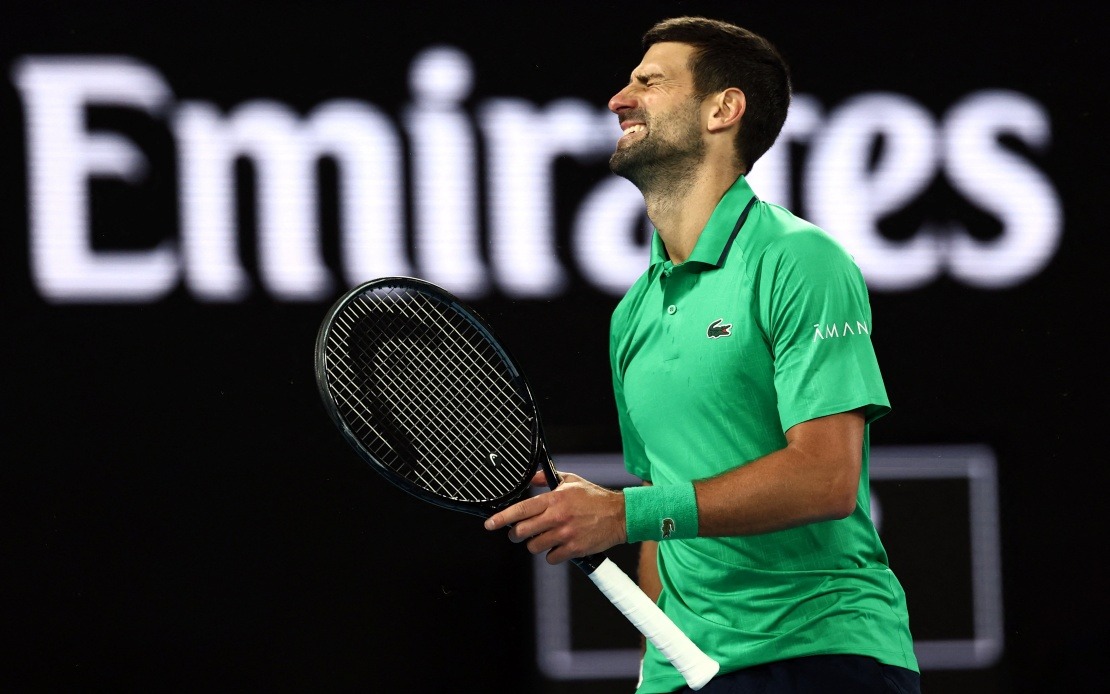
Novak Djokovic has etched his name further into tennis history by matching Roger Federer's benchmark of 105 men's singles victories at Wimbledon, a milestone he reached on Friday after an intense three-hour battle against France's Arthur Rinderknech on Centre Court. The seven-time champion secured a 7-5, 6-4, 1-6, 7-6 (7-4) victory to advance to the fourth round, extending his remarkable association with the All England Club and cementing his status as one of the sport's greatest Wimbledon performers.
The 39-year-old Serbian's achievement represents more than mere statistical accumulation; it underscores his sustained excellence across two decades of professional tennis. Djokovic's path to this record has been characterised by consistency, resilience, and an almost unparalleled ability to perform on grass, a surface that demands precision, timing, and adaptability. His 18 consecutive appearances in the Wimbledon fourth round reflects not only his physical durability but also his psychological fortitude in maintaining peak performance at an age when most players have transitioned away from elite competition.
Reacting to the historic moment with characteristic levity, Djokovic suggested a direct contest with Federer to determine who would claim the 106th victory, a lighthearted response that nonetheless highlighted the competitive spirit that has defined his career. In his on-court interview, the record 24-time Grand Slam champion emphasised that chasing numbers was secondary to the deeper satisfaction of creating history in a sport that has been his lifelong passion. He reflected on Wimbledon's enduring significance to him, describing it as a childhood dream that continues to motivate his pursuit of excellence at a stage in his career when most athletes would be contemplating retirement.
Djokovic's progression also came at a crucial juncture, as the tournament enters its decisive phase. His next challenge sees him face Russian qualifier Roman Safiullin, a matchup that will determine whether the Serbian can maintain his momentum toward another deep run in this year's championship. Despite the historical marker, Djokovic's focus remains firmly on the immediate task at hand, refusing to be distracted by the allure of chasing further records.
On the men's side, Italian world number one and defending champion Jannik Sinner demonstrated why he remains the favourite for the title, dispatching American Jenson Brooksby with clinical efficiency in straight sets, 6-4, 6-3, 6-4. Sinner's performance extended an impressive Open Era record of 20 consecutive third-round victories at Grand Slam events, a statistic that underscores his current form and adaptability across different tournament stages. The Italian acknowledged the crucial role of crowd support in maintaining the necessary intensity during the match, a reminder that Wimbledon's atmosphere remains a defining feature of the championship.
In the women's draw, top seed Aryna Sabalenka continued her pursuit of an elusive first Wimbledon title by overcoming former French Open champion Jelena Ostapenko with a commanding 6-4, 6-4 display. The Belarusian world number one has yet to claim victory at the All England Club despite reaching the finals previously, and her current run offers renewed hope of breaking that drought. Sabalenka's dominant approach, characterised by powerful baseline striking and aggressive court positioning, has proved formidable across the grass courts this fortnight.
Sabalenka's path now leads to a tantalising fourth-round encounter with four-time Grand Slam champion Naomi Osaka, a meeting that has captured significant media attention and public imagination. Osaka, remarkably, will be competing in the Wimbledon fourth round for the first time in her career despite her extraordinary pedigree at other majors, a fact that highlights the unique challenges posed by grass-court tennis even to the sport's most decorated performers. The Japanese star reached this stage by defeating Daria Kasatkina in a one-sided affair, 6-1, 6-3, demonstrating the form required to progress at this elite level.
Sabalenka's characterisation of Osaka as another formidable offensive player reflects the broader trend in women's tennis toward increasingly aggressive baseline play and power generation. The Belarusian's willingness to acknowledge the challenge ahead, combined with her determination to match Osaka's intensity, suggests a competitor who has mentally prepared for this significant encounter. Such mentality often proves decisive in high-pressure matches where margins between victory and defeat are measured in millimetres and microseconds.
The meeting between Sabalenka and Osaka carries implications beyond the immediate tournament context. For Sabalenka, success would represent a significant step toward her primary Wimbledon objective and would enhance her credentials as a complete Grand Slam champion. For Osaka, a victory would validate her continued relevance at the elite level and suggest that her recent performances have successfully rebuilt the consistency that characterised her earlier career dominance. Both players arrive at this juncture as legitimate threats to the eventual champion, their collective presence ensuring that the women's draw remains wide open and unpredictable as the tournament enters its most decisive phase.
The convergence of these storylines—Djokovic's historical achievement, Sinner's defensive prowess, and the Sabalenka-Osaka showdown—exemplifies Wimbledon's enduring capacity to generate compelling narratives. These are not merely sporting contests but chapters in an ongoing story about excellence, longevity, and the perpetual challenge of sustaining peak performance across time. As the tournament progresses deeper into the second week, these players will face increasingly demanding opponents and the mounting pressure that accompanies proximity to a Grand Slam title.

