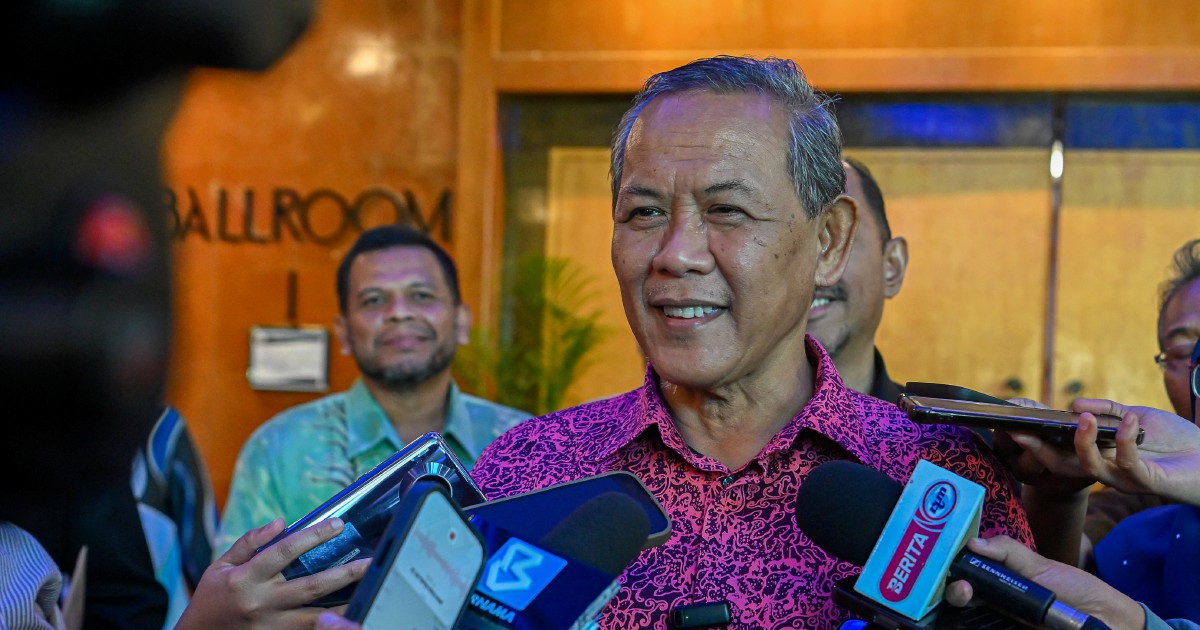
Negri Sembilan Menteri Besar Datuk Seri Aminuddin Harun has appealed to voters to judge the government's flood-management strategy for the chronically affected Linggi constituency on its merits, cautioning that opportunistic politicisation of the disaster could undermine genuine relief efforts ahead of the 16th state election.
The Linggi flood crisis represents one of the most persistent infrastructure challenges in Negri Sembilan, with recurring inundation cycles affecting thousands of residents and disrupting commerce and transportation across the district. The issue has long festered as a flashpoint for political messaging, with opposition groups frequently citing it as evidence of governmental neglect whilst the ruling coalition defends its investment record. Aminuddin's latest intervention signals mounting frustration within the state administration over how the catastrophe has become entangled with electoral calculations rather than remaining focused on practical solutions.
The Menteri Besar's statement reflects a broader pattern in Malaysian politics where major infrastructure crises become weaponised by competing factions, with voters caught between rival claims about capacity and commitment. Rather than allowing sustained technical discussion about engineering solutions, the Linggi situation has repeatedly descended into tit-for-tat accusations, with each monsoon season becoming an occasion for political point-scoring. Aminuddin appears to be pushing back against this dynamic, insisting that voters consider the substantive measures being rolled out rather than succumbing to partisan rhetoric.
Mitigation works currently underway in Linggi encompass multiple components designed to address both immediate flood response and longer-term structural resilience. These initiatives represent a significant investment commitment from the state administration, though their progress and efficacy remain subjects of public scrutiny. The urgency surrounding these projects has intensified as seasonal weather patterns approach, making the completion timeline critically important for affected communities who have endured repeated displacement and property damage.
The flood vulnerability in Linggi stems from a combination of geographical, hydrological, and urban planning factors that have compounded over decades. The constituency sits within a floodplain geography that experiences regular inundation during heavy rainfall, whilst rapid residential and commercial development has altered natural water drainage patterns. Older infrastructure systems designed for historical precipitation levels now operate under significant stress when contemporary weather events occur, creating a gap between existing capacity and contemporary demand. These structural realities mean that political blame-shifting, whilst emotionally satisfying, cannot substitute for genuine engineering intervention.
For Malaysian voters evaluating such claims during election season, the distinction between rhetoric and reality becomes paramount. Parties in opposition have political incentives to emphasise governmental failures whilst downplaying mitigation efforts, just as the incumbent administration tends toward optimistic timelines and capability projections. Residents living with flood risks require independent assessment of what projects are actually being executed, their technical adequacy, their funding security, and their realistic timescales. Aminuddin's warning implicitly acknowledges this dynamic whilst asking voters to demand evidence rather than accept political narratives uncritically.
The 16th Negri Sembilan state election will undoubtedly feature Linggi prominently in campaign discourse, as the constituency represents a tangible, recurring problem that voters can directly relate to their electoral choices. Opposition candidates will likely highlight any remaining vulnerabilities or project delays, whilst government representatives will emphasise investments and prevention achievements. This predictable cycle of electoral politics creates genuine risks that technical discussions about flood management become subordinated to campaign strategy, with actual implementation quality suffering as a consequence.
Neighbouring Selangor and Perak have confronted similar flooding challenges with varying degrees of success, offering potential lessons for Negri Sembilan's approach. Selangor's experience with flooding along the Klang River and its tributaries demonstrates how infrastructure projects require sustained funding, political continuity, and professional engineering oversight across multiple election cycles. When flood mitigation becomes hostage to electoral outcomes, project momentum often fractures when administrations change, leaving communities in perpetual vulnerability. Aminuddin's implicit argument is that protecting Linggi residents requires treating flood management as a non-partisan infrastructure challenge rather than temporary electoral advantage.
The timing of this statement, concurrent with mitigation works progressing, suggests a deliberate effort to establish the government's technical credibility before campaign messaging intensifies. By framing the issue around concrete actions rather than political promises, the Menteri Besar is attempting to shift voter focus toward implementable solutions. This approach carries risks, as any project delays, cost overruns, or technical problems will be seized upon as evidence of governmental incompetence. However, the alternative of remaining silent whilst opposition parties define the narrative entirely arguably poses greater electoral danger.
For residents of Linggi and other flood-prone communities across Southeast Asia, Aminuddin's statement highlights a fundamental governance tension: how to insulate essential infrastructure projects from electoral volatility whilst remaining accountable to democratic processes. The solution likely requires greater transparency about project specifications, funding mechanisms, and completion schedules, allowing voters to independently verify claims rather than relying solely on political assertions. When communities can access objective data about flood mitigation efforts, political opportunism becomes more difficult to sustain.
Moving forward, the credibility of Aminuddin's appeal rests on whether promised mitigation works demonstrably materialise and deliver measurable improvements in Linggi's flood resilience. Voters will ultimately judge not the rhetoric of avoiding politicisation, but the tangible reduction in inundation frequency and severity that residents experience. This represents the only truly non-partisan metric by which flood management success can be measured, transcending electoral calculations and serving as the ultimate test of governmental capacity.

