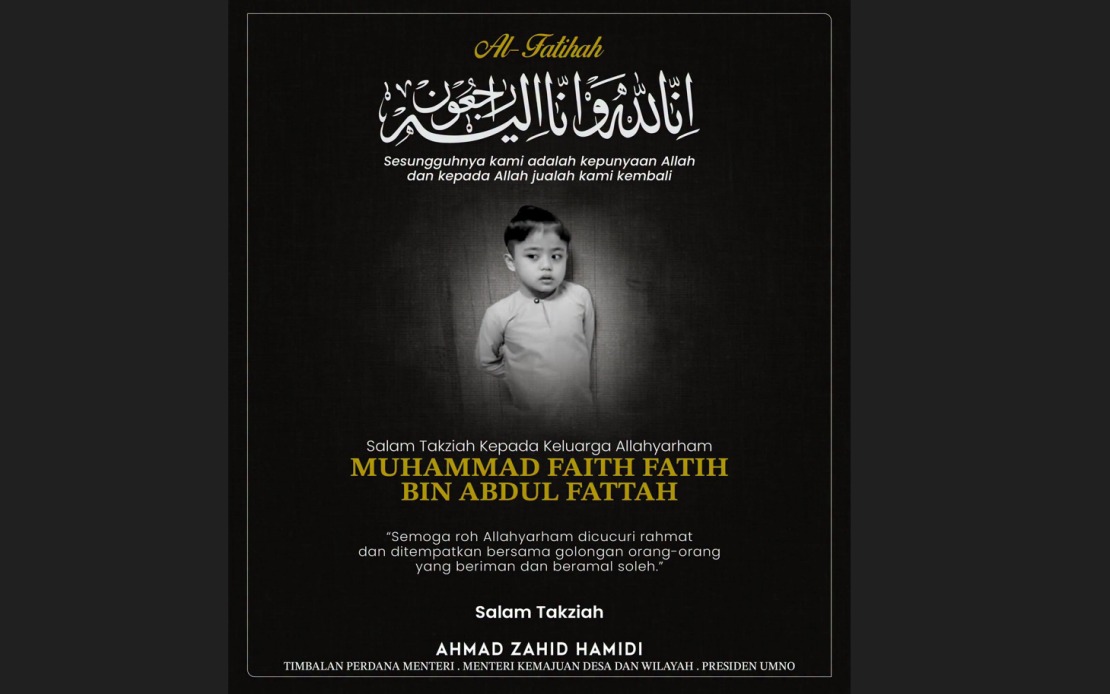
Deputy Prime Minister Datuk Seri Dr Ahmad Zahid Hamidi has expressed his sympathies to the bereaved family of Muhammad Faith Fatih Abdullah Fattah, a six-year-old boy with autism, after the child's death was confirmed in an oil palm plantation near Sungai Sumun in Hutan Melintang, Perak. The tragic discovery marked the conclusion of an intense search-and-rescue effort that had begun when the boy went missing from his home.
In remarks shared on his social media platform, Ahmad Zahid, who represents the Bagan Datuk parliamentary constituency, described the incident as deeply sorrowful, highlighting the particular vulnerability of a young child living with special needs. The Deputy Prime Minister acknowledged the exceptional emotional burden that such a loss places on a family, recognizing the profound grief that accompanies the death of a child, especially one requiring specialized care and support.
Ahmad Zahid directed his message of comfort specifically toward the child's parents, emphasizing the unique suffering experienced by mothers and fathers who lose offspring. His statement underscored the universal nature of parental loss whilst acknowledging the additional complexities faced by families of children with developmental conditions. The remarks reflected a formal acknowledgment of loss from Malaysia's second-highest ranking governmental position.
The Deputy Prime Minister called upon both the immediate family and the broader community to find strength and resilience in the face of this calamity. He invoked religious observance by encouraging the recitation of Al-Fatihah, the opening chapter of the Quran, and requested divine compassion for the departed soul. This combination of emotional support and spiritual comfort represents a traditional Malaysian approach to grieving, particularly within Islamic cultural contexts.
The search operation that ultimately led to the tragic discovery began following a report filed by police at approximately 4.54 pm on the day prior. The Bagan Datuk police chief, Supt Mohammad Ali Mohd Jali, confirmed that the child had last been observed in his family's living room before disappearing. The subsequent search-and-rescue effort proceeded through the evening hours, involving personnel and resources mobilized to locate the missing boy.
Authorities eventually located the child's body at approximately 10.08 pm within a drainage channel situated in the oil palm cultivation zone. The location suggests the child may have ventured away from his residential area and become lost or trapped in the plantation landscape. The circumstances surrounding how the child came to be in the drainage system remain subject to investigation, though the challenging terrain of agricultural areas presents inherent risks for young and vulnerable individuals.
The incident highlights ongoing concerns within Malaysia regarding child safety, particularly for children with autism spectrum disorder and other developmental conditions. Families caring for children with special needs face distinct challenges in ensuring supervision and preventing unauthorized wandering, challenges that existing community support systems and infrastructure do not always adequately address. The tragic outcome underscores the intersection between individual family circumstances and broader public health considerations.
Autism in Malaysia remains an area requiring increased awareness and resource allocation. While diagnostic capabilities have improved in recent years, access to comprehensive support services, specialized education, and community infrastructure designed to accommodate children with autism remains unevenly distributed across the country. Urban centers tend to have more developed services, whilst rural and semi-rural areas like those in Perak often experience significant service gaps.
The involvement of the Deputy Prime Minister in offering condolences reflects the significance that Malaysian leadership attributes to such tragic incidents. Public acknowledgment from senior governmental figures serves multiple functions: it recognizes the humanity of the affected family, validates their grief through official attention, and sends broader societal messages about the value placed on protecting vulnerable populations. Such gestures, whilst not addressing the immediate tragedy, contribute to a framework of collective acknowledgment and support.
The case also raises questions about how residential communities can better implement safety measures for children with special needs. Environmental design, community awareness programs, and coordination between families and local authorities all represent potential areas for improvement. Moving forward, stakeholders including education officials, health authorities, and local government representatives may examine this incident as a catalyst for reviewing existing protocols and support mechanisms.
Families of children with autism throughout Malaysia will likely regard this incident with heightened awareness of risks inherent in their daily circumstances. The case serves as a sobering reminder of the constant vigilance required and the devastating consequences when oversight lapses occur. Community organizations focused on special needs support may find increased urgency to develop preventative strategies and emergency response procedures.

