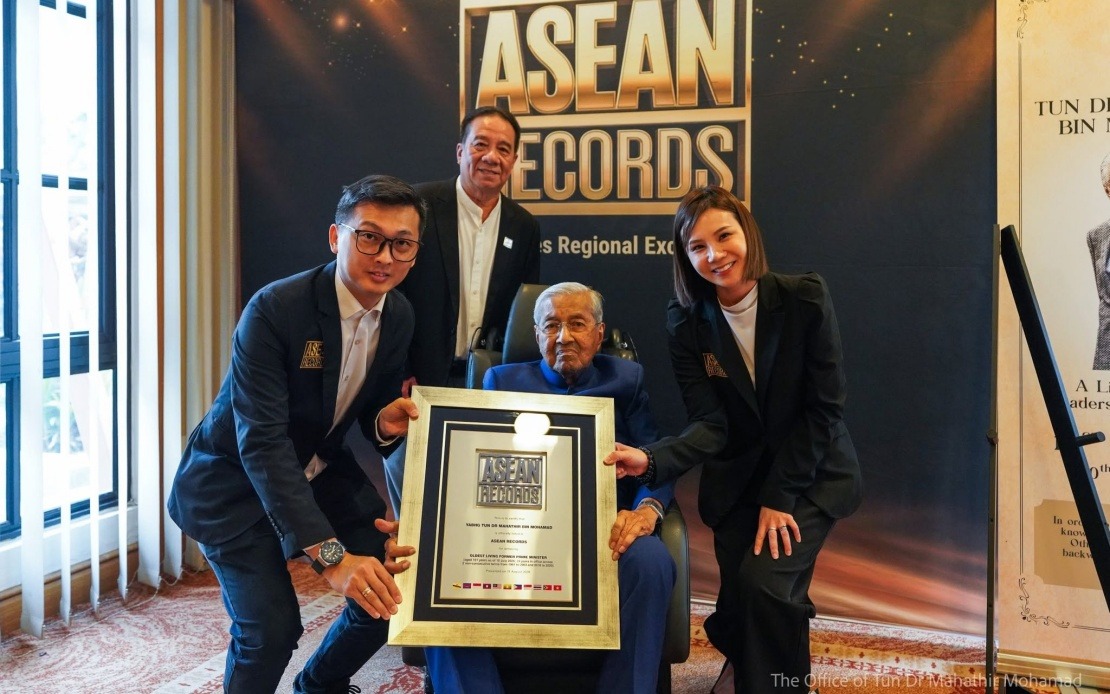
Tun Dr Mahathir Mohamad and his wife Tun Dr Siti Hasmah Mohd Ali have etched their names into regional record books following the official recognition of three major longevity milestones that underscore their remarkable life partnership. The dual certifications, presented during a ceremony at the Perdana Leadership Foundation in Kuala Lumpur, acknowledge achievements that have not been matched anywhere across the ASEAN region or major Asian markets, according to the adjudication teams that verified the records.
At 101 years old, Dr Mahathir now holds the distinction of being the oldest living former prime minister recognised by ASEAN Records, a title that reflects both his individual longevity and the historical significance of his lengthy tenure leading Malaysia. Simultaneously, his centenarian spouse, Dr Siti Hasmah, has been acknowledged as the oldest living spouse of a former prime minister in the region, marking a parallel achievement that extends the couple's collective prominence beyond political history into the realm of human longevity studies.
The third record, jointly awarded to both Dr Mahathir and Dr Siti Hasmah, carries perhaps the most symbolic weight: recognition as the first former head of government and spouse to simultaneously become living centenarians. This achievement encompasses not only their individual lifespans but the unusual circumstance of reaching this milestone together, which the verification teams determined had no documented precedent across ASEAN nations and other major Asian countries.
The timing of these recognitions carries particular poignancy given the extraordinary succession of personal milestones the couple experienced this summer. Dr Mahathir celebrated his 101st birthday on July 10, followed five days later by Dr Siti Hasmah's entry into centenarian status on July 12. Just weeks afterward, on August 5, the couple marked their 70th wedding anniversary, a diamond jubilee that speaks to both their individual resilience and the stability of their relationship across seven decades.
The presentation of the records was overseen by Tan Sri Danny Ooi, who chairs the ASEAN Records Advisory Board, assisted by chief adjudicators Gillian Ooi and Eldrick Koh, both of whom serve as directors for ASEAN and ASIA Records respectively. Their involvement underscores the official nature of the recognition and the rigorous verification process undertaken to confirm that no comparable achievements existed in the region's documented history.
For Malaysia specifically, these records represent more than mere statistical curiosities. They reflect the changing nature of human longevity in the region, where improved healthcare and living standards have extended lifespans significantly compared to previous generations. Dr Mahathir's tenure as prime minister spanned 22 years across two separate periods—from 1981 to 2003 and again from 2018 to 2020—and his continued vitality into his 101st year demonstrates the capacity for active engagement even at advanced ages.
The recognition of Dr Siti Hasmah as a centenarian in her own right carries independent significance beyond her role as a former first lady. Her century-long lifespan encompasses the entire modern history of Malaysia, from before independence through decades of rapid national development, medical advancement, and social change. Her longevity alongside her husband's creates a living bridge to Malaysia's political and social past.
The achievement also illuminates broader patterns of healthy ageing and family stability within Malaysian society. That both members of a long-married couple should reach centenarian status together, while maintaining sufficient health and mental acuity to be publicly recognised for their achievement, speaks to advantages of social connection, purposeful engagement, and access to quality healthcare that characterise their circumstances.
These records arrive at a moment when regional and global attention to longevity research continues expanding. The ASEAN region, like much of Asia, faces rapidly ageing demographics, with countries developing strategies to support and celebrate elderly populations. The Mahathir-Siti Hasmah records provide a compelling narrative of successful ageing that may inspire broader conversations about longevity planning and elder care across Southeast Asia.
Dr Mahathir's public announcement of the records through a Facebook post reflects modern communication patterns even among the most senior citizens, demonstrating that technological engagement extends across generations. The formal ceremony and media coverage surrounding the recognition also highlight Malaysia's institutional capacity to acknowledge and document such milestones, placing the country alongside others maintaining comprehensive records of regional achievements.
The convergence of three separate record classifications—individual achievement for Dr Mahathir, individual achievement for Dr Siti Hasmah, and joint achievement for the couple—creates a comprehensive recognition structure that acknowledges both their personal resilience and their collective legacy. This multifaceted approach to record-keeping reflects evolving understanding of how achievements can be measured and valued across different dimensions of human experience and relationship.

