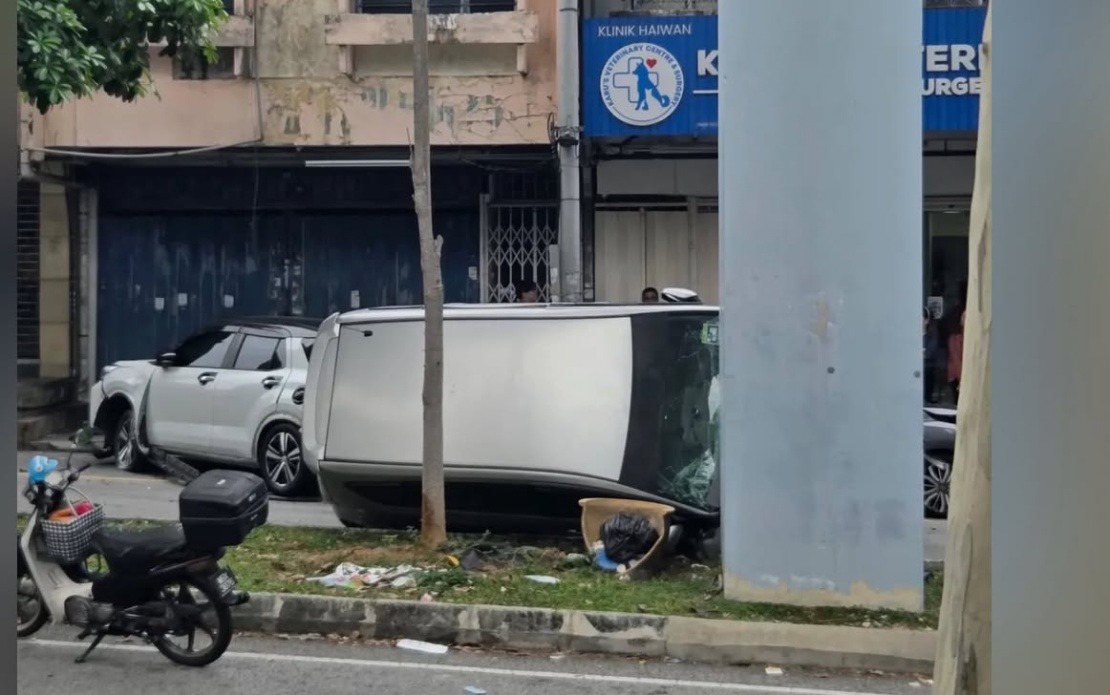
A routine morning commute turned chaotic in the Cheras area of Kuala Lumpur when a 28-year-old man operating a BMW 320i abruptly lost control of his vehicle after experiencing a seizure, ultimately striking six vehicles parked along the roadside. The collision unfolded at approximately 8.30 am on Jalan Midah 1, near Taman Midah 1, according to statements issued by traffic authorities investigating the incident.
The Kuala Lumpur Traffic Investigation and Enforcement Department confirmed that the driver suddenly lost consciousness or experienced a convulsive episode whilst navigating the stretch, causing the vehicle to veer from the roadway and collide with the stationary motorcars positioned on the left shoulder. The impact sequence damaged all six vehicles involved, though the absence of occupants in the parked cars meant that physical harm was entirely avoided—a fortunate outcome given the potential severity of the situation.
ACP Mohd Zamzuri Mohd Isa, heading the JSPT, elaborated that initial investigations revealed the vehicle owner has endured a prolonged struggle with seizure disorders, with medical records indicating a condition spanning approximately ten years. This medical history becomes critically relevant to both the investigation's trajectory and broader questions regarding the licensing and operational fitness of individuals with known neurological conditions. The department's findings suggest the seizure was unpredictable and unrelated to driver impairment from substances, as a breathalyser examination yielded entirely negative results with zero milligrammes per 100 millilitres of alcohol detected.
The six affected vehicles belonged to four women between ages 29 and 43, one 39-year-old man, and a commercial enterprise's registered vehicle. All vehicles remained unoccupied at the moment of impact, sparing their owners and any potential passengers from injury or trauma. The damages, whilst exclusively vehicular, nonetheless represented a significant disruption to the morning routines of multiple residents in this residential-commercial zone of Kuala Lumpur.
From an investigative perspective, traffic authorities have classified the matter under Rule 10 of LN 166/59, the relevant traffic regulation governing accidents arising from driver incapacity or medical emergencies. This classification distinguishes the incident from typical traffic violations, instead framing it within a framework that acknowledges involuntary loss of vehicle control precipitated by sudden health crises. The ongoing investigation aims to establish definitive causation and determine whether regulatory or administrative measures are warranted regarding the driver's continued possession of a valid driving licence.
The incident underscores a recurring tension within Malaysian road safety frameworks: the relationship between medical conditions and driving privileges. Individuals diagnosed with seizure disorders face variable standards across jurisdictions, and local regulations often permit continued driving provided seizure frequency remains controlled through medication. However, breakthrough seizures—those occurring despite pharmaceutical management—remain an ever-present risk factor. This particular case exemplifies how even a solitary uncontrolled seizure episode can generate substantial property damage and pose theoretical risks to pedestrians or other road users.
For Malaysian motorists and vehicle owners, the collision highlights the ongoing vulnerability associated with street parking in densely populated residential areas. Despite the absence of injuries this morning, the incident nonetheless generated considerable administrative burden for the affected vehicle proprietors and raises questions about parking arrangements in neighbourhoods where vehicular density and residential proximity create inherent risks.
Traffic police have actively encouraged witnesses or members of the public possessing relevant information to contact the Tun H.S. Lee traffic police station at 03-2071 9999 or the nearest police facility. Such outreach enables authorities to accumulate comprehensive accounts of the sequence of events leading to the collision, potentially clarifying the precise moment and mechanism of the seizure's onset. Enhanced witness testimony may also contribute to determining whether visible warning signs preceded the incident, information valuable for the broader investigation.
The Kuala Lumpur Traffic Investigation and Enforcement Department's examination of this matter will likely extend beyond simple accident documentation to encompass questions touching on medical certification standards for commercial and private drivers, the efficacy of existing seizure-management protocols, and potential administrative interventions to prevent recurrence. The case may ultimately inform policy discussions regarding mandatory periodic medical assessment for drivers with documented neurological conditions, a practise already implemented in several Southeast Asian jurisdictions.
As investigations persist, the incident serves as a reminder of the multifaceted risks inherent in urban driving environments, where medical emergencies can instantaneously transform a controlled commute into a collision scenario. Whilst this particular morning culminated without personal injury, the six damaged vehicles and their owners' subsequent inconvenience underscore the far-reaching consequences when driver incapacity intersects with populated roadways. The outcome could easily have differed had children been playing nearby or pedestrians occupied the affected area, making the investigation's thoroughness and any resulting regulatory adjustments potentially consequential for broader public safety considerations across Kuala Lumpur's residential corridors.

