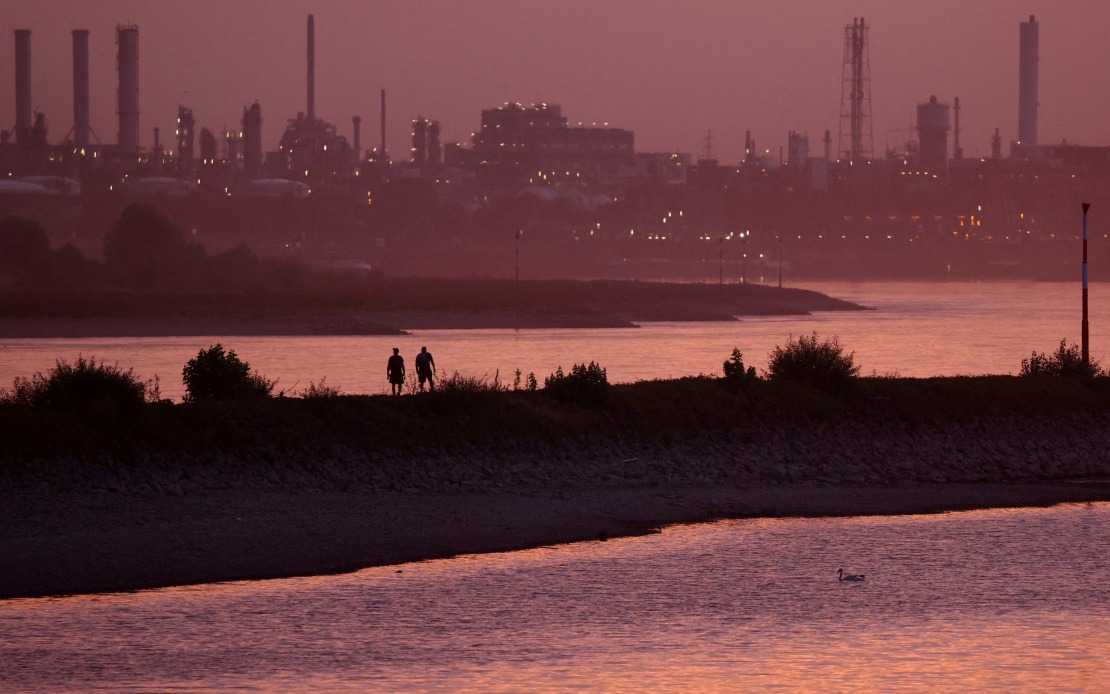
German bomb disposal specialists prepared to undertake a delicate operation on Thursday to safely defuse a substantial unexploded ordnance discovered in the Rhine River near Cologne, following an unprecedented environmental shift that exposed one of Europe's most dangerous legacies. The 500-kilogramme American aerial bomb, uncovered on Wednesday evening near the city's Rheinpark, emerged from beneath the river's surface as water levels plummeted to historic lows during an extended heat and drought period gripping the continent.
The discovery illustrates the dual nature of the current water crisis affecting the region: while drought conditions have devastated agriculture and disrupted commerce, they have simultaneously dredged up reminders of the Second World War's destructive reach nearly 80 years after the conflict's conclusion. German Press Agency reported that approximately 360 residents and workers residing or employed within a 400-metre safety perimeter around the bomb site required mandatory evacuation, a precautionary measure reflecting both the device's substantial explosive potential and the populated nature of Cologne's riverside zones.
Among those displaced were occupants of a retirement home and personnel stationed at the nearby RTL television studios, one of Germany's major broadcasting operations. The evacuation order underscores how wartime ordnance continues to present genuine hazards to contemporary European communities, particularly in heavily-bombed industrial cities like Cologne that endured intense Allied bombing campaigns. Authorities had not announced the precise timing of the defusing operation as of Thursday, suggesting that preliminary assessments and safety preparations were still underway.
The circumstances surrounding the bomb's discovery reveal the interconnected challenges facing Europe's environmental and infrastructure systems. The Rhine gauge registered just 67 centimetres on Thursday in Cologne, matching a record minimum established days earlier, with forecasters anticipating further descent to 66 centimetres. This represents an alarming situation for one of the world's most critical waterways, responsible for transporting approximately 200 million tonnes of cargo annually through Germany and linking the continent's industrial heartland to international markets.
Shipping operations have already suffered significant disruption due to these conditions, with commercial vessels forced to drastically reduce cargo loads to navigate the shallower passages. Barge operators and logistics companies face mounting economic pressures as transportation costs rise and delivery schedules stretch, with ripple effects throughout European supply chains. The reduced water depth creates both immediate operational difficulties and longer-term economic concerns for the region's manufacturing and export-dependent industries.
Hydrologists and water management officials have provided sobering assessments regarding the timeline for recovery. Current forecasts indicate only modest water level increases over the coming days, with no substantial restoration expected in the near term. The prolonged heat episode driving the drought shows little sign of relenting, meaning that the Rhine will likely remain dangerously low throughout the remainder of the summer season. This represents an unusually severe situation; while the Rhine occasionally experiences low-water episodes, the convergence of record lows with exposed wartime munitions highlights the scale of the current crisis.
The exposure of unexploded ordnance during environmental shifts is not unprecedented along European waterways, though such discoveries carry particular significance given their potential danger. Thousands of bombs were dropped on Cologne during the Second World War, making the city one of the most heavily bombed German municipalities. Many of these devices failed to detonate upon impact, remaining embedded in river sediment or buried beneath structures for decades. As environmental conditions fluctuate, some of these historical explosives periodically resurface, requiring emergency response protocols and specialist intervention.
For Southeast Asian observers monitoring European infrastructure challenges, this situation illustrates vulnerabilities that extend beyond immediate geographic boundaries. Global supply chains depend substantially on Rhine transport, and disruptions reverberate through international commerce. Malaysian exporters, manufacturers relying on European component imports, and shipping companies with operations in the region all face potential complications as logistical bottlenecks develop. The incident underscores how environmental stress, aging industrial infrastructure, and historical legacies converge to create systemic risks in developed economies.
The defusing operation, once commenced, will require meticulous execution by trained specialists using contemporary technology to safely neutralise an 80-year-old device that has been submerged in river conditions for decades. The prolonged immersion may have affected the bomb's structural integrity, creating unpredictable behaviour during handling. Authorities will prioritise safety throughout the operation, mindful that complications could release stored explosives and endanger both the specialists and nearby areas.

