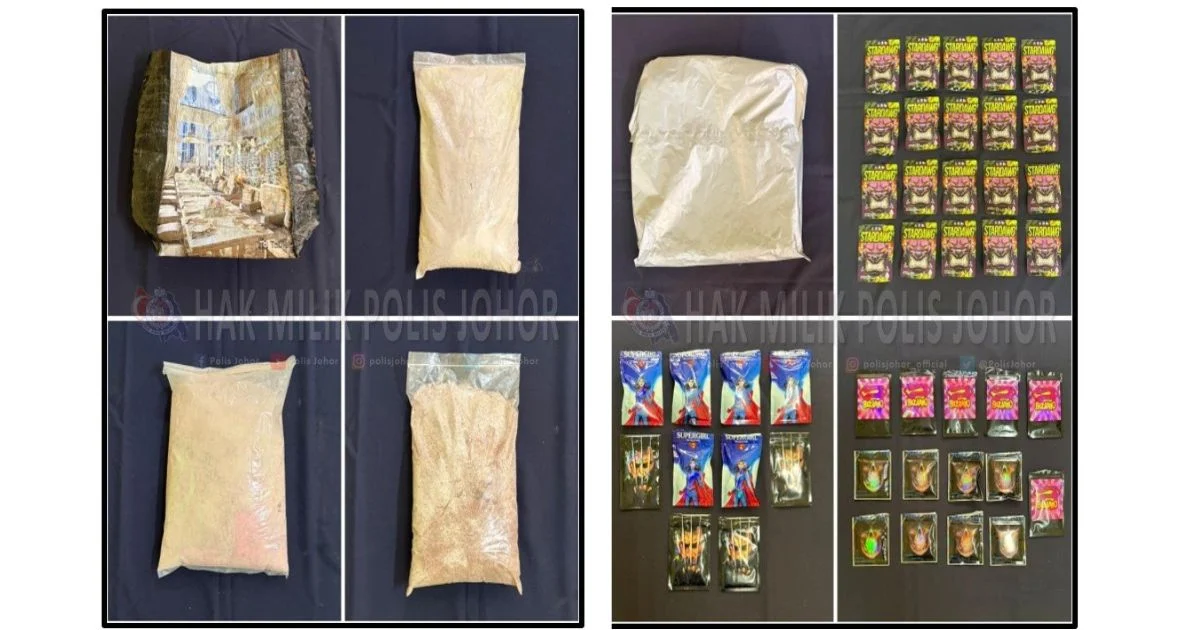
Law enforcement agencies in Johor Baru have successfully brought down what police describe as an organised drug distribution network centred in Kulai, resulting in the arrest of a husband and wife team and the seizure of controlled substances valued at approximately RM3.59 million. The operation represents a notable breakthrough in the ongoing battle against narcotics trafficking in the southern state, where authorities have intensified efforts to dismantle supply chains feeding the illicit drug market across Peninsular Malaysia.
The dismantling of this particular syndicate is significant in the context of Johor's location and infrastructure. As a major economic hub and gateway connecting Malaysia to Singapore, the state serves as a strategic transit point for drug trafficking operations that exploit its proximity to major ports and highway networks. Criminal organisations have long viewed Johor as a crucial link in supply chains extending across Southeast Asia, making it a priority area for police anti-narcotics divisions.
Kulai, where the operation was based, sits along a transport corridor that facilitates both legitimate commerce and illicit activities. The town's location within the broader Johor landscape makes it vulnerable to becoming a distribution hub, allowing traffickers to reach markets across the peninsula while potentially exploiting the area's population and transient nature. The syndicate's choice of this location would have provided operational advantages for moving and selling narcotics to customers in multiple states.
The couple's arrest involved an undisclosed operational timeframe, though such interventions typically follow sustained surveillance and intelligence gathering. Police investigations preceding the takedown would have mapped the network's structure, identified key players, and established supply sources and distribution patterns. The coordination required to locate, access, and seize drugs of this scale reflects considerable detective work and inter-agency collaboration within Malaysia's drug enforcement apparatus.
The narcotics haul valued at RM3.59 million represents the street value of substances rather than their chemical weight, meaning the actual quantity would vary depending on the type of drug and its purity levels. Street valuation calculations typically account for local market prices and the wholesale-to-retail markup that traffickers employ. This figure underscores the substantial financial stakes within Malaysia's drug economy and the potential profitability that attracts individuals into trafficking operations despite severe legal consequences.
For the detained couple, the implications are profound. Malaysia maintains among Asia's strictest drug laws, with trafficking offences carrying mandatory sentences and, for quantities exceeding specified thresholds, potential capital punishment. The RM3.59 million valuation suggests quantities likely to trigger serious charges under the Dangerous Drugs Act. Both individuals now face extended detention periods during investigations and potential lengthy court proceedings that could determine their legal fate for decades.
The broader context of drug enforcement in Malaysia reveals persistent challenges despite aggressive policing strategies. While major busts like this generate headlines and demonstrate police capability, transnational trafficking networks continue adapting tactics, employing couriers, dispersing operations across multiple locations, and utilising corrupt officials to bypass law enforcement. The couple's operation, though now disrupted, represents merely one node within larger systems. The source of their supplies and the network of dealers distributing their products remain subjects requiring further investigation.
Johor's vulnerability to narcotics trafficking reflects supply-side pressures originating from established drug-producing regions in Southeast Asia. Methamphetamine manufacturing clusters in Myanmar's borderlands, heroin refineries in Afghanistan's poppy fields, and new psychoactive substance laboratories increasingly operating in clandestine locations throughout the region continuously feed demand from consuming markets including Malaysia. Regional cooperation through frameworks like the ASEAN Regional Forum remains critical, though implementation varies across member states.
For Malaysian readers and policymakers, this bust illustrates the persistent nature of the drug problem and enforcement agencies' ongoing efforts to contain it. However, it also underscores that drug demand within Malaysia—driven by addiction issues, limited treatment capacity, and socioeconomic factors—continues fuelling criminal entrepreneurship. Supply-side interventions like this one, while necessary, address only symptoms rather than underlying drivers of trafficking.
The case also highlights enforcement disparities across Malaysia. Johor's relatively sophisticated police operations reflect resource allocation and capacity in more developed areas, while less urbanised regions and smaller states may lack equivalent investigative capabilities. This creates an uneven playing field where some trafficking networks face greater exposure while others operate with relative impunity in less-monitored territories.
Moving forward, this operation provides valuable intelligence for understanding syndicate structures, operational methods, and supply chains. Police can analyse the couple's communications, financial records, and customer networks to identify upstream suppliers and downstream distributors. Such information feeding into broader anti-narcotics strategy potentially yields longer-term disruption to trafficking ecosystems.
The arrest also serves a deterrent function, demonstrating that narcotics trafficking carries serious consequences and that Malaysia's law enforcement maintains capacity to detect and apprehend offenders. However, deterrent effects remain limited when potential profits from trafficking far exceed legitimate income opportunities and when addiction-driven demand persists in Malaysian communities.
Ultimately, while celebrating law enforcement successes remains appropriate, understanding that RM3.59 million busts occur regularly and drug trafficking continues expanding suggests that Malaysian authorities and society must pursue complementary strategies encompassing demand reduction, treatment expansion, and regional cooperation alongside traditional enforcement approaches.

