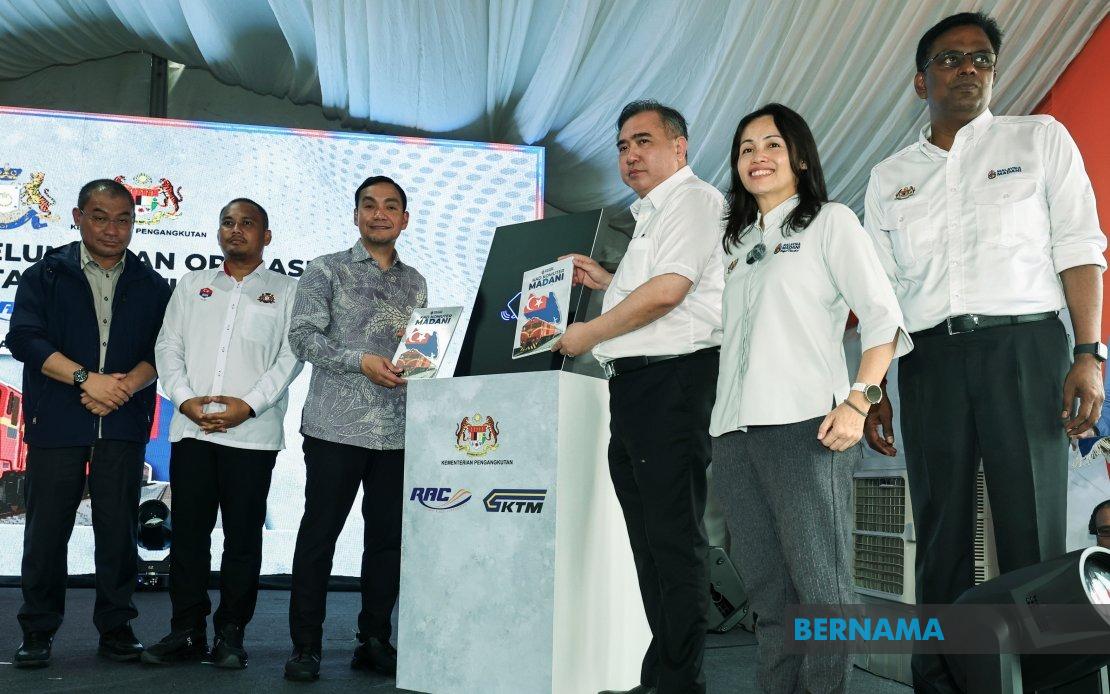
Johor Menteri Besar Datuk Seri Onn Hafiz Ghazi has warned that the Elevated Autonomous Rapid Transit (E-ART) system represents an indispensable component of the state's transport strategy as the region prepares for the arrival of the Johor Bahru-Singapore Rapid Transit System (RTS) Link next year. Speaking during the launch of the Southern Shuttle train service at KTM Kulai Station, Onn Hafiz outlined the cascading pressures that the cross-border connection will exert on Johor Bahru's existing mobility infrastructure, necessitating a multi-layered response from state and federal authorities.
The challenge confronting Johor Bahru is substantial in scope. The state capital's population stands at approximately 1.8 million residents—a figure that approaches the entire population of Penang—making it Malaysia's second-largest metropolitan centre. This dense urban concentration, combined with the region's status as the country's primary international gateway, generates extraordinary cross-border traffic volumes. Once the RTS Link becomes operational, planners anticipate a marked surge in passenger movements between Malaysia and Singapore, with commuters and visitors inevitably funnelling through the city's existing road network.
Onn Hafiz characterised the interim transport interventions currently underway as temporary relief measures rather than comprehensive solutions. The expansion of Park & Ride facilities, coupled with smart traffic management systems at JB Sentral, are designed to offer short-term and medium-term congestion relief. However, the Menteri Besar was forthright in acknowledging that these measures alone cannot sustain mobility once the RTS Link attracts its full complement of daily users. The permanent solution, he contended, must involve infrastructure of greater ambition and capacity—namely, the E-ART system.
The E-ART project represents a departure from conventional ground-level transport modes and reflects growing international recognition that elevated transit networks can effectively disperse traffic flows in congested metropolitan areas. By operating above existing road networks, the system would bypass surface-level bottlenecks whilst maintaining rapid, high-capacity passenger movement. This characteristic makes it particularly valuable for Johor Bahru, where geographical constraints and existing urban development patterns limit the expansion of traditional road infrastructure.
The timing of E-ART implementation assumes critical importance in Onn Hafiz's assessment. With the RTS Link's commencement now imminent, the window for establishing complementary transit infrastructure narrows considerably. Should E-ART remain in the planning or early construction phases when cross-border traffic intensifies, the state risks experiencing severe congestion that could undermine economic productivity and citizen quality of life. The Menteri Besar's emphasis on expediting the project reflects this urgency.
From an economic perspective, Johor Bahru's position as Malaysia's gateway to Singapore carries implications extending far beyond state borders. The city functions as a crucial node in the broader Southeast Asian commercial network, facilitating trade, labour movement, and tourism flows across the region. Congestion that degrades the efficiency of this gateway would impose costs on Malaysian exporters, create bottlenecks for cross-border workers, and diminish the region's attractiveness to international investors. Conversely, a well-functioning, modern transport ecosystem would reinforce Johor Bahru's competitive advantages.
Onn Hafiz's framing of the E-ART project as requiring federal government determination and swift implementation reveals the funding and coordination challenges inherent in such ambitious infrastructure development. State governments typically lack the financial capacity to independently fund large-scale transit systems, necessitating federal investment and political commitment. By publicly emphasizing federal responsibility, the Menteri Besar applied diplomatic pressure whilst simultaneously highlighting the project's national significance beyond Johor's boundaries.
The presence of Transport Minister Anthony Loke and Deputy Communications Minister Teo Nie Ching at the Southern Shuttle launch event signalled federal engagement with the broader transport agenda affecting the region. These officials' attendance provided a platform for articulating the interconnected nature of transport investments—linking the immediate Southern Shuttle initiative to longer-term strategic projects like E-ART and the RTS Link itself. The gathering thus functioned as a demonstration of coordinated governance on transport matters affecting Malaysia-Singapore relations.
Onn Hafiz's observation that E-ART would represent "Federal intervention that can truly be felt, appreciated and remembered by the people" reveals the political dimensions underlying infrastructure investment. Citizens directly experience transport infrastructure daily; efficient, modern systems enhance quality of life and reinforce public confidence in government capacity. Conversely, congestion-plagued networks generate frustration and dissatisfaction. By positioning E-ART as a transformative intervention, the Menteri Besar sought to elevate public and political consciousness regarding its necessity.
The E-ART project must operate in concert with the RTS Link rather than in isolation. When completed, the cross-border rail connection will concentrate passenger arrivals at Bukit Chagar, creating distribution challenges that existing surface transport cannot adequately manage. E-ART would serve as a critical distribution mechanism, channelling arriving passengers throughout greater Johor Bahru and reducing dependency on traditional bus and taxi services. This complementary relationship underscores why serial delays in E-ART implementation could ultimately constrain the effectiveness of the RTS Link investment itself.
International precedent supports the value of elevated transit systems in congested metropolitan areas. Cities including Bangkok, Manila, and Jakarta have deployed elevated rail networks to manage traffic pressures whilst maintaining urban mobility. However, each context differs in terrain, urban form, and development patterns, requiring site-specific design and implementation strategies. Johor Bahru's relatively flat topography and ongoing urban expansion offer advantages compared to more mountainous or densely built environments, potentially simplifying E-ART construction and deployment.
The broader policy question emerging from Onn Hafiz's remarks concerns the hierarchy of transport investments across Malaysia. Competition for federal development funding remains intense, with infrastructure demands extending throughout the peninsula and beyond. Articulating a convincing case for E-ART requires demonstrating not merely local benefit but national significance—framing the project as essential to maintaining Malaysia's competitiveness in the regional economy and fulfilling the potential of the RTS Link investment. The Menteri Besar's emphasis on Johor Bahru's population and international gateway status constituted precisely such an argument.