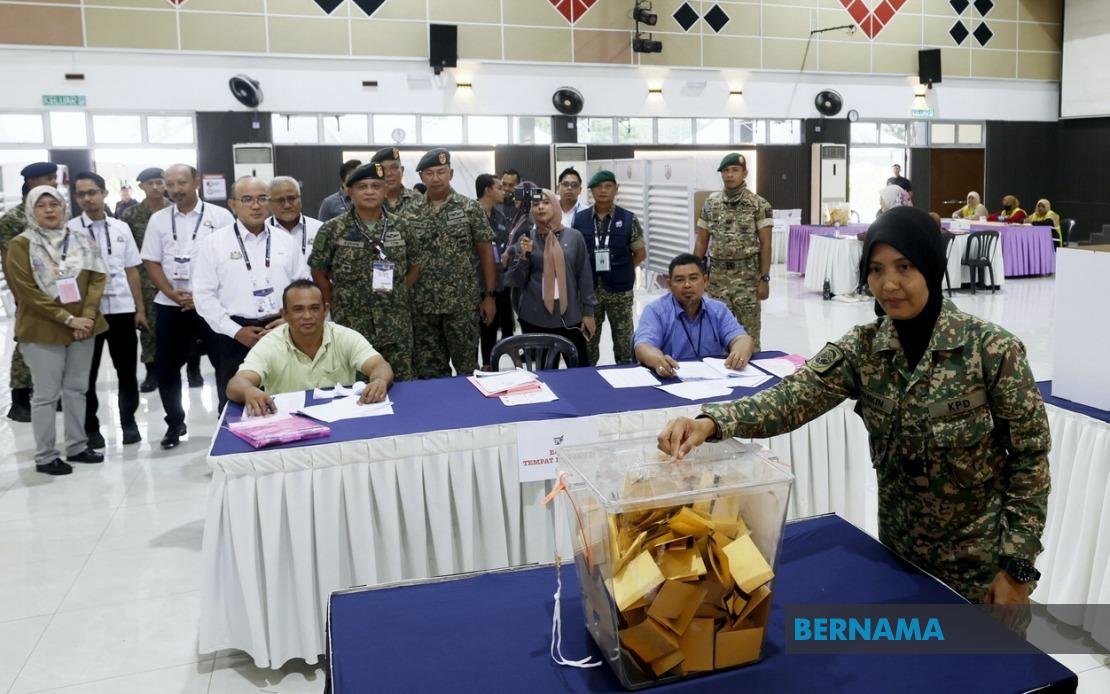
The early voting phase for Johor's 16th state election concluded today with all 62 designated centres shutting their doors by 5 pm, marking a significant milestone in the electoral process just days before the main polling day on Saturday. Election Commission chairman Datuk Seri Ramlan Harun disclosed that the staggered closure schedule, determined by the EC to accommodate varying voter loads across different locations, saw 29 centres close at noon, five additional centres at 2 pm, and the remaining 28 at 5 pm. The early voting mechanism, a standard procedure in Malaysian elections, was established primarily to allow security personnel and their spouses to participate without compromising operational readiness in the state.
The turnout for this preliminary voting phase demonstrated considerable enthusiasm among the target demographic. A total of 20,607 registered electors participated in the early voting process, comprising 8,544 Malaysian Armed Forces personnel along with their spouses and 12,063 police officers and their families. By 3 pm, when preliminary figures were tabulated, the Election Commission reported that 19,136 voters had successfully cast their ballots, translating to a 92.86 per cent participation rate—a figure that falls short of the commission's ambitious 96 per cent target but nevertheless represents strong engagement from security sector voters.
The logistical framework underpinning the election reflects the Election Commission's meticulous planning to ensure operational efficiency. All completed ballot boxes from the 62 early voting centres will be transported to police stations across Johor for secure storage until the formal vote counting process commences at 5 pm on Saturday, immediately following the conclusion of polling at the general voting stations. This arrangement protects ballot integrity while maintaining the sequential nature of the election process, preventing any premature disclosure of early voting results that could theoretically influence subsequent voter behaviour.
The upcoming Saturday election carries substantial significance for Johor's political landscape. A total of 1,140 polling centres have been established throughout the state to accommodate the 2,727,926 registered voters eligible to participate in the main polling day. These polling stations will be distributed across the 56 state legislative assembly seats that constitute the Johor State Legislative Assembly. The scale of this electoral exercise underscores Johor's demographic importance within Malaysia's federal structure, as the southern state remains one of the nation's most populous and economically significant regions.
The contest itself features considerable competition, with 172 candidates vying for the 56 available seats across the state assembly. This distribution equates to an average of approximately three candidates per seat, suggesting moderately competitive races in most constituencies. The diversity of candidates reflects the multi-party nature of Malaysia's political system, where established coalitions and emerging independent candidates jostle for voter support across varying demographic and socioeconomic contexts.
For Malaysian observers and regional analysts, the Johor state election represents a crucial barometer of electoral sentiment in one of the nation's most strategically important states. As a traditionally influential political entity with significant economic output, Johor's election results typically reverberate across national political calculations. The participation rates observed during early voting, despite falling slightly short of the Election Commission's target, suggest a baseline level of civic engagement that will be tested more comprehensively when general voters head to polling centres on Saturday.
The staggered closure of early voting centres reflects operational realities specific to security sector voting arrangements. By distributing closures across three time windows rather than implementing a uniform end time, the Election Commission could manage the flow of voters more effectively and reduce congestion at individual centres. This approach also acknowledged geographical variations, as some polling stations serving military installations or police headquarters required longer operating hours to process the concentrated voter populations they served.
The forthcoming main election day will provide a more comprehensive picture of voter sentiment across Johor's broader population. While the 92.86 per cent early voting turnout suggests reasonable enthusiasm among security personnel, the performance of general voting turnout on Saturday will be the definitive indicator of overall civic participation. High turnout across both early and general voting phases would demonstrate robust democratic engagement, while lower general voting figures might point to apathy or competing priorities among certain voter segments.
From a Southeast Asian perspective, Johor's election occurs within a regional context of ongoing democratic renewal and political recalibration across ASEAN member states. Malaysia's continued commitment to regularly scheduled state-level elections and transparent voting procedures reinforces the country's democratic credibility within the region, particularly as several neighbouring nations grapple with their own political transitions. The Election Commission's meticulous management of the voting process, evident in the detailed scheduling and security arrangements surrounding early voting, demonstrates institutional competence in electoral administration that sets standards for the broader region.

