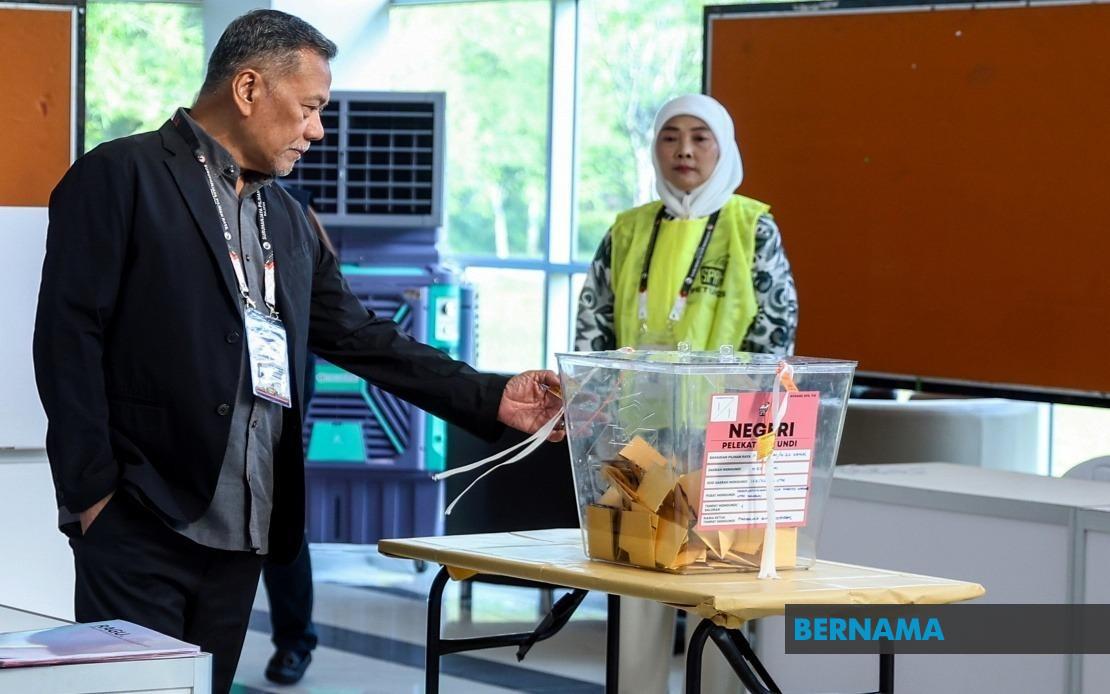
The head of Malaysia's Election Commission made a series of unannounced visits to polling stations across Johor Bahru on July 11 to personally assess the administration of the 16th Johor state election. Datuk Seri Ramlan Harun's inspection tour encompassed four distinct voting centres distributed throughout the city, reflecting the Commission's commitment to maintaining transparency and operational integrity during a crucial state electoral process that carries significant implications for Malaysia's political landscape.
Ramlan's first stop brought him to Dewan Raya Taman Ungku Tun Aminah, serving voters in the Skudai constituency. This centre operated with seven separate polling streams to manage voter throughput efficiently. The inspection commenced at approximately 8.50 am, allowing the Commission chairman to observe voting procedures during the morning period when poll stations typically experience steady traffic from voters. Skudai, as one of Johor's prominent urban constituencies, commands considerable attention given its socioeconomic profile and electoral competitiveness in state politics.
From Skudai, Ramlan proceeded to Raja Zarith Sofiah Library situated within the Universiti Teknologi Malaysia campus, which administered ballots for the Senai constituency. This location notably operated with two polling streams, a considerably smaller configuration compared to other centres visited. The choice of a university library as a polling venue reflects efforts to facilitate voting participation among student populations and academic staff, a demographic segment that Malaysian electoral administrators have increasingly prioritised in recent election cycles.
The inspection itinerary continued to Sekolah Agama Taman Bukit Mewah, the designated polling centre for Kempas constituency. This centre managed six polling streams throughout voting day. Schools, particularly religious educational institutions, remain conventional choices for polling sites across Malaysia due to their established infrastructure, accessibility to communities, and neutral institutional status that electors from diverse backgrounds can typically access without apprehension.
Ramlan concluded his tour at Sekolah Menengah Kebangsaan Bandar Uda Utama in the Perling constituency, which operated the largest configuration among visited centres with nine separate polling streams. The concentration of polling streams at this location suggests higher anticipated voter turnout or a more substantial electorate size compared to other visited constituencies, necessitating enhanced logistics and personnel deployment to prevent bottlenecks and maintain orderly queuing.
During each site visit, Election Commission officials provided detailed briefings to the chairman regarding voting procedures being implemented on the ground. These consultations enabled direct communication of operational realities, potential challenges, and adaptive measures being deployed to optimise the electoral process. Ramlan simultaneously conducted examinations of the physical facilities and amenities provided to both voters and election personnel, assessing standards of comfort, accessibility, and functionality across all visited locations.
The facility inspections represent a critical dimension of election supervision that extends beyond procedural compliance. Adequate seating areas, clear directional signage, functioning lighting and ventilation systems, and accessible facilities for voters with disabilities all contribute to the overall quality of the electoral experience and public confidence in election administration. Malaysia's Election Commission has increasingly emphasised such considerations, recognising that voter satisfaction with the polling environment influences perceptions of electoral legitimacy and may affect future turnout patterns.
The presence of the Election Commission chairman undertaking in-person inspections carries symbolic significance alongside its practical monitoring function. Direct supervisory engagement by the Commission's highest-ranking official signals institutional commitment to maintaining standards and demonstrates responsiveness to potential irregularities or administrative failures. Such visible oversight can reinforce public trust in the electoral process, particularly important in competitive state elections where margin of victory and perceived fairness significantly influence political narratives in subsequent months.
Ramlan's inspection visits occurred during active voting, affording genuine observation of operational procedures rather than facility inspection in absence of actual polling conditions. This approach provides more authentic assessment of how systems function under real demand, revealing coordination challenges between polling station staff, identification verification procedures, ballot distribution mechanisms, and queue management that might not be apparent during theoretical reviews.
The 16th Johor state election represents a consequential political contest with implications extending beyond the state level. Johor remains Malaysia's second-most populous state and historically serves as a barometer for broader electoral sentiment affecting national politics. Election Commission vigilance during such contests reflects recognition that state-level credibility contributes to overall public confidence in Malaysia's democratic processes and institutions.
A press conference scheduled following the inspection tour would provide the Election Commission chairman with opportunity to communicate preliminary observations to media and public stakeholders, potentially addressing any concerns about voting procedures or offering reassurances regarding administrative standards being maintained. Such communications form essential components of election transparency frameworks in contemporary Malaysian democracy, wherein public bodies increasingly acknowledge obligations to proactively communicate operational status rather than maintaining silence until finalised results announcement.
The commission's decision to conduct multi-location inspections rather than focusing on a single centre reflects appropriate recognition that voting quality and procedural adherence requires verification across diverse geographical and institutional contexts. Variations in crowd density, staff experience levels, facility adequacy, and local coordination capabilities between different polling stations necessitate comprehensive sampling to ensure representative assessment of statewide election administration quality.

