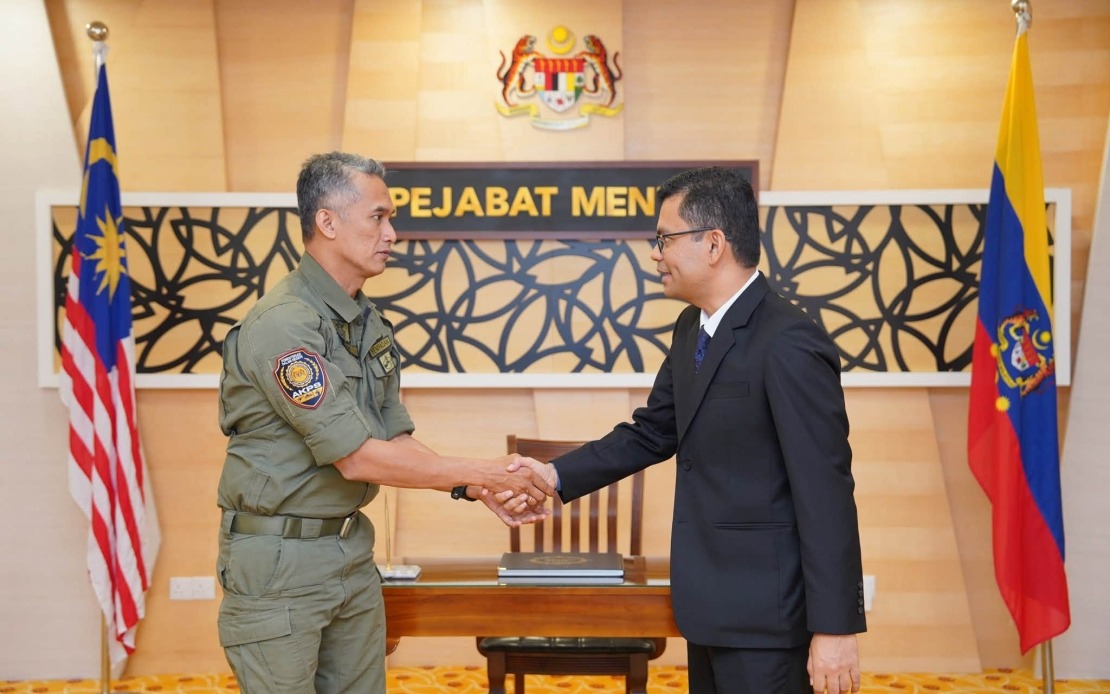
Malaysia's push to modernise its border management framework moved forward this week as senior officials from the Economy Ministry and the Malaysian Border Control and Protection Agency convened in Putrajaya to assess funding requirements for critical infrastructure enhancements and technological upgrades at the country's entry points.
The discussions between Economy Minister Akmal Nasrullah Mohd Nasir and AKPS director-general Datuk Seri Mohd Shuhaily Mohd Zain underscore the government's commitment to transforming border operations through substantial capital investment. The talks centred on how development budgets can best support the strategic modernisation of border infrastructure, with particular emphasis on the financial architecture needed to underpin long-term operational improvements across Malaysia's network of land, sea and air checkpoints.
The timing of these discussions reflects a critical juncture for Malaysia's border administration. The AKPS officially commenced operations on January 1, 2025, representing a significant institutional consolidation that brings together previously dispersed enforcement functions into a unified command structure. This amalgamation absorbed operational responsibilities and personnel from six core government agencies: the Immigration Department, the Royal Malaysian Customs Department, the Malaysian Quarantine and Inspection Services Department, the Health Ministry's relevant divisions, the Department of Wildlife and National Parks, and the Road Transport Department. The integration of these entities creates opportunities to eliminate redundancies and establish standardised protocols, but requires substantial capital investment to succeed.
The Economy Ministry's public statement highlighted how strengthened AKPS capabilities would deliver tangible economic benefits beyond security considerations. Enhanced border management efficiency stands to accelerate legitimate trade flows, reduce processing times at critical checkpoints, and lower compliance costs for businesses dependent on regional supply chains. For Malaysian exporters and importers, improvements in border infrastructure translate directly into competitive advantages in an increasingly time-sensitive global marketplace. The emphasis on supporting "smoother trade" acknowledges that modern border management must balance security imperatives with commercial fluidity.
Infrastructure upgrades form the cornerstone of AKPS's modernisation agenda. The agency and ministry discussions focused on physical improvements to facilities at entry points, from enhanced inspection facilities to upgraded administrative infrastructure that can accommodate advancing technologies and larger processing volumes. These upgrades extend beyond cosmetic improvements; they represent foundational investments that enable the deployment of sophisticated systems and accommodate projected growth in cross-border traffic as regional economic integration deepens.
Technology adoption emerged as a critical pillar in the discussions. Shuhaily emphasised AKPS's commitment to deploying smart border infrastructure centred on integrated biometric systems that can rapidly authenticate travellers and verify documentation across multiple databases. The agency is also prioritising automated cargo scanning capabilities that can process freight declarations and physical contents verification with minimal human intervention, substantially accelerating clearance times while maintaining security standards. These technological investments reflect global best practices adopted by leading border authorities in Europe, North America, and Singapore.
Artificial intelligence and real-time data integration represent the frontier of AKPS's technological vision. By consolidating data streams from multiple enforcement agencies into unified analytical systems, border officials gain unprecedented situational awareness of cross-border movement patterns, emerging smuggling routes, and security anomalies. This data-driven approach enables predictive risk assessment, allowing inspectors to concentrate resources on high-risk movements rather than subjecting all traffic to uniform scrutiny. For Malaysia's economy, this efficiency gain directly reduces friction costs and improves the predictability of border crossing times.
The establishment of AKPS itself reflects recognition that Malaysia's previous fragmented border control architecture had become unsustainable. With different agencies operating according to separate mandates and systems, inconsistencies emerged at different checkpoints and coordination gaps compromised both security and efficiency. The unified agency model, successfully implemented in countries like Australia and the United Kingdom, creates accountability structures and enables coherent strategic planning that dispersed agencies cannot achieve.
Human resource development features prominently in AKPS's strategic planning, with the agency prioritising capacity enhancement programmes to build expertise across its workforce. This encompasses not only training border officers in new technologies and procedures, but also developing specialised expertise in areas like intelligence analysis, biometric system management, and supply chain security. The transition from multiple agencies to a single entity requires cultural integration and the development of common professional standards, demanding significant investment in personnel development.
For Malaysia and the broader Southeast Asian region, the modernisation of border infrastructure carries implications extending beyond national boundaries. As the Association of Southeast Asian Nations pursues deeper economic integration through frameworks like the ASEAN Comprehensive Investment Agreement and the Regional Comprehensive Economic Partnership, efficient border operations become competitive advantages in attracting manufacturing investment and regional trading hubs. Malaysia's position as a maritime and air transport crossroads between major Asian economies makes border modernisation particularly consequential for regional supply chains.
The Economy Ministry's engagement with AKPS reflects broader government recognition that border management has become a strategic economic issue rather than purely a security matter. By integrating border investment planning into development budgeting frameworks, policymakers signal that frontier modernisation ranks alongside conventional infrastructure investment in national economic planning. This institutional positioning should facilitate sustained funding flows and long-term strategic commitment beyond electoral cycles.
The discussions also contextualise Malaysia's approach to the ongoing technological disruption reshaping how nations manage borders globally. Biometric systems, automated processing, and AI-driven risk assessment represent the current frontier of border technology, with continuous advances expected in subsequent years. By investing now in systems architecture and personnel expertise, Malaysia positions AKPS to adapt to emerging technological capabilities rather than requiring wholesale system replacements when new standards emerge.
Stakeholders across Malaysia's trading community and logistics sector will likely watch AKPS's implementation trajectory closely. The success or failure of the agency's modernisation agenda will materially affect the cost and predictability of doing business across Malaysia's borders, influencing investment decisions by companies dependent on efficient regional supply chains. The discussions between the Economy Ministry and AKPS suggest policymakers understand these commercial imperatives and are treating border modernisation as an economic priority meriting substantial development investment.

