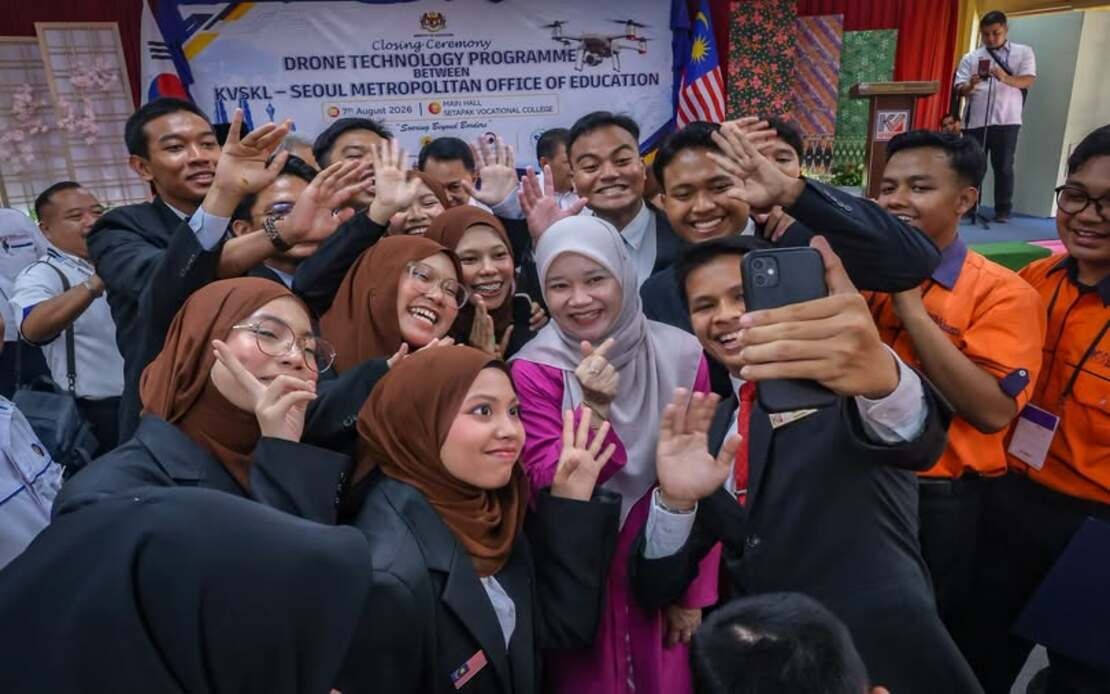
Education Minister Fadhlina Sidek has issued a practical challenge to students at Setapak Vocational College, asking them to harness drone technology to strengthen security measures across their campus. The initiative marks a deliberate effort to bridge the gap between theoretical learning and real-world problem-solving, with students given a month to research, develop, and present concrete proposals for implementing the technology. The minister will personally review the submissions, signalling the seriousness with which the government views this hands-on educational exercise.
The challenge emerged during a collaborative programme between the Seoul Metropolitan Office of Education and Setapak Vocational College, underscoring Malaysia's growing partnerships with international institutions to enhance technical education. South Korean Ambassador to Malaysia Yeo Seung-bae attended the event, reflecting the bilateral commitment to knowledge exchange and technological capacity-building. Such partnerships are increasingly important as Southeast Asian nations seek to develop skilled workforces equipped to compete in global markets where advanced technologies have become essential rather than optional.
Fadhlina's remarks during the event reveal a strategic vision for vocational education that extends beyond conventional curriculum delivery. Rather than limiting instruction to operating drones and robotics as isolated technical skills, she explicitly encouraged students to think critically about how these tools address tangible challenges within their immediate environment. This pedagogical approach—connecting technology to problem-solving—represents a significant shift from rote learning toward applied innovation, a shift that aligns with broader regional efforts to cultivate entrepreneurial thinking among young people.
The minister observed firsthand the students' determination as they demonstrated their capabilities with drone operations and robotic systems. She acknowledged that mistakes and setbacks occurred during these demonstrations, yet highlighted this as evidence of authentic learning rather than failure. This perspective is particularly valuable in Malaysian educational discourse, where risk-aversion and fear of failure have historically constrained innovation. By celebrating perseverance through technical difficulties, Fadhlina models an attitude that encourages experimentation and iterative improvement—qualities essential in sectors driven by rapid technological change.
Robotics, drone technology, and artificial intelligence are no longer abstract concepts confined to research laboratories or distant futures. These technologies have firmly embedded themselves within contemporary workplaces across manufacturing, logistics, agriculture, infrastructure management, and public administration. Malaysia's vocational colleges, which serve as crucial pathways into skilled employment for hundreds of thousands of young Malaysians, must therefore ensure their curricula remain aligned with industry demands. The challenge to Setapak students represents an institutional acknowledgment of this imperative.
Security applications for drones have become increasingly sophisticated globally, with unmanned systems enhancing surveillance capabilities, reducing human risk in hazardous situations, and improving response times to incidents. Educational institutions across the region are beginning to explore these possibilities, though systematic integration remains limited. By tasking vocational students with this assignment, Fadhlina is not merely assigning homework; she is positioning Malaysia's technical education sector as proactive in identifying and developing solutions to genuine institutional needs.
The one-month timeline is deliberately compressed, reflecting the fast-paced nature of modern innovation cycles. This constraint forces students to prioritise, make decisions with incomplete information, and deliver functional concepts rather than theoretical treatises—skills that mirror demands in actual professional environments. For vocational college graduates who typically enter employment within months of completing their studies, this practicum-style approach proves far more relevant than extended academic research.
The broader context here involves Malaysia's transition toward a knowledge-driven economy. The country has invested substantially in vocational and technical education as an alternative pathway to university, recognising that not all economic value flows through degree-granting institutions. Vocational colleges produce electricians, technicians, craftspeople, and increasingly, technology specialists. When the Education Ministry directly engages with student projects and emphasises innovation, it sends unmistakable signals about the value and prestige of technical education—messages that help attract capable students who might otherwise default to traditional academic tracks.
International collaboration appears central to this initiative. South Korea has emerged as a model for vocational education integration with industry, and the Seoul Metropolitan Office of Education partnership provides access to teaching methodologies and resources developed in a context where technical skills command significant social respect. Malaysian educators and policymakers can observe how Korean institutions maintain currency with workplace demands, a lesson increasingly relevant as automation and digitalisation reshape employment landscapes throughout Asia.
For Setapak students specifically, participation in this challenge offers tangible portfolio material for future employment applications. A proposal for drone-based campus security, developed under ministerial scrutiny, demonstrates problem-solving capability, technical competency, and understanding of real institutional constraints—precisely the combination of attributes that employers seek. Some students may develop these ideas further, potentially commercialising their solutions or launching careers in security technology, drone operations, or related fields.
The challenge also reflects shifting perceptions about what vocational education encompasses. Traditionally viewed as training for manual trades, vocational pathways increasingly encompass sophisticated technology domains that demand analytical thinking, programming knowledge, and systems understanding. This evolution, while positive, requires continuous curriculum revision and investment in instructor training and equipment—areas where government support remains crucial.
Fadhlina's framing of the challenge emphasises that students should not merely learn how to operate technology, but develop capacity to deploy it purposefully. This distinction matters profoundly. Operating drones requires procedural knowledge; applying them to solve security challenges requires systems thinking, understanding of stakeholder needs, cost-benefit analysis, and risk assessment. By pushing students toward the latter, the minister elevates vocational education beyond technical apprenticeship toward applied engineering and innovation.
Looking ahead, the outcomes of this Setapak initiative may extend beyond the individual students involved. Successful proposals could become templates for other vocational institutions across Malaysia, contributing to standardised best practices for security applications. The project may also demonstrate value propositions that could interest private security firms, campus management companies, and government agencies, potentially creating employment opportunities or entrepreneurial ventures for graduates. In this way, a single challenge issued by an education minister can catalyse broader shifts in how an entire sector views its mission and capabilities.

