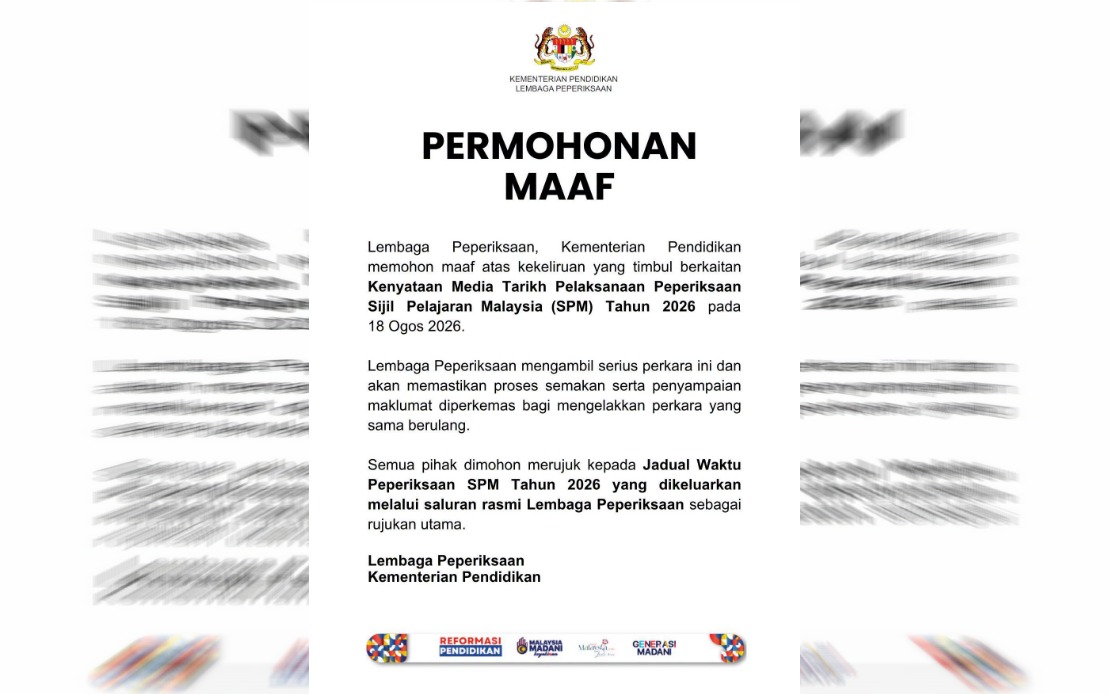
The Examination Board under Malaysia's Ministry of Education has issued a formal apology following widespread confusion triggered by a press release distributed yesterday regarding the scheduling of the 2026 Sijil Pelajaran Malaysia examination. The board's statement, released today in Kuala Lumpur, acknowledged the administrative misstep and committed to overhauling its internal processes to prevent similar incidents from disrupting public communication in the future.
The clarification represents an important moment for one of Malaysia's most significant examination systems, which directly affects hundreds of thousands of students annually. With over 420,000 candidates already registered to sit for the 2026 SPM across 3,334 examination centers nationwide, any confusion regarding examination dates can create substantial anxiety among students, parents, and educational institutions. The scale of participation underscores why accuracy in official announcements carries considerable weight within Malaysia's education ecosystem.
In its formal response, the Examination Board stressed that the matter would be treated with appropriate gravity and that comprehensive reviews of both procedural safeguards and information dissemination protocols were underway. The organization emphasized its commitment to ensuring that future announcements undergo more rigorous verification before release, particularly for communications that directly impact the examination calendar affecting such a vast student population.
To restore clarity and provide reliable guidance, the Examination Board explicitly directed all stakeholders—including schools, students, parents, and educators—to consult only the official 2026 SPM Examination Timetable distributed through the board's designated communication channels. This instruction serves as the definitive reference point, replacing any conflicting information that may have circulated during the confusion. The board's decision to consolidate all official guidance through its primary channels reflects standard best practice in managing high-stakes educational communications.
The confirmed schedule establishes that the 2026 SPM examination will commence on November 23 and conclude on December 17, providing secondary school students with a clearly defined testing window. This nearly four-week examination period follows standard practice for Malaysia's major national examinations, allowing sufficient time for the comprehensive assessment of subjects across the SPM curriculum. For schools nationwide, this extended timeframe enables proper coordination of invigilation, venue preparation, and administrative logistics.
The registration figures reveal robust participation from the cohort eligible to sit for the 2026 SPM. The distribution across 3,334 examination centers demonstrates the substantial logistical infrastructure that Malaysia has established to administer national examinations. This geographic spread ensures that students from urban centers to more remote areas have reasonable access to testing facilities, reflecting the education ministry's commitment to equitable examination administration across the country.
For Malaysian secondary schools and students preparing for 2026, the incident underscores the importance of obtaining information exclusively from official sources rather than relying on secondary reports or unverified announcements. Educational institutions would be prudent to communicate with their students and parents based only on documentation directly sourced from the Examination Board, particularly regarding time-sensitive scheduling matters that can affect examination preparation and academic planning.
The Examination Board's acknowledgment that information delivery processes require streamlining suggests that internal communication breakdowns may have contributed to the confusion. Such administrative missteps, while resolved relatively quickly, highlight the critical need for robust quality assurance mechanisms within government agencies responsible for national examinations. The board's commitment to preventing recurrence indicates awareness that public confidence in examination administration depends fundamentally on the reliability and clarity of official communications.
Beyond the immediate resolution of yesterday's confusion, this incident carries implications for how Malaysian educational authorities manage transitions between examination systems. With ongoing discussions about curriculum reforms and examination structures, the capacity of the examination board to communicate clearly and accurately will remain essential for maintaining stakeholder confidence during periods of change. Parents and students considering their educational pathways depend on trustworthy, precise information from official sources.
The apology and clarification signal that the Ministry of Education takes its responsibility for clear communication seriously, particularly for matters affecting hundreds of thousands of students. The board's commitment to reviewing and refining its processes reflects recognition that administrative excellence must accompany pedagogical excellence in Malaysia's education system. As preparations continue for 2026 SPM examinations, students and educational institutions can proceed with confidence based on the official timetable and schedule now clearly reaffirmed by the examination authorities.

