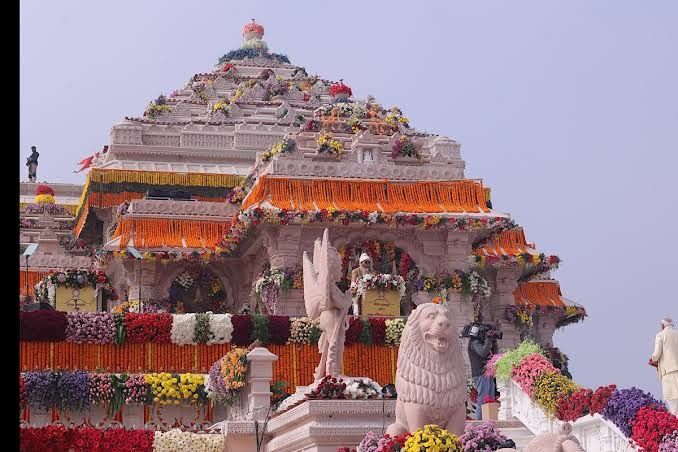
Law enforcement in India's Uttar Pradesh state have taken eight individuals into custody following accusations of systematically misappropriating donations and valuables from the Ram Mandir temple in Ayodhya, one of the country's most high-profile religious sites. The arrests, announced Thursday following the registration of criminal charges, mark a significant embarrassment for a temple that Prime Minister Narendra Modi personally inaugurated in 2024 with considerable ceremonial prominence. The accused individuals held various positions within the temple's administrative structure, with most having direct responsibility for receiving, counting, and safeguarding monetary gifts and precious metals offered by Hindu pilgrims.
The Ram Mandir occupies ground that carries immense symbolic weight in Indian politics and religious identity. The site formerly housed the Babri Mosque, a 16th-century structure that stood for approximately five centuries before being demolished by Hindu activists in 1992. The mosque's destruction became a defining moment in the political ascendancy of Modi's Bharatiya Janata Party, which leveraged the construction of a replacement temple dedicated to the deity Ram as a central electoral promise. The temple's completion and consecration represented the culmination of a project that fundamentally reshaped India's political landscape, consolidating support among Hindu nationalist constituencies and contributing to the BJP's displacement of the secular Indian National Congress as the nation's dominant political force.
While authorities have refrained from publicly detailing the financial magnitude of the alleged theft, opposition parties and independent media investigations suggest the shortfall in donations could reach or exceed $20 million. This figure represents a substantial proportion of the donations collected from millions of devotees who contributed toward the temple's construction, which consumed approximately $240 million in total expenditure entirely derived from public contributions rather than government funding. The discrepancy between expected and actual donation amounts first emerged through irregularities detected in the financial handling procedures, prompting the registration of a formal criminal investigation on June 25.
The eight detained individuals now face charges encompassing criminal breach of trust, theft, criminal conspiracy, and corruption under Indian law. Temple employees were primarily implicated in the mishandling scheme due to their access to donation collection points and storage facilities containing cash, gold jewellery, and silver articles contributed by visiting pilgrims. The investigation process has been entrusted to a Special Investigation Team established by the Uttar Pradesh state government, overseen by Chief Minister Yogi Adityanath, who has pledged that all culpable individuals will face prosecution without exception.
The scandal has generated profound disquiet among the temple's donor base and broader Hindu religious communities. Viti Saxena, a 44-year-old homemaker from the region who herself contributed funds to the construction effort, expressed dismay at the allegations and their implications. Her concerns centred on whether her personal donation had genuinely reached the temple's coffers or been diverted by dishonest administrators. Saxena articulated broader anxieties held by many pilgrims regarding the integrity of donation management systems, characterising the embezzlement allegations as damaging to Hindu faith communities globally and tarnishing the international reputation of a site celebrated as religiously paramount within Hinduism.
The timing of these allegations presents a particular challenge for the Modi government and the BJP, given the temple's centrality to the party's political narrative and ideological positioning. The Ram Mandir inauguration was orchestrated as a moment of national culmination, representing the realisation of a decades-long political objective that resonated deeply with Hindu nationalist constituencies. The subsequent discovery of systematic financial irregularities undermines the temple's symbolic integrity and raises uncomfortable questions about governance standards within religious institutions aligned with the ruling political establishment.
From a Southeast Asian perspective, the Ram Mandir embezzlement case offers instructive lessons regarding the intersection of religion, politics, and administrative accountability. Malaysia, with its own complex relationship between religious institutions, political authority, and communal trust, faces comparable challenges in ensuring that religious donations and charitable funds are managed with transparency and integrity. The case demonstrates how inadequate oversight mechanisms in major religious facilities can erode public confidence not merely in specific institutions but in the religious communities they represent, a risk that applies across diverse faith traditions throughout the region.
The investigation's progression will likely influence discussions regarding financial governance standards at major temples, mosques, churches, and other religious sites throughout India and potentially inspire comparable scrutiny elsewhere in South Asia. The alleged theft, if substantiated through legal proceedings, will establish a significant precedent regarding accountability expectations for employees managing donations at nationally prominent religious institutions. The case also underscores the challenges faced by donation-based financing models, particularly when institutions lack robust internal audit mechanisms and independent oversight.
Uttar Pradesh Chief Minister Adityanath's public commitment to prosecuting all guilty parties reflects the government's recognition that permitting such allegations to remain unaddressed would intensify credibility damage. Nevertheless, the investigation's outcomes will substantially determine whether public confidence in the temple's management can be restored or whether perceptions of institutional corruption become permanent. The Ram Mandir case thus represents not merely a criminal matter but a defining test of governance capacity and administrative integrity at one of contemporary India's most symbolically loaded religious sites.

