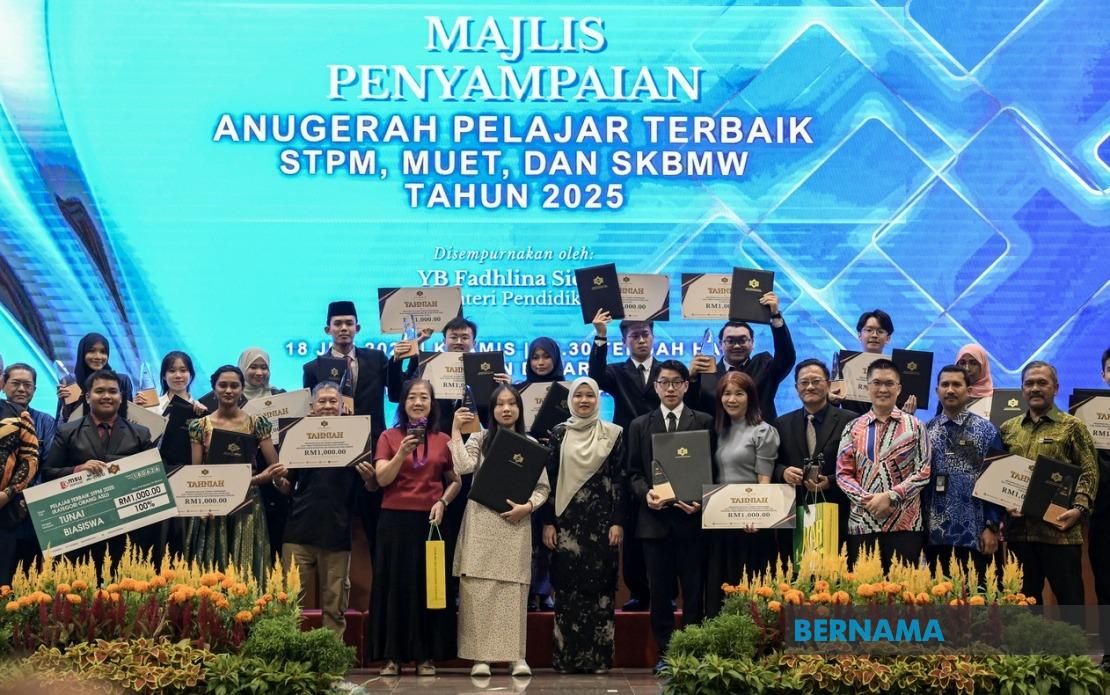
Education Minister Fadhlina Sidek has announced a landmark scholarship initiative that will see 18 outstanding students from the 2025 Sijil Tinggi Persekolahan Malaysia cohort receive tuition fee sponsorships from public universities. The announcement came during a press conference following the presentation of awards to top performers in the 2025 STPM examination, alongside recognitions for achievement in the University of Malaysia English Test (MUET) and the Certificate of Proficiency in Malay for Foreigners (SKBMW) held at the Malaysian Examinations Council building in Kuala Lumpur.
The scholarship scheme represents a deliberate policy shift designed to elevate the prestige of the Form Six pathway and counter what has been a persistent trend of declining enrolments in Malaysia's pre-university system. By having each public university commit to offering full Bachelor's degree scholarships to their respective top STPM performers, the government is attempting to create tangible incentives that make the two-year pre-university route an attractive alternative to other educational options such as private colleges or overseas study. Fadhlina's decision to publicly acknowledge the contribution of participating institutions suggests a collaborative approach that extends beyond top-down policy implementation.
This initiative must be understood within the context of Malaysia's broader educational challenges. The Form Six system has experienced fluctuating popularity among school leavers, with many families opting for alternative pathways perceived to offer more immediate pathways to employment or international credentials. The scholarship programme addresses this concern by directly rewarding academic excellence and removing a significant financial barrier—tuition fees—that might otherwise deter high-performing students from economically disadvantaged backgrounds from pursuing Form Six studies. For Malaysian families considering educational investments, this represents a meaningful gesture of support that could influence critical decision-making points.
The Education Ministry has positioned this scholarship offering within a wider ecosystem-strengthening initiative that encompasses multiple infrastructure and support measures. Parallel developments include the expansion of Form Six College facilities nationwide, the installation of smartboards to enhance classroom technology, implementation of early schooling assistance programmes, and distribution of MADANI Book Vouchers to students. Together, these interventions suggest a comprehensive attempt to modernise the Form Six experience and address both structural and motivational barriers that previously discouraged uptake. For educators and administrators managing these institutions, such coordinated support represents meaningful recognition of the pre-university sector's importance to Malaysia's knowledge economy.
The 2025 STPM examination results themselves offer encouraging indicators of system performance. The national Cumulative Grade Point Average (CGPA) increased to 2.88, a modest but measurable improvement from the previous year's 2.85 figure. While the improvement may appear incremental, such year-on-year gains in a mass examination system suggest consistency in educational quality across hundreds of schools and thousands of students. This upward trajectory provides empirical support for Fadhlina's confidence in the direction of Malaysia's pre-university education, though analysts might note that sustained growth requires continued investment and systemic refinement.
For Malaysian students currently in secondary education, the scholarship announcement carries practical significance. Those who excel in their Form Four and Five studies and proceed to Form Six now have a concrete incentive structured around academic merit. The visibility of these scholarships—particularly when attached to each public university and their respective Bachelor's programmes—allows students and parents to map educational pathways more clearly. Students from the Klang Valley and Johor can envision potentially studying at Universiti Malaya or Universiti Kebangsaan Malaysia on fully sponsored terms if they achieve top grades, while those in Penang or Kedah might target Universiti Sains Malaysia, creating a more tangible connection between current effort and future opportunity.
The broader Southeast Asian context adds another dimension to this policy development. Regional competitors such as Thailand and Indonesia have long maintained robust government investment in pre-university education, viewing it as critical infrastructure for producing university-ready students. Malaysia's renewed emphasis on Form Six scholarships can be seen as a recalibration of educational priorities that brings the country more closely into alignment with regional norms. As universities across Asia compete for talent and research capacity, ensuring a strong pipeline of well-prepared undergraduates becomes strategically important. The scholarship programme, therefore, functions not merely as a welfare measure but as an element of institutional competitiveness.
The participation of all public universities in this scheme deserves particular attention. Rather than concentrating scholarships within flagship institutions such as Universiti Malaya, the programme distributes them across the entire public university system. This approach has merit in encouraging geographic and institutional diversity among high-achieving students. A top STPM performer in Sabah might receive equivalent recognition whether studying at Universiti Malaysia Sabah or a peninsula-based institution, creating fairer access to elite recognition and potentially strengthening educational capacity across all public universities. For regional development, this distributed model aligns with broader goals of balanced university sector growth.
Implementation details remain partially opaque from the public announcement. Questions regarding the number of scholarships each institution will offer, the specific eligibility criteria beyond top-STPM-2025-cohort status, and whether scholarships extend to postgraduate study or remain confined to Bachelor's programmes have not been detailed. Additionally, clarity on whether the sponsorship extends beyond tuition to encompass accommodation, living allowances, or other student support mechanisms would strengthen the appeal to underprivileged high achievers. Nevertheless, the framework appears sufficiently flexible for universities to tailor implementation to their respective capacities and priorities.
The announcement also reflects evolving conversations within Malaysia's education ministry regarding the relationship between excellence and accessibility. By specifically targeting top-performing students rather than implementing broad fee waivers, the government reinforces the principle that scholarly achievement merits tangible recognition. Simultaneously, by extending this opportunity through publicly funded universities rather than private institutions, the policy reaffirms government commitment to public higher education. For taxpayers and education stakeholders, this framing positions the scholarships as investments in identifying and nurturing national talent rather than as undifferentiated subsidy.
Looking forward, the success of this initiative will depend substantially on sustained implementation and resource commitment. If public universities maintain these scholarships as permanent offerings with genuine prominence in their recruitment narratives, the programme could meaningfully influence secondary students' educational choices within five to ten years. Conversely, if the scholarships become nominal or administratively marginalised, their motivational impact will diminish. The presence of Deputy Education Minister Wong Kah Woh and senior Education Malaysia officials at the announcement ceremony suggests ministerial commitment, though political continuity and budget allocation cycles will ultimately determine longevity.
For Malaysian society more broadly, this initiative embodies a strategic choice to invest in human capital development through the pre-university system. Rather than viewing Form Six as a residual pathway for students unable to access private alternatives, the government is now actively promoting it as the prestigious route for top academic performers. This reorientation carries implications for how families perceive educational value, how schools market their Form Six programmes, and ultimately how Malaysia's university system constitutes its freshman cohorts. As implementation unfolds, monitoring how these scholarships influence application patterns and student outcomes will provide valuable data for assessing whether policy intention translates into measurable impact.

