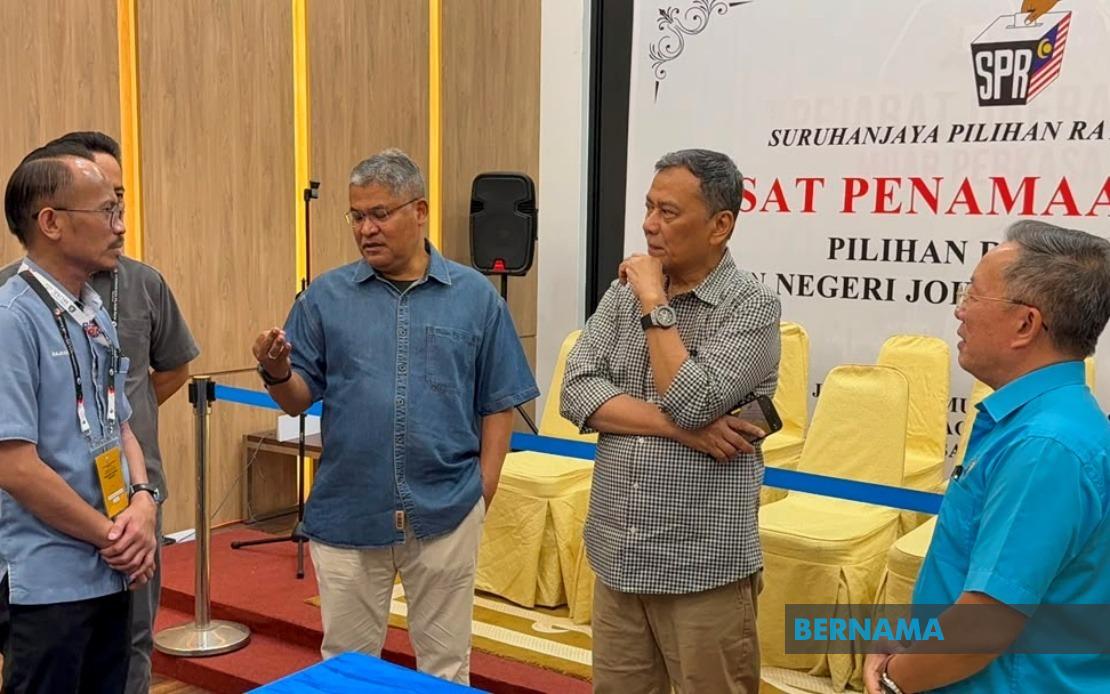
The Election Commission has confirmed it is fully prepared for the commencement of the Johor state election's nomination process tomorrow, with all 56 candidate nomination centres across the state undergoing final technical preparations and operational drills today. This readiness check comes as the electoral authority races to ensure that the critical first phase of the election cycle — when candidates formally register to contest — proceeds without disruption or incident.
Returning officers at multiple nomination centres have signalled their operational readiness. At the Perling state constituency centre located at Dewan Jubli Intan Hall, returning officer Nazatul Shima Mohamad confirmed that final logistics, including layout configuration and simulation exercises involving all participating agencies, had been completed. In remarks to media, she emphasised that all stakeholders involved in administering the nomination process had demonstrated equal commitment to ensuring a seamless operation, and she urged prospective candidates to arrive early and bring the necessary documentation, including their nomination deposits.
The broader logistics and security framework has also been finalised at major urban centres. At the Kota Iskandar nomination centre based at the Main Hall of Iskandar Puteri City Council in Medini, returning officer Shahrulizam Abdul Rashid outlined a comprehensive approach to managing the anticipated crowds of party supporters who will gather outside nomination venues. The preparation involves a coordinated response with police authorities, including the closure of roads immediately adjacent to the centre, a designated 50-metre perimeter restriction preventing supporters from directly approaching the nomination hall, and the erection of tents and barriers to physically separate rival party groups and maintain order throughout the day.
This level of security planning reflects the Election Commission's experience managing competitive elections in Johor, where nomination day has historically drawn significant partisan activity. The authority's decision to establish clear physical boundaries and separation zones appears designed to prevent spontaneous clashes between opposing political camps while still permitting supporters to participate in what remains a civic exercise. Officials have also cautioned members of the public to exercise restraint and avoid escalating tensions, a reminder that even in formal electoral proceedings, the management of political competition requires vigilance and cooperation from all parties.
The scale of the Johor election, as measured by voter registration, underscores the significance of ensuring a flawless nomination process. According to Election Commission data, approximately 2.73 million voters are registered to participate in this exercise, comprising 2.7 million ordinary voters alongside 12,041 military personnel and their spouses and 12,710 police officers and their families. The inclusion of military and police voters in separate categories reflects Malaysia's constitutional framework governing the electoral participation of security personnel, a feature that adds administrative complexity to the voter management process.
The nomination process itself will follow a compressed timeline running from 9 to 10 am across all 56 centres, after which returning officers will publicly announce the complete list of candidates officially eligible to contest. This compressed window is standard practice in Malaysian elections, designed to maintain momentum in the electoral calendar and ensure that the subsequent campaign period can commence without undue delay. The early-morning timing also reflects operational efficiency, allowing nomination officers to conclude their work and move swiftly to candidate verification and validation processes.
Johor's election cycle has been accelerated following the state legislative assembly's dissolution on June 1. The Election Commission designated June 27 — tomorrow — as nomination day, June 7 as the date for early voting, and July 11 as polling day. This compressed timeframe, with just over two weeks between nomination and the actual polling, is consistent with Malaysian electoral practice and allows political parties minimal time to campaign but ensures that the democratic mandate is renewed relatively promptly following the dissolution.
The significance of this election extends beyond Johor itself. As the second-largest state in Malaysia by population, Johor's electoral outcome carries considerable weight in national political calculations. The state has historically been a battleground between the ruling Barisan Nasional coalition and opposition alliances, and the results of this contest will provide important signals about voter sentiment heading into potential federal elections. Opposition parties and government supporters will be watching closely to assess whether recent national political trends have shifted voter preferences at the state level.
For Malaysian voters and international observers, the competence with which the Election Commission executes the nomination process and subsequent phases of the election will also be significant. The independence and efficiency of Malaysia's electoral administration has occasionally attracted scrutiny, and a smoothly run election in Johor — without major logistical failures, security incidents, or credibility challenges — would reinforce confidence in the integrity of the electoral system. Conversely, any significant problems during nomination day could undermine public trust and fuel allegations from opposition quarters regarding the fairness of the broader process.
The Election Commission's visible readiness also signals to candidates that the formal machinery of the state is prepared to administer the election according to established rules and procedures. This institutional clarity is important for candidates from all political backgrounds, as it reduces uncertainty and establishes clear parameters for participation. Political parties will have had the opportunity to brief their candidates on nomination requirements and procedures, and the commission's thorough preparation sends a message that these procedures will be administered consistently and fairly across all 56 locations.
As Johor voters prepare for the weeks ahead, the smooth execution of nomination day will set the tone for the campaign period. A nomination process marked by order and efficiency may contribute to a campaign environment characterised by substantive political debate and competition focused on policy and governance. Conversely, if nomination day is marred by disruption or perceived administrative failings, it could poison the political atmosphere and encourage more contentious campaign dynamics. The Election Commission's investment in preparation is therefore not merely a technical exercise but an effort to establish conditions conducive to democratic competition.

